


Over the last dozen years, the view from Gemima Mukashyaka’s small coffee garden in the lush emerald-green hills of southwestern Rwanda has changed.
In 1994, after the genocide that killed 800,000 people, it was a site of devastation, chaos and abandonment. Five years ago, when worldwide coffee prices spiraled downward, her neighbors in the densely populated region near Butare were uprooting their coffee trees and planting quick-growing food crops to survive.
But today, there is a clean coffee processing station nearby, and sprouted around it are two restaurants, a pharmacy, a bank, six hair salons, and just last week, the village’s first Internet cafe.
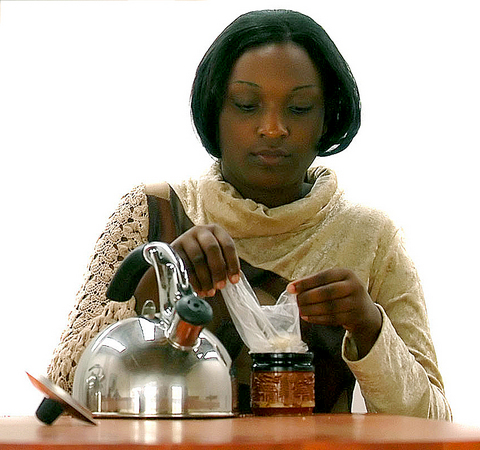
PHOTO: NY TIMES NEWS SERVICE
“My coffee gave me hope for a better future,” Mukashyaka, 29, said. At last harvest, her coffee, sold through a farmers’ cooperative to a roaster of premium coffee in the US, fetched three times the price it did five years ago.
Rwanda, a tiny East African country recently rent by a famously savage civil war, has found hope in that most colonial of crops: coffee. By riding booming demand in the developed world for specialty brews — and to a certain extent by turning its own challenges to its advantage — Rwanda has made premium-coffee growing a national priority. That has not only brought in a trickle of money to a country with little else to trade, but provided a stage on which one-time blood enemies can reconcile their terrible history.
“By improving the quality of their coffee, about 40,000 of Rwanda’s 500,000 coffee farmers have at least doubled their incomes,” said Kevin Mullally, who runs the office of the US Agency for International Development, or AID, in Kigali, the Rwandan capital. “Coffee has played a crucial role in the positive changes in Rwanda.”
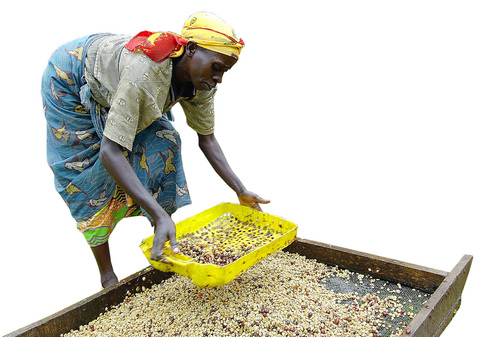
PHOTO: NY TIMES NEWS SERVICE
Since 2001, AID has invested US$10 million in helping Rwandans improve the quality of their coffee, mainly by providing farmers’ cooperatives and small entrepreneurs with financing for washing stations and training in their use. The Rwanda government’s goal is to make all coffee produced in the country specialty coffee by next year.
At the washing stations, or wet mills, farmers clean, sort, pulp and dry coffee cherries — the bright red berrylike fruit produced by coffee trees. Then the beans, or seeds, that they contain can be sold to the lucrative specialty market, where demand and prices remain relatively high even when conventional coffee prices dip.
The big canned coffee companies currently pay about US$2.20 a kilogram for C-grade coffee beans, while the higher-grade specialty coffees preferred by Starbucks, Green Mountain and other chains generally fetch about $3.30 a kilogram or more. In Rwanda, premium roasters will pay as much as $7.70 a kilogram for the best beans.
When these prices are paid to cooperatives, instead of to private dealers, the profits go directly to farmers, 20 percent of whom are widows and orphans because of the genocide. In the US, specialty coffee has generally accounted for 15 percent of the market, but 40 percent of the revenue (currently US$11 billion, up from US$7.6 billion in 2000), so roasters are eager to develop relationships with cooperatives that can deliver consistently high-quality coffee.
Rwanda is still a desperately poor country, with a per-capita economic output of only US$1,500. Sixty percent of Rwandans live below the poverty line, and even though 90 percent are engaged in subsistence agriculture food production has not kept pace with the population growth. Rwanda is a landlocked country that is the most densely populated in Africa, 8.6 million people in an area slightly smaller than Maryland. The country has few natural resources.
Until the 1990s, coffee accounted for 60 percent of total exports, but that declined to about 20 percent in 2001 because of the economic devastation of the genocide and a worldwide crash in coffee prices. Since then, the government has focused on increasing the volume and quality of coffee exports as it tries to revive the economy; coffee now accounts for 30 percent of exports, totaling US$35 million, which is expected to double this year, Mullally said.
Before joining the Maraba coffee co-op, Mukashyaka’s life could hardly have been less hopeful. The sixth of nine children born to relatively prosperous coffee farmers — they had 800 trees, while the average Rwandan farmer had 175 — Mukashyaka was entering high school when the genocide erupted. The Butare region was one of the poorest in the country, and the most devastated in the genocide, where Hutu extremists attempted to massacre all Tutsis and moderate Hutus.
‘THE ONLY HERITAGE’
Mukashyaka said she escaped death because she was visiting her Hutu godmother when most of her family was tortured and murdered. After her godmother betrayed Mukashyaka’s Tutsi ethnicity to the Interahamwe, the Hutu extremist killers, Mukashyaka was ordered to dig her own grave.
A young Hutu intervened, bought her from the killers and kept her against her will. When the war was over, Mukashyaka said she left the man to go to a refugee camp with her two surviving younger sisters.
When she returned, 16 and pregnant, to the family’s plantation, it was in ruins, but the orphans struggled to maintain it. “It was the only heritage from our parents,” Mukashyaka said.
After lean years of selling coffee cherries to the nearest collectors for a low price, Mukashyaka joined Maraba in 2001. It was Rwanda’s first coffee cooperative and the initial experiment of AID’s Partnership to Enhance Agriculture in Rwanda Through Linkages.
The partnership, which is known by its acronym as the PEARL project and is directed by Timothy Schilling of Texas A&M University, has since made a 300 percent return on its investment, with 90 percent of its revenue being paid to farmers. PEARL has promoted the production of higher-grade coffee by organizing farmer co-ops and training their members in farming techniques, coffee processing, quality control, marketing and by building relationships directly with the roasters who buy coffee.
By bringing villagers together to work toward a common economic goal, Schilling said, co-ops have helped Rwandans with the monumental task of reconciliation, since genocide widows work side by side with women whose husbands are in jail for participating in the killing.
Before the co-ops, the social fabric of the coffee-growing areas was destroyed, Schilling said, but now the tidy washing stations, planted with flowers like community gardens, serve as a place for people to come together and work, sorting coffee, talking about their common project. “What’s reconciliation if it’s not people who have conflict getting together and talking?” he said.
With a new washing station, the Maraba co-op sold 17 tonnes of fully washed coffee, enough to fill an entire standard 12m shipping container, to Community Coffee, a family-owned coffee roaster and retailer in Baton Rouge, Louisiana, in 2001. “The coffee was excellent,” said Carl Leonard, Community Coffee’s vice president of green-coffee procurement
After joining the co-op, Mukashyaka doubled her coffee earnings in one year. She also grew less isolated and less distrustful of her neighbors, since she had people to talk to at the washing station and in co-op meetings.
With the co-op’s support, she borrowed money from a bank to help maintain the rest of the plantation, replacing some old trees. She was able to send her child to school, buy fertilizer for next year’s crop and replace rags with second-hand clothing. A job at the coffee processing station helped her repay her loan; now she is one of the directors of the co-op, which has more than 2,000 members. “I am very proud of my coffee,” she said.
The pride is evident in the product. Partly because of abundant labor, which allows farmers to pick through and hand-sort cherries, the coffee that goes to market is exceptionally clean, or free of imperfect beans. Geoff Watts, who oversees coffee buying for Intelligentsia Coffee and Tea Inc, a premium roaster based in Chicago, said, “Rwanda’s gone from 0 to 60, from a complete unknown in the specialty coffee industry to becoming the source of some of the cleanest coffees in East Africa.”
Five years ago, all Rwandan coffee sold at the C-grade, or lowest-quality, price. Now, demand for fully washed Rwandan coffee (about 7 percent of the crop) far exceeds supply. “The emergence of Rwandan specialty coffee on the global market is stunning,” said Michael Ferguson, a spokesman for the Specialty Coffee Association of America, a trade group in Long Beach, California. “Everyone inside the specialty coffee industry is excited about it.”
Costco will begin offering Rwandan beans in September. Starbucks featured Rwandan coffee — at US$48 a kilogram, as one of its exceptional Black Apron offerings — and buys it regularly for its blends.
RIGHT ALTITUDE, SOIL AND SUN
Cursed with a calamitous history, Rwanda is nevertheless blessed with particularly good coffee-growing conditions: high altitude, volcanic soil and plenty of sun and equatorial mist. “The coffees are wonderfully sweet, either bright with clear citric characteristics, or plush and full of berry and chocolate-like flavors,” Watts, of Intelligentsia Coffee, said.
Specialty roasters in the US have played a direct role in improving the quality of Rwandan coffee, and have built close relationships with cooperatives. Watts, for example, was one of several American roasters who volunteered in 2002 to train Rwandans to “cup” coffee, or identify quality characteristics by tasting, in a program and lab created by the PEARL project.
“Once farmers start to taste their coffee, it opens their taste buds and their eyes, and they start looking at their trees differently,” says Paul Katzeff, founder of the Thanksgiving Coffee Co in Fort Bragg, California, who developed the training. “They become not just farmers, but craftsmen.”
Some specialty coffee companies market their Rwandan coffees with a humanitarian message. Thanksgiving sells Gorilla Fund Coffee, giving US$2 a package to the Dian Fossey Gorilla Fund International to protect Rwanda’s 380 endangered mountain gorillas. “The message is ‘save the gorillas,’ but we’re helping farmers have a hope for the future,” Katzeff said.
At Thousand Hills Coffee in Boston, the message is more direct. “I’m selling coffee to bring awareness about the genocide and about what’s good in Rwanda now,” Stephen Coffey, the owner, said. “Our country stood by and did nothing in 1994, but we can still make a difference.”
For other companies, the story of Rwanda’s survivors is secondary to the distinctive taste of its coffee. “We promote the quality of the coffee and explain the circumstances behind the communities as a back story,” said Lindsey Bolger, the chief coffee buyer at Green Mountain Coffee Roasters, in Waterbury, Vermont. “We’re appealing to people’s palates, not their passions — but then they become more engaged.”
Rwanda’s ambassador to the US, Zac Nsenga, called the approaches synergistic. “The more you consume coffee from Rwanda, the more you give Rwanda hope,” he said. “It’s the quality and the story behind it that makes it special.”
Until recently, Rwandans had little interest in improving their coffee, a crop introduced to the country by its Belgian colonial rulers. The colonial government made coffee-growing compulsory in 1933, requiring Rwandans to plant coffee on at least a quarter of their farms, which were then about a half-acre in size and used mainly for subsistence. “Rwandans don’t drink coffee because of its political background,” Nsenga said. “They prefer tea.”
VIRTUAL MONOPOLY
From the late 1960s until the genocide, most of Rwanda’s coffee was sold to Rwandex, a virtual monopoly controlled by the postcolonial government, for whatever price the company would offer, so farmers had no incentive to pick out the bad cherries.
After the genocide, coffee farms were essentially dormant while other countries increased production by planting higher-yielding plants that were more resistant to pests and sun, but produce inferior-tasting coffee. Rwandans never ripped out their heirloom Bourbon arabica trees, which many connoisseurs now treasure. “Because of the genocide and its aftermath, Rwanda had an accidental advantage,” Bolger of Green Mountain said. “Finding those trees was cause for celebration.”
The world discovered Rwandan coffee after Paul Kagame was sworn in as president in 2000 and focused on coffee as one of the handful of enterprises that could revive the devastated economy.
Worldwide, overproduction of high-yielding varieties caused conventional coffee prices to bottom out, but specialty coffee prices remained relatively strong. Kagame liberalized coffee trade, sold the government’s interest in Rwandex and began working with AID to develop specialty coffee.
He has taken a direct role in selling the coffee to the US, meeting with specialty coffee company executives, including Howard Schultz of Starbucks last May. The strategy has paid off: specialty coffee exports have jumped, and Rwanda’s economy is growing more than 5 percent annually.
In an e-mail message, Kagame wrote: “The significant achievement in exporting specialty coffee over the past three years provides hope to many Rwandan farmers that they can realize increased income through value addition.”
Co-op members generally share 70 percent of the profits among themselves and reinvest the remainder in the co-op for management, marketing, equipment, training and other expenses. Co-op members are able to sell directly to the roaster, cutting out brokers and wholesalers, and learn about buying, selling and bookkeeping in the process.
Co-ops also provide their members with social support. “After the genocide, I feared other people’s reaction when they got to know that my husband is in jail, so it was not easy to join the co-op,” said Gemma Uwera, a 53-year-old mother of eight whose husband is accused of a genocide crime. “Now I have friends, I meet regularly with widows of genocide, and we plan how we can help each other if someone has a problem.”
Christian Ruzigama, 43, left his 300-tree coffee plantation in 1994, and returned to find his house destroyed and the plantation in shambles. At the co-op’s washing station, he has become an expert in fermenting the beans. He has earned enough money to send his children to school, buy health insurance, a cow and two goats, and is planning on building a new house. At the co-op, he said, no one is focused on the past any more.
“I think the Rwandan future will be bright,” Ruzigama said. “Coffee is our new source of life.”

Sept.16 to Sept. 22 The “anti-communist train” with then-president Chiang Kai-shek’s (蔣介石) face plastered on the engine puffed along the “sugar railway” (糖業鐵路) in May 1955, drawing enthusiastic crowds at 103 stops covering nearly 1,200km. An estimated 1.58 million spectators were treated to propaganda films, plays and received free sugar products. By this time, the state-run Taiwan Sugar Corporation (台糖, Taisugar) had managed to connect the previously separate east-west lines established by Japanese-era sugar factories, allowing the anti-communist train to travel easily from Taichung to Pingtung’s Donggang Township (東港). Last Sunday’s feature (Taiwan in Time: The sugar express) covered the inauguration of the

The corruption cases surrounding former Taipei Mayor and Taiwan People’s Party (TPP) head Ko Wen-je (柯文哲) are just one item in the endless cycle of noise and fuss obscuring Taiwan’s deep and urgent structural and social problems. Even the case itself, as James Baron observed in an excellent piece at the Diplomat last week, is only one manifestation of the greater problem of deep-rooted corruption in land development. Last week the government announced a program to permit 25,000 foreign university students, primarily from the Philippines, Indonesia and Malaysia, to work in Taiwan after graduation for 2-4 years. That number is a

In a stark demonstration of how award-winning breakthroughs can come from the most unlikely directions, researchers have won an Ig Nobel prize for discovering that mammals can breathe through their anuses. After a series of tests on mice, rats and pigs, Japanese scientists found the animals absorb oxygen delivered through the rectum, work that underpins a clinical trial to see whether the procedure can treat respiratory failure. The team is among 10 recognized in this year’s Ig Nobel awards (see below for more), the irreverent accolades given for achievements that “first make people laugh, and then make them think.” They are not

This Qing Dynasty trail takes hikers from renowned hot springs in the East Rift Valley, up to the top of the Coastal Mountain Range, and down to the Pacific Short vacations to eastern Taiwan often require choosing between the Rift Valley with its pineapple fields, rice paddies and broader range of amenities, or the less populated coastal route for its ocean scenery. For those who can’t decide, why not try both? The Antong Traversing Trail (安通越嶺道) provides just such an opportunity. Built 149 years ago, the trail linked up these two formerly isolated parts of the island by crossing over the Coastal Mountain Range. After decades of serving as a convenient path for local Amis, Han settlers, missionaries and smugglers, the trail fell into disuse once modern roadways were built


 RSS
RSS