


As a guide to the preoccupations of young Arabs, the Middle-Eastern chaos currently splashed across the front pages is only part of the story. Vying with bearded Hizbollah commanders for the hearts and minds (or at least cash and attention) of Middle-Eastern youths is a well-funded and altogether better-looking army: a gang of half-naked girls. Stars of the omnipresent Arabic music videos (video-clips), the girls — led by Maria, Elissa, Ruby, Nancy Ajram and Haifa Wehbe — are the region’s super-groomed, cosmetically enhanced sweethearts — or its “porno clip devils,” according to one Egyptian newspaper.
Their grip on “the morals of Arab youth” is so strong that in 2004 conservative Egyptian legislators called for a ban on the clips — supported by letters and petitions from young Egyptians.
But how do the region’s armies of under-30 video-lovers and haters square up? Early last year Allegra Stratton, a young BBC producer, set off on a tour of Beirut, Amman, Cairo, Dubai, Kuwait City and Damascus with the aim of finding out.
Stratton is in search of a cultural revolution — experts on the Middle East have told her that a massive rise in the number of educated young people coupled with a stunted job market have led to a situation that parallels the English Civil War, the French Revolution and 1968. So, at first, she goes looking for a Haight-Ashbury-type counterculture, hanging out with TV producers, struggling artists, MCs and curators.
Her findings are less romantic than she had hoped — there are no flower children in Damascus, and Amman’s only nude portraitist is, she disappointedly remarks, “crap.” The verdict is characteristic of Muhajababes, which is written in a jaunty conversational tone that allows Stratton to feel “rubbish” about “shit” things, such as the invasion of Iraq or badly produced Arabic music. The chirpiness can grate — “Here, everyone has a telly on their desk,” she observes artlessly of BBC Westminster — but it has an upside. In comparison with many products of the Middle-Eastern comment and analysis industry, and despite its off-puttingly trend-spotting title, Muhajababes is direct, energetic and unpretentious. Stratton is out on the street accosting passers-by and counting the number of veiled women with a persistence that makes her a likeable and instructive guide to the lure of extremism for Palestinian refugees or why What Not to Wear will never air in Beirut.
And what she learns is fascinating. The video-clip girls are indeed a serious cultural force — Nancy Ajram was recently voted one of the region’s most influential Arabs by the Arabic version of Newsweek — but their eminence grise is the Saudi Prince Al-Waleed bin Talal, the eighth-richest man in the world and the owner of the Rotana satellite stations and record label that 80 per cent of Arab pop stars are signed to.
Despite the acres of flesh on display at Rotana, the singers’ most fervent fans are the eponymous “muhajababes”: veiled girls (muhajaba is Arabic for one who veils) who nevertheless wear skin-tight jeans, stiletto heels and plenty of make-up. To describe them, Stratton learns a great new Arabic word, rewish, which means somewhere between hip and distracted — these are the Dazed & Confused-sters of the Middle East. Nominally strict Muslims, some sneak cigarettes, date boys and engage in other behavior that is technically haram (forbidden).
Ranged against (or sometimes, confusingly, alongside) them are members of the conservative anti-clip brigade. But increasingly they, too, Stratton discovers, worship the TV screen. Their idol is a swoonsome young accountant-turned-preacher called Amr Khaled, who appears on religious shows with “young men and women, praying, crying and giving hearty, healthy belly laughs, as if they were in a vitamin-supplement advert.” Stratton is particularly scathing about Khaled, a well-fed BMW driver who announces, televangelist-style, that: “I want to have money and the best clothes to make people love God’s religion.” But it’s only when she ditches her dream of finding the Arab Bob Dylan and focuses on Khaled’s Life Makers initiative that Muhajababes gains in pace and authority.
Capable of mobilizing hundreds of thousands of young Muslims worldwide for causes ranging from the benign (collecting clothes for charity) to the sinister (berating smokers and drinkers in public), Khaled is the well-groomed face of a new, media-friendly conservative Islam that reviles the “degrading display of women’s bodies.”
Between the muhajababes and the Life Makers, there is little room for the handful of arty oddballs (including the gay Kuwaiti who provides the book’s best line, “There’s no such thing as straight in Kuwait”) to whom Stratton, as a liberal Westerner, is instinctively drawn. But this is the point. Social change in the Middle East won’t be led, as Stratton — and many Western policy-makers — had hoped, by the secular trendies, but by those she dismissively describes as the “Life Making, green-fingered, litter-collecting, I’d-like-to-teach- the-world-to-sing Arabs.”
Muhajababes discovers a world in which religion is packaged and sold as slickly as a video clip. And the people behind the scenes are the same, too: Prince Al-Waleed has already diversified into an immensely popular new Islamic channel, Al-Risala, or the message. And it is not a conveniently distant world either: having been banned from preaching by the nervous Egyptian regime in 2002, Khaled now finds refuge in the UK and is soon, Stratton surmises, advising the British government on engaging with the Muslim world.
It is hard, as Muhajababes demonstrates, for secular observers to appreciate the genuine force of belief, however clumsily or confusedly it may be expressed. In the summer of 2004 when I was living in Cairo, I was surprised to meet engineering graduates who believed in djinn with green claws and veiled girls who swapped oral-sex tips. But with bombs falling in the Beirut streets that Stratton scoured fruitlessly for a trendier revolution, the region’s latest crisis is a reminder that it’s essential to try.
Publication Notes:
MUHAJABABES
By Allegra Stratton
281 pages
CONSTABLE AND ROBINSON

In late October of 1873 the government of Japan decided against sending a military expedition to Korea to force that nation to open trade relations. Across the government supporters of the expedition resigned immediately. The spectacle of revolt by disaffected samurai began to loom over Japanese politics. In January of 1874 disaffected samurai attacked a senior minister in Tokyo. A month later, a group of pro-Korea expedition and anti-foreign elements from Saga prefecture in Kyushu revolted, driven in part by high food prices stemming from poor harvests. Their leader, according to Edward Drea’s classic Japan’s Imperial Army, was a samurai

The following three paragraphs are just some of what the local Chinese-language press is reporting on breathlessly and following every twist and turn with the eagerness of a soap opera fan. For many English-language readers, it probably comes across as incomprehensibly opaque, so bear with me briefly dear reader: To the surprise of many, former pop singer and Democratic Progressive Party (DPP) ex-lawmaker Yu Tien (余天) of the Taiwan Normal Country Promotion Association (TNCPA) at the last minute dropped out of the running for committee chair of the DPP’s New Taipei City chapter, paving the way for DPP legislator Su

It’s hard to know where to begin with Mark Tovell’s Taiwan: Roads Above the Clouds. Having published a travelogue myself, as well as having contributed to several guidebooks, at first glance Tovell’s book appears to inhabit a middle ground — the kind of hard-to-sell nowheresville publishers detest. Leaf through the pages and you’ll find them suffuse with the purple prose best associated with travel literature: “When the sun is low on a warm, clear morning, and with the heat already rising, we stand at the riverside bike path leading south from Sanxia’s old cobble streets.” Hardly the stuff of your
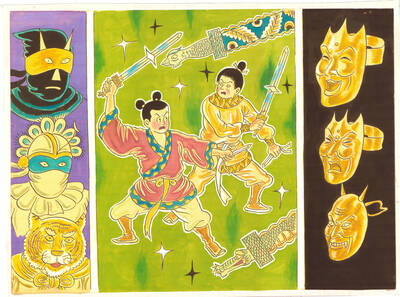
April 22 to April 28 The true identity of the mastermind behind the Demon Gang (魔鬼黨) was undoubtedly on the minds of countless schoolchildren in late 1958. In the days leading up to the big reveal, more than 10,000 guesses were sent to Ta Hwa Publishing Co (大華文化社) for a chance to win prizes. The smash success of the comic series Great Battle Against the Demon Gang (大戰魔鬼黨) came as a surprise to author Yeh Hung-chia (葉宏甲), who had long given up on his dream after being jailed for 10 months in 1947 over political cartoons. Protagonist


 RSS
RSS