


Lots of kids who came up hard in New York think they have a song in them. And others a book. And there are even those who are bold enough to think the life they have lived belongs on a big screen.
Dito Montiel, a guy from Astoria, Queens, pulled off the trifecta, with a bit of help from Robert Downey Jr. A Guide to Recognizing Your Saints, a movie based on a memoir of the same name, will be out this fall. It not only got made against tall odds, it also picked up significant notice and awards at the Sundance Film Festival.
Montiel, 35, whose resume includes leading Gutterboy, a downtown rock band that signed for US$1 million; a stint as a familiar of Cherry Vanilla (of Andy Warhol fame), and then a turn as a Calvin Klein underwear model, can now legitimately list “director” on a vita that is all over the map.
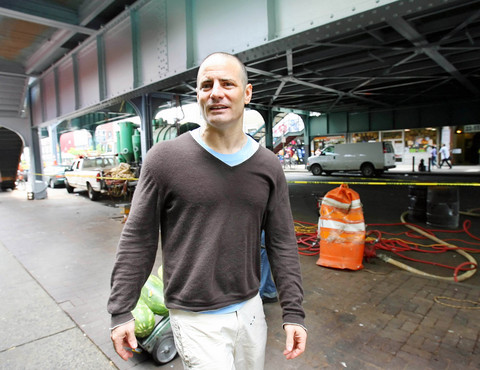
PHOTO: NY TIMES NEWS SERVICE
Standing under the N train on 31st Street in Astoria one afternoon a few weeks ago and shouting over the repairs that were taking place, Montiel said he was just dumb enough to think he was smart enough to do a movie, so he did.
“I benefited from my ignorance,” he said. “I was blinded by the idea of just getting in there and doing it. I am from the school that says you can either do it or you can't, and I thought I could.”
The movie is a moody evocation of growing up rough in Astoria, a place that seemed filled with possibility but became a cul-de-sac for most of Montiel's running buddies. Dito, the real-life one who is standing under the elevated N talking about his movie, and Dito the character in that movie, both made it out, but found themselves pulled back by the rugged draw of the place. Montiel, who recently moved back to Astoria from Santa Monica, California, has made a movie that is less New York borough set piece — “Everybody kept thinking I wanted to make this ‘Yo, Vinny’ kind of movie, when I was trying to do something exactly opposite” — than a brutal miniature about understanding the place that made you.
“When is our movie coming out?” Dody, a guy who grew up next to Montiel, said as he passed by on 31st Street. Everyone in the neighborhood knows Montiel, knows about the movie because it was made here, and will give him an earful when it comes out. No matter. (In fact, the movie is set for release in September by First Look.)
“It is one of the only things in life that turned out exactly liked I wanted it to be,” Montiel said, kicking the sidewalk with the Pony sneakers that he got at one of the swag tents at Sundance. In spite of his history pouting for the camera in Bruce Weber fashion ads, Montiel is not classically pretty. Like Queens itself, his character and visage are composed of many seemingly unrelated but complementary components. In his brown sweater and overlong shorts, he fits in just fine in the neighborhood he wanted to document absent sentiment or cliche.
Part of the reason the movie scans so much like Queens back in the day is that unlike much of the rest of New York, parts of Queens still live back in the day — in this case, the 1980s.
“Give or take an ATM sign, this fruit store looks pretty much like it did when I grew up,” Montiel said. “You change the Korean to a Muslim and it's the same.”
There is history, both personal and cinematic, every time we turn the corner.
At 32nd Street and 24th Avenue, Montiel looks up a hill.
“This is where they filmed that scene in Goodfellas where they shot the guy in the clubhouse,” he said, indicating a building partway up the slope. “One of my friends stole the lighting truck and smashed it up.”
Decades later, Montiel used the same street to film a scene in which Antonio, a friend of Dito's who is a giant walking grenade, is set upon by his abusive father.
“We didn't really have to recreate anything,” he said, gesturing toward the neighborhood. “The rest of New York has changed, but the feeling is still very much here. I wanted it to seem like what it is, which is sort of a small town in the big city.”
That ‘sorta’ guy‘
Montiel walks the streets as someone who knows them, but does not own them. He can still get jazzed about the Sicilian pizza at Rose & Joe's.
“It's been here for eternity,” Montiel said. “It goes up a nickel a year, but it's still just as good.”
Montiel and pals were parented by these streets, which may feature Greek restaurants but reflect the polyglot life of the borough. The son of a Nicaraguan father and an Irish mother, he pulled capers for the Greek and Italian gangsters in the neighborhood and then stopped by the Church of the Immaculate Conception to plead guilty to a few select misdemeanors. His later life as a downtown scenester appears nowhere in the film. Instead, Downey unwinds formative teenage history as Dito returns to visit an ailing father. A mix of no-name — there was an open audition on Craigslist — and big-name young actors serves as the posse the movie pivots around.
“I used the book as a bank of emotions and people to draw from, less than trying to put the same story on film,” he said. A small parade of cars goes by, Italian flags waving in rhythm to the honking of World Cup fans.
We duck into Bohemian Hall and into the giant back patio, which is a world away in terms of temperature. Sitting in the suddenly cool afternoon air, Montiel said the book was true, in its own way, and the movie was another kind of truth, but neither was intended as a strict recollection of what happened.
“There are composites, and there are events that did not really take place,” he said.
“In a way, you make cartoons out of people to make a movie, but you sort of have to,” he added, taking a bite of a sausage the joint is famous for.
He was not short on local advice while making the movie. “Kenny Coyle, a guy from the neighborhood, watched this scene where Antonio jumped a guy and said that the ‘real’ Antonio would have picked the guy up and thrown him out on the curb and spit on him. We got a lot of that while we were making the movie.”
Montiel's lack of mastery over the moviemaking process caused a bit of trepidation among the pros on the set at the start of filming. One of the movie's pivotal scenes centered on the volatile character of Antonio, played by Channing Tatum. Montiel, who was used to the improvisation that goes into making a record, encouraged Tatum to follow the character's anger wherever it went. Without getting into spoilers, Wiest ended the scene with feet cut by broken glass and the crew shaking their heads about what they had gotten themselves into.
“They were all yelling at Channing, and Chazz Palminteri, who plays Dito's father, told them to back up and leave him alone,” he said. “There was magic in that, them forming a partnership. It is the kind of thing that would never happen on a big-budget movie with an experienced director, but you should be lucky enough so that those things should happen all the time.”
“I feel lucky, truly lucky,” Montiel said, walking back toward the N. “People work hard on movies and then most of them end up in the garbage can. We managed to make this movie, and people are actually going to see it.”
Not bad for a guy who admits to being a “sorta” rock star who was “sorta” involved in fashion and “sorta” wrote an autobiography that became the basis for his first movie.
“I'm a ‘sorta’ kind of guy,” he said.

By global standards, the traffic congestion that afflicts Taiwan’s urban areas isn’t horrific. But nor is it something the country can be proud of. According to TomTom, a Dutch developer of location and navigation technologies, last year Taiwan was the sixth most congested country in Asia. Of the 492 towns and cities included in its rankings last year, Taipei was the 74th most congested. Taoyuan ranked 105th, while Hsinchu County (121st), Taichung (142nd), Tainan (173rd), New Taipei City (227th), Kaohsiung (241st) and Keelung (302nd) also featured on the list. Four Japanese cities have slower traffic than Taipei. (Seoul, which has some

Michael slides a sequin glove over the pop star’s tarnished legacy, shrouding Michael Jackson’s complications with a conventional biopic that, if you cover your ears, sounds great. Antoine Fuqua’s movie is sanctioned by Jackson’s estate and its producers include the estate’s executors. So it is, by its nature, a narrow, authorized perspective on Jackson. The film ends before the flood of allegations of sexual abuse of children, or Jackson’s own acknowledgment of sleeping alongside kids. Jackson and his estate have long maintained his innocence. In his only criminal trial, in 2005, Jackson was acquitted. Michael doesn’t even subtly nod to these facts.
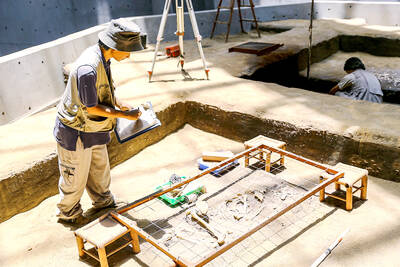
Writing of the finds at the ancient iron-working site of Shihsanhang (十 三行) in New Taipei City’s Bali District (八里), archaeologist Tsang Cheng-hwa (臧振華) of the Academia Sinica’s Institute of History and Philology observes: “One bronze bowl gilded with gold, together with copper coins and fragments of Tang and Song ceramics, were also found. These provide evidence for early contact between Taiwan aborigines and Chinese.” The Shihsanhang Web site from the Ministry of Culture says of the finds: “They were evidence that the residents of the area had a close trading relation with Chinese civilians, as the coins can be
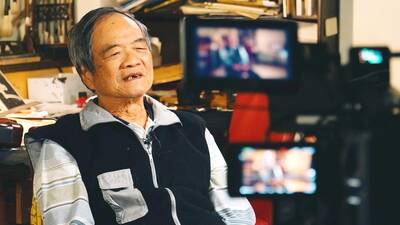
During her 2015 trip to Taiwan, Sophia J. Chang (張詠慧) got fewer answers than she’d hoped for, but more revelations than she could have imagined. “That was the year I last saw my grandmother. She was in hospice care in Tainan, and it was painful to see her in bed, barely able to open her eyes,” says Los Angeles-born Chang. “The grandma I’d known, a fantastic cook and incredibly kind, was already gone.” After their visit, Chang and her grandfather went back to his apartment. There she asked him how he’d met her grandmother. “He hesitated, then started talking a bit.


 RSS
RSS