


Wu Hui-min (吳慧敏) couldn't stand the thought of leaving her Yorkshire terrier caged up in a kennel when she went on vacation to Japan.
“You have no way of knowing what goes on once you leave,” said Wu, who had seen how unhappy a stint at the kennel made her old dog. So Wu sent Hadi (哈第) on a vacation of his own — a five-day retreat in Xindian.
Wu's search for a humane boarding facility led her to Lai Mei-yan (賴美燕) who runs a pet hotel and doggie kindergarten with business partner Yao Ben-jun (姚本軍). Now, Wu often leaves Hadi at Dog Baby (小寶貝) during the day, where he plays on a plastic slide, listens to Yao read children's stories and has his progress noted in a daily report.
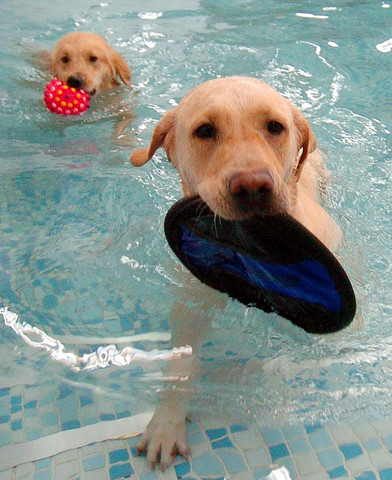
PHOTO: WANG YI-SHUNG, TAIPEI TIMES
“When I say let's go to Dog Baby, Hadi's ears perk up. He really likes it there,” Wu said. The service, which costs NT$350 per night for boarding or NT$100 per day for kindergarten classes, is more expensive than boarding the puppy in a kennel. But Wu said it's worth it. “After four classes he was housebroken and would sit when told to. Now, he doesn't bark as much and he waits for permission before eating.”
Dog Baby (www.dogbaby.com.tw), located a 10-minute walk from the Xiaobitan MRT station, is one of half a dozen pet hotels that have opened in the Taipei area in the last three years. In addition to doggie kindergartens, several offer extra perks like swimming pools and shuttle services. It's an idea that might not have worked 10 years ago, but the business is now finding plenty of customers among childless couples and singles who pamper their pets like humans.
“When we first started people didn't understand what we were doing. But now business is booming,” Yao said. Dog Baby will move into a much larger facility near its current location later this month.
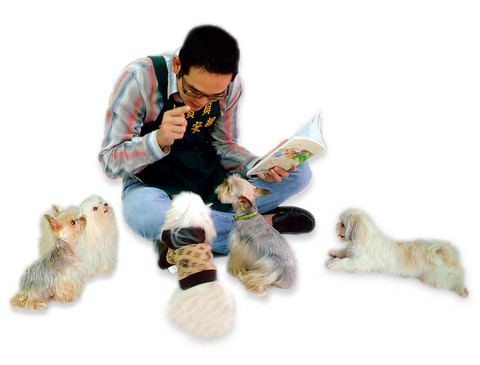
PHOTO COURTESY OF HAPPY DOG
Most of the larger pet hotels are located in Xindian or Yangminshan, where space is cheaper. But Pets Dream Park (寵物夢公園), which charges NT$420 a night for small dogs, has been doing a brisk business since it opened on Bade Road Section 4 near City Hall two years ago. Owner Kevin Lin (林志杰) and his staff take care of roughly 40 dogs each weekday, and 80 percent of rooms in their doggie hotel are booked on weekends.
“I could never find a good place to leave my dogs when I went overseas,” said Lin, who received an MBA from Baruch College in New York City. “In kennels the cages are too close. The dogs catch colds and other infections, like children in preschool.”
Pet's Dream Park (www.petsdreampark.com) is equipped with a ventilation system that changes the air every five minutes. Dogs sleep in spacious cubicles, each equipped with a Web cam that owners can access via the Internet by means of a password. Web cams also monitor the swimming pool, activity area and cafe.
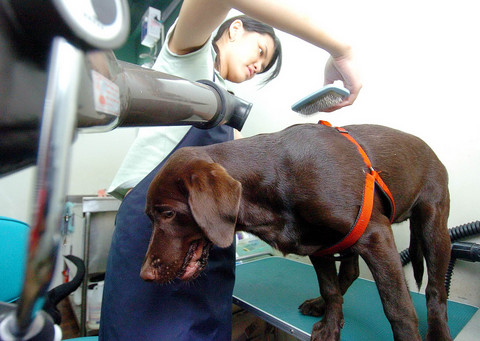
PHOTO: WANG YI-SHUNG, TAIPEI TIMES
“It's worth the extra money to know that your dog is safe, “ said Yang Hsiu-chuan (楊秀娟), who owns five four-year-old golden retrievers.
“Other places promise to take your dog on walks, but you have no way of knowing. I can call Kevin anytime and tell him if , for example, I see my dog eating another dog's food.”
Yang was sitting in the cafe, where small and medium-sized dogs hang out during the day. Beneath her, Lin-lin (琳琳), a beagle in an Elizabethan collar, tried to eat a bowl of food meant for Ringo, a beagle in a leather harness who belongs to a local rock band.
The cafe serves coffee and human food as well as chicken, lamb or beef meals for dogs. “They prefer the lamb,” Lin said. The space behind the counter doubles as a lounge for older boarders, which last Wednesday included two dachshunds and a blind-and-deaf miniature schnauzer.
In the back are a recreation area for larger dogs and a small swimming pool. Chu Ya-wen (朱雅雯) takes her two-year-old Labrador retriever Cindy here once every two weeks. “I let her swim for 50 minutes and she's still not tired,” Chu said as Cindy did laps and chomped at the waves.
“This is the only time she doesn't listen to me.”
Most of the dogs seemed comfortable in their home away from home, and none appeared overly aggressive. But Tango, a shy white Pomeranian who seemed to prefer humans to other dogs, looked lonely and stared plaintively at the door. Lin said his employees take special precautions with dogs that aren't used to being around other animals.
Dog Baby has a special enclosure separated from the main activity area by a low glass wall. Dogs lacking proper socialization stay here for a few hours until they get used to the other dogs. Yao and Lai follow a similar approach when it comes to swimming lessons. “We don't just throw them into the water,” Yao said.
“We wet half of their body so that they get used to the water first.”
“They treat dogs like children,” said Wu, who runs a kindergarten for children. Another customer agreed: “They're very gentle,” said Ma Hui-lin (馬慧伶).
Her poodle Coco likes Dog Baby so much that she sometimes refuses to eat when home.
The success of larger pet hotels has hurt business at Happy Dog (快樂天堂), which claims to be Taipei's oldest humane boarding facility.
Like Pet's Dream Park, it offers a cafe where owners can dine with their pooches. Employee Tseng Da-hua (曾荅華) said the cafe is full on weekends, but their lodging business has suffered because they lack space for amenities like swimming pools.
Fortunately, Happy Dog (happydog.idv.st) is home for a family of English sheepdogs with names like Momo and Gucci and a one-year-old St. Bernard named Money. The sheepdogs have appeared in numerous TV ads and Money has found work doing promotions for a Swiss company.
“They have to earn their keep,” Tseng said.
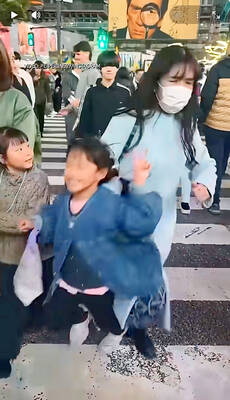
It starts out as a heartwarming clip. A young girl, clearly delighted to be in Tokyo, beams as she makes a peace sign to the camera. Seconds later, she is shoved to the ground from behind by a woman wearing a surgical mask. The assailant doesn’t skip a beat, striding out of shot of the clip filmed by the girl’s mother. This was no accidental clash of shoulders in a crowded place, but one of the most visible examples of a spate of butsukari otoko — “bumping man” — shoving incidents in Japan that experts attribute to a combination of gender

The race for New Taipei City mayor is being keenly watched, and now with the nomination of former deputy mayor of Taipei Hammer Lee (李四川) as the Chinese Nationalist Party’s (KMT) candidate, the battle lines are drawn. All polling data on the tight race mentioned in this column is from the March 12 Formosa poll. On Christmas Day 2010, Taipei County merged into one mega-metropolis of four million people, making it the nation’s largest city. The same day, the winner of the mayoral race, Eric Chu (朱立倫) of the Chinese Nationalist Party (KMT), took office and insisted on the current
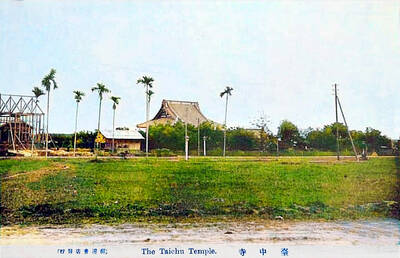
March 16 to March 22 Hidden for decades behind junk-filled metal shacks, trees and overgrowth, a small domed structure bearing a Buddhist swastika resurfaced last June in a Taichung alley. It was soon identified as a remnant of the 122-year-old Gokokuzan Taichuu-ji (Taichung Temple, 護國山台中寺), which was thought to have been demolished in the 1980s. In addition, a stone stele dedicated to monk Hoshu Ono, who served as abbot from 1914 to 1930, was discovered in the detritus. The temple was established in 1903 as the local center for the Soto school
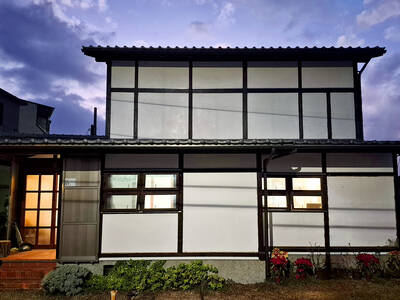
When my friend invited me to take a tour of a wooden house hand-built by a Pingtung County resident, my curiosity was instantly piqued and I readily agreed to join him. If it was built by a single person, it would surely be quite small. If it was made of wood, it would surely be cramped, dingy and mildewy. If it was designed by an amateur, it would surely be irregular in shape, perhaps cobbled together from whatever material was easily available. I was wrong on all counts. As we drove up to the house in Fangliao Township (枋寮鄉), I was surprised


 RSS
RSS