


Instant messages, e-mail, space travel: We can communicate and traverse the world faster than our predecessors could. But is being faster necessarily better? Modern thinkers rue the fact that new technology obliterates distance. Musing on the connections between the human body, speed and efficiency in this era of nanoseconds, artist and curator Yuan Goang-ming (袁廣鳴) has brought together international artists for Slowtech, an exhibition that examines the aesthetics of slowness, and asks us to slow down and smell the roses.
With Huang Po-chih's (黃博志) strangely titled Flov"er, one can stop and, well, not smell, but see roses. The artist scanned 10,000 roses over a four-month period to make a work that is extremely time-consuming. Speed and time are relative terms as demonstrated in Chen Chih-chien's (陳志建) Date Line, a work of digital photos of the Ximen area shot during a 24-hour period, then made into a 5-minute collage that used over 2.5 million frames to show the "now " and the "then" together. These labor-intensive works become anomalies in this age of quick consumption though; yet this self-imposed delay in the technology is shared by many contemporary digital artists who laboriously build their works bit by digital bit.
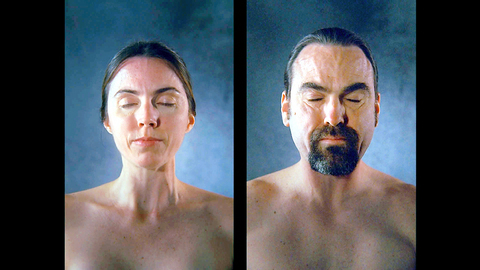
Dissolution by video-art pioneer Bill Viola is on display. The portraits of a man and woman were first filmed at a high speed of 240 frames per second (fps) with a 35mm camera, then digitally scanned and slowed down to 15fps. Their faces slowly submerge under the water, which produces a vibrant effect like a Renaissance portrait painting.
PHOTOS: SUSAN KENDZULAK AND COURTESY OF MOCA
The exhibition's piece de resistance is Granular Synthesis's booming digital visual-sound installation. Four large projections of a woman's head made from thousands of flickering images and high-frequency staccato sounds create a high tech for the the senses. Even though she acts in a familiar way, smiling, rotating her head, and blinking, the exaggerated editing makes this riveting to watch.
Have you ever thought what you would look like 40 years from now? Miwa Yanagi 's photographic series titled My Grandmothers shows the artist and other young women acting out their fantasy images of aged woman. They appear as archetypes, not withered flowers.
Laurie Anderson of O Superman fame is represented here by Tilt, a carpenter's level equipped with sensors that create sounds when the viewer approaches. In her words "I just enjoy giving old tools new jobs. "

Taiwanese artists hold their own among what is termed "blue chip" artists. Tao Ya-lun's (陶亞倫) disorienting installation titled Unconsciousness -- Drifting Speed: 300,000 Kilometers Per Second consists of a light beam that moves slowly up and down a darkened mirror room to create a physical sensation of being suspended in gravity-free space. The beams highlight the particles of dust in the air and seem to penetrate the body.
Tseng Yu-chin's (
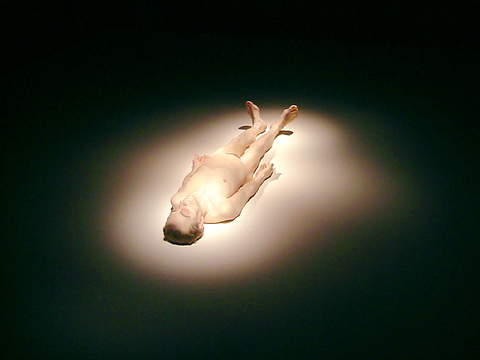
Ron Mueck used to make human models for Hollywood movies. His realistic technique of model-making combined with his extreme sense of scale makes him an artworld favorite. Here, his lifeless prone Dear Dad captures an eerily accurate representation of human skin.
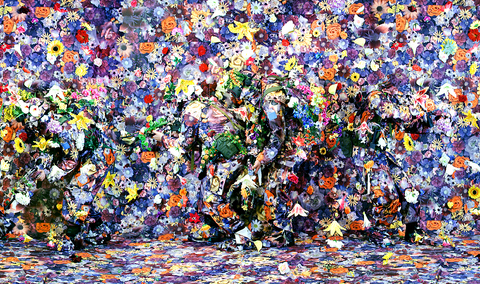
Lee Yong-baek's disturbing Angel Soldier exemplifies the times we live in. At first the large wall projection looks like a brightly colored field of flowers. The viewer gets disoriented as the brain perceives the bright flowers as happy symbols, but when a camouflaged figure starts to emerge, clutching a rifle, the happy image suddenly becomes nightmarish.
Slowed down digital art, encourages deeper reflection on the messages conveyed through conceptual art.
Exhibition notes:
What: SlowTech
Where: MOCA, 39 Changan Road, Taipei (台北當代藝術館, 台北市長安西路39號)
When: Through Sept. 3

In late October of 1873 the government of Japan decided against sending a military expedition to Korea to force that nation to open trade relations. Across the government supporters of the expedition resigned immediately. The spectacle of revolt by disaffected samurai began to loom over Japanese politics. In January of 1874 disaffected samurai attacked a senior minister in Tokyo. A month later, a group of pro-Korea expedition and anti-foreign elements from Saga prefecture in Kyushu revolted, driven in part by high food prices stemming from poor harvests. Their leader, according to Edward Drea’s classic Japan’s Imperial Army, was a samurai

The following three paragraphs are just some of what the local Chinese-language press is reporting on breathlessly and following every twist and turn with the eagerness of a soap opera fan. For many English-language readers, it probably comes across as incomprehensibly opaque, so bear with me briefly dear reader: To the surprise of many, former pop singer and Democratic Progressive Party (DPP) ex-lawmaker Yu Tien (余天) of the Taiwan Normal Country Promotion Association (TNCPA) at the last minute dropped out of the running for committee chair of the DPP’s New Taipei City chapter, paving the way for DPP legislator Su

It’s hard to know where to begin with Mark Tovell’s Taiwan: Roads Above the Clouds. Having published a travelogue myself, as well as having contributed to several guidebooks, at first glance Tovell’s book appears to inhabit a middle ground — the kind of hard-to-sell nowheresville publishers detest. Leaf through the pages and you’ll find them suffuse with the purple prose best associated with travel literature: “When the sun is low on a warm, clear morning, and with the heat already rising, we stand at the riverside bike path leading south from Sanxia’s old cobble streets.” Hardly the stuff of your
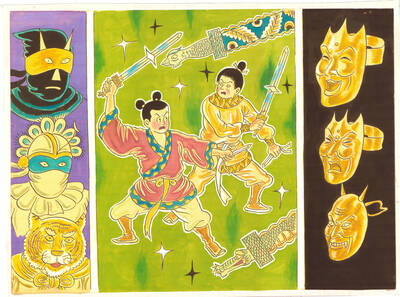
April 22 to April 28 The true identity of the mastermind behind the Demon Gang (魔鬼黨) was undoubtedly on the minds of countless schoolchildren in late 1958. In the days leading up to the big reveal, more than 10,000 guesses were sent to Ta Hwa Publishing Co (大華文化社) for a chance to win prizes. The smash success of the comic series Great Battle Against the Demon Gang (大戰魔鬼黨) came as a surprise to author Yeh Hung-chia (葉宏甲), who had long given up on his dream after being jailed for 10 months in 1947 over political cartoons. Protagonist


 RSS
RSS