


For well over a decade, southern Africans have battled the spread of AIDS with everything from condoms and abstinence campaigns to doses of anti-retroviral drugs for pregnant women -- and generally found themselves losing. Now a growing number of clinicians and policymakers in the region are pointing to a simple and possibly potent weapon against new infections: circumcision for men.
Armed with new studies suggesting that male circumcision can reduce the chance of HIV infection in men, and perhaps in women, health workers in two southern African nations are pressing to make circumcisions broadly available to meet what they call a burgeoning demand for them.
The validity of the approach is still being tested. But in Lusaka, the capital of Zambia, surgeons at the University Teaching Hospital began offering circumcisions for about US$3 some 18 months ago and are urging the government to expand the service across the country.
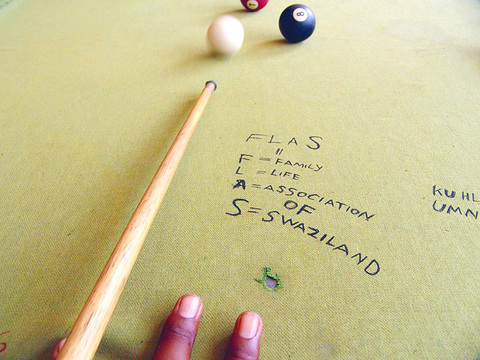
PHOTO: NY TIMES NEWS SERVICE
Kasonde Bowa, a urologist at the hospital, says about 400 patients a month request the procedure -- eight times as many as the surgeons can accommodate.
"One reason we decided to set up this service was the increasing evidence in the research in relation to reducing HIV," the virus that causes AIDS, he said. "The evidence is very strong." In Swaziland, the Health Ministry backed a workshop in January to train 60 doctors in circumcision, responding to what it called a surge in desire for the procedure. Studies indicate that circumcision may protect against HIV, the ministry said, adding that the service should be more widely available.
"I've lost a cousin and an aunt," Nokuthula Sibandze said as she waited nervously with her 16-year-old son and 10-year-old nephew at a Swazi clinic offering free circumcisions in February.
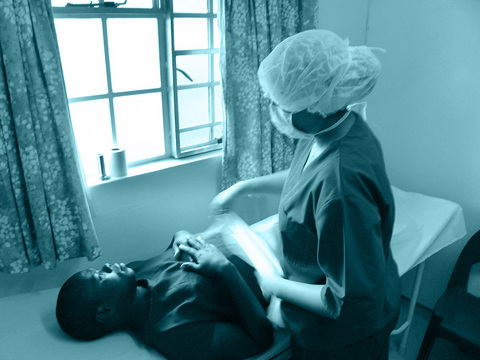
PHOTO: NY TIMES NEWS SERVICE
"I am trying to do the best for my children, and I have heard that if a male is circumcised there is less risk of infection." Other policy-makers in the region are holding back, waiting for direction from the WHO. Officials there say the evidence so far, while intriguing, is not definitive enough to call for a shift in strategy on HIV prevention.
The most striking studies suggest that men can lower their own risk of infection by as much as 75 percent, and that infected men can reduce the odds of transmitting the virus to their partners by about 30 percent, simply by undergoing circumcision.
Research suggests that the cells on the underside of the foreskin are prime targets for the virus and that tears and abrasions in the foreskin can invite the infection. But World Health Organization experts say it would be premature to recommend circumcision until results come in from two randomized controlled trials involving nearly 8,000 people in Kenya and Uganda.
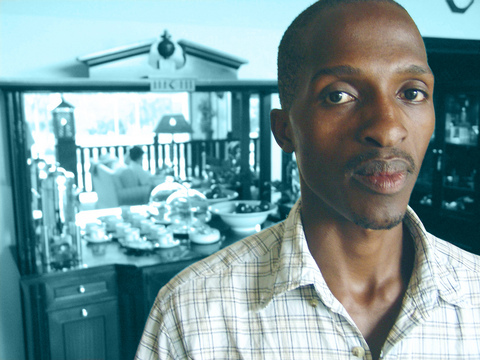
PHOTO: NY TIMES NEWS SERVICE
Preliminary results could be released by late June. Data from earlier studies is "excitingly tantalizing, and the potential effectiveness looks pretty good," said Kevin O'Reilly, who is in charge of HIV prevention for the health organization. But it must be confirmed, he said, "before we officially declare that circumcision is a policy that should be adopted by countries."
"We don't want to steer countries wrong," he said.
So far, southern Africa's HIV infection rate, the world's highest, has resisted a battery of efforts to lower it. Only three countries in sub-Saharan Africa -- Kenya, Uganda and Zimbabwe -- have shown declines in the prevalence of the virus among adults, according to UNAIDS, the UN agency devoted to curbing the epidemic.
Of the nearly 5 million people worldwide who became infected last year, 3.2 million live in sub-Saharan Africa, the agency said. Daniel Halperin, an epidemiologist and HIV
specialist in Africa for the US Agency for International Development, argues that low rates of circumcision and high rates of multiple, concurrent sexual partners are the main reasons that the AIDS epidemic has raged in southern Africa but left western Africa mostly unscathed.
"Lack of circumcision and concurrent partnerships appears to be the lethal cocktail," he said in a speech last week to HIV clinicians in Johannesburg.
According to a study Halperin published in 1999, seven southern African countries, where fewer than one in five men were circumcised, had HIV prevalence rates in adults of 14 to 26 percent in 1998. In nine western African countries, where more than four in five men were circumcised, HIV prevalence rates were below 5 percent.
Researchers have suspected since the 1980s that such patterns are more than coincidence, and while the topic has long been a controversial one, many experts say the bulk of studies suggest that circumcision has at least some protective effect.
growing body of evidence
An analysis of data in 2002 cited by the Agency for International Development found that 38 studies, mostly in Africa, appeared to show that uncircumcised men were more than twice as likely to be infected than circumcised men.
Perhaps the most compelling evidence came last year from a study financed by the French government of 3,274 men outside Johannesburg. Half of the men underwent circum-cision; the other half were uncircumcised. After 17 months, 49 of the uncircumcised men became infected with HIV, while only 20 of the circumcised men caught the virus. The study was called to a halt in March last year when a review board decided that it would be unethical to withhold circumcision from the control group.
Researchers estimated that the procedure reduced the risk of contracting HIV by 60 to 75 percent. One study in February of the medical records of more than 300 Ugandan couples suggested that male circumcision also benefited women. In it, researchers estimated that circumcised men infected with HIV were about 30 percent less likely to transmit the virus to their female partners.
Diana Dickinson, who has battled HIV for years from her private health clinic in Gaborone, Botswana, is one of many clinicians in southern Africa in a quandary over how to react to such studies. On the one hand, she said, she wants her patients to be protected as much as possible. On the other, she worries that if circumcision is oversold, circumcised men may think they are free to engage in risky sex.
"I really worry about mixed messages," she said. World Health Organization officials warn that even if studies now under way confirm the benefits of circumcision, it must be viewed as part of a much broader prevention strategy to promote testing, condom use, reduction in the number of sexual partners and abstinence. "There never has been a magic bullet," O'Reilly of the WHO said, "and there never will be."
Other HIV specialists are concerned that the studies may encourage unsafe circumcisions by traditional healers. Every year, the authorities in Eastern Cape province in South Africa report deaths and amputations from botched circumcisions of young boys.
While many Western doctors routinely encourage circumcision of newborns, surgeons in government hospitals and clinics in southern Africa typically schedule circumcisions only if medically necessary. At Chris Hani Baragwanath Hospital in Soweto the waiting list runs six to nine months. To offer it more broadly, "you can imagine what kind of resources would have to be made available," said Martin Smith, head of the hospital's surgery department.
Although circumcision is not a custom among most ethnic groups in the region, studies in Botswana and elsewhere suggest that more than half of men would accept circumcision if it were free and done safely. Most say they think circum-cision improves hygiene and sexual pleasure.
The few programs that offer free or low-cost circumcision have been swamped with applicants. Officials of the Family Life Association, a nonprofit organization in Swaziland, expected a few dozen volunteers when they offered free circumcisions in January. But about 140 men and boys showed up at its clinic in the Swazi capital, Mbabane. Doctors worked until 8pm to circumcise 54 patients and told the rest to come back later. About 10 men and boys returned in February,
including a 28-year-old laboratory technician, a 19-year-old student and a 31-year-old unemployed father of four. Dennis Mkhonta, 44, a married government meteorologist, said he wanted to be circumcised for hygenic reasons. But he wants his 21-year-old son to do so because he is afraid of HIV.
"There is nobody who is not," Mkhonta said. "I tell my sons: Protect yourselves." Thulani Shongwe, 29, missed the Family Life Association's one-day advertisement and appears to be out of luck. In the past four years, he said, he has gone repeatedly to the government hospital asking to be circumcised, only to be told to try again another day. He said that "they give the impression they don't care much about it." But he does. "It reduces the risk of HIV," he said. Besides, he added, "my girlfriend wants me to do it."

In late October of 1873 the government of Japan decided against sending a military expedition to Korea to force that nation to open trade relations. Across the government supporters of the expedition resigned immediately. The spectacle of revolt by disaffected samurai began to loom over Japanese politics. In January of 1874 disaffected samurai attacked a senior minister in Tokyo. A month later, a group of pro-Korea expedition and anti-foreign elements from Saga prefecture in Kyushu revolted, driven in part by high food prices stemming from poor harvests. Their leader, according to Edward Drea’s classic Japan’s Imperial Army, was a samurai

The following three paragraphs are just some of what the local Chinese-language press is reporting on breathlessly and following every twist and turn with the eagerness of a soap opera fan. For many English-language readers, it probably comes across as incomprehensibly opaque, so bear with me briefly dear reader: To the surprise of many, former pop singer and Democratic Progressive Party (DPP) ex-lawmaker Yu Tien (余天) of the Taiwan Normal Country Promotion Association (TNCPA) at the last minute dropped out of the running for committee chair of the DPP’s New Taipei City chapter, paving the way for DPP legislator Su

It’s hard to know where to begin with Mark Tovell’s Taiwan: Roads Above the Clouds. Having published a travelogue myself, as well as having contributed to several guidebooks, at first glance Tovell’s book appears to inhabit a middle ground — the kind of hard-to-sell nowheresville publishers detest. Leaf through the pages and you’ll find them suffuse with the purple prose best associated with travel literature: “When the sun is low on a warm, clear morning, and with the heat already rising, we stand at the riverside bike path leading south from Sanxia’s old cobble streets.” Hardly the stuff of your
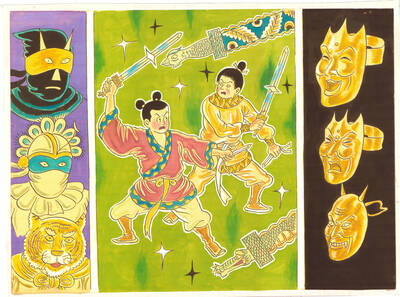
April 22 to April 28 The true identity of the mastermind behind the Demon Gang (魔鬼黨) was undoubtedly on the minds of countless schoolchildren in late 1958. In the days leading up to the big reveal, more than 10,000 guesses were sent to Ta Hwa Publishing Co (大華文化社) for a chance to win prizes. The smash success of the comic series Great Battle Against the Demon Gang (大戰魔鬼黨) came as a surprise to author Yeh Hung-chia (葉宏甲), who had long given up on his dream after being jailed for 10 months in 1947 over political cartoons. Protagonist


 RSS
RSS