


"Happy are they who don't doubt themselves and whose pens fly across the page," Gustave Flaubert wrote in 1847, when he was 25. "I myself hesitate, I falter, I become angry and fearful, my drive diminishes as my taste improves, and I brood more over an ill-suited word than I rejoice over a well-proportioned paragraph."
The Flaubert who wrote those words to his mistress, Louise Colet, was a work in progress with very uncertain prospects. Madame Bovary lay more than a decade ahead. Behind stretched a miserable trail of false starts. He had a sense of mission but no real plan.
One of the virtues of Frederick Brown's quietly persuasive biography is its careful documentation of Flaubert's always agonized search for a literary idea to match his aesthetic ideals. Another is its sensitivity to the complexities of his artistic personality. Flaubert was both defiant and desperate, contemptuous of fame and eager to attain it, supremely certain on questions of art yet tormented by self-doubt, an aesthetic hermit and a fixture in the Paris salons, a realist who described himself to the critic Sainte-Beuve as "an old romantic mad dog."
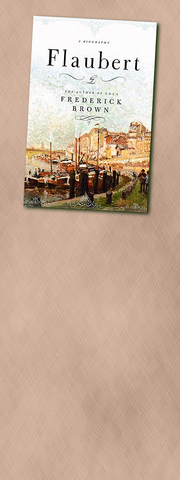
Brown, the author of well-received biographies of Jean Cocteau and Emile Zola, has no overarching thesis to offer in Flaubert. There are no surprises. In his own sweeping biography of Flaubert, The Family Idiot, Sartre proposed that Flaubert's epilepsy was hysterical, an unconscious strategy to free him from his impending career as a lawyer. Brown, examining the medical evidence, concludes that Flaubert was, in fact, epileptic. He is content with the data, and, accordingly, has put together a judicious work that sticks to the record and relies on expertly chosen passages from Flaubert's brilliant letters and the works of his contemporaries to develop a convincing portrait, brushstroke by brushstroke.
The Flaubert who emerges is much less isolated than the aloof ascetic of popular imagination, the cool disciple of absolute form, drawn, as he once put it, "to the pure line, the prominent curve, the loud color, the ringing note."
Flaubert did an excellent job of advertising his distaste for modern life, contemporary politics and the thousand and one vulgarities that he captured in his fiction with scientific precision.
Yet, as Brown shows, Flaubert was an effective operator when it came to pulling strings and working the government for favors, usually on behalf of deserving friends. He was capable of pulling off a business deal. And he cut an impressive figure in the Parisian social world populated by writers, artists, powerful court-esans and government officials. "Action has always revolted me," he once wrote. "But when I have had to, or chosen to, I have acted decisively, quickly and well."
Flaubert, a grand narcissist, did as he pleased. When he required solitude, he retired to his study in rural Croisset, near Rouen, in Normandy. When he yearned for companionship, he took the train to Paris, where he kept an apartment and presided over a salon. A lifelong bachelor, he showed an uncanny knack for keeping women on the string, but at a safe distance. A lover of solitude, he nevertheless surrounded himself with admiring friends, to whom he insisted on reading his works aloud for hours at a stretch. ("He reads me three hundred excellent pages," George Sand confided to her diary in 1868. "I'm entranced.")
The narrative, advancing at a stately pace, sometimes sags. Flaubert, scratching away with his quill pen in Normandy, doles out drama with a stingy hand. Brown takes great pains to place Flaubert in his time, setting the political stage for the great upheavals of 1848 and 1870, but his subject refuses to take part. As the 1848 uprising in Paris boils all around him, Flaubert wanders through the uproar like a somnambulist, untouched, like a silent-film comedian unaware as a house collapses around him.
Brown's interpretations of individual works tend to be pedestrian, even term-paperish. But he excels at extended character sketches, and populates Flaubert's surprisingly crowded world with a colorful group of literary all-stars, including Zola, the Goncourt brothers, Guy de Maupassant, Ivan Turgenev and the enormously sympathetic Sand, who did the valuable work of supporting or deflating Flaubert when he most needed it.
Brown makes the most of his few narrative opportunities. He gives a spirited account of Flaubert's tour of the Near East with his friend Maxime du Camp, a riot of exotic color and nonstop sex. He also mines gold in Flaubert's tempestuous relationship with Colet, a writer and the paramour of several famous writers, whose sense of personal drama and colossal self-absorption made her a worthy match for the man she would later call "that insidious Norman."
Passionate, determined and myopic, Colet stalked Flaubert for decades, undeterred by his wizardly evasions. "I tried to love you and do love you in a way that isn't the way of lovers," he once told her, in a typically maddening formulation. Colet, in love and in anger, was more direct. "I scorn his character utterly and am revolted by his premature decrepitude," she fumed, as the affair reached its endgame.
Flaubert gave to his art what he refused to give to women: constancy, devotion, passion. Until he wrote Madame Bovary, his lofty pronouncements, Brown subtly suggests, were more than slightly defensive. Flaubert showed contempt for a public he knew he could not please. He turned his back on honors unlikely to be offered.
With Madame Bovary there came a turning point. "I'm seeking the high seas rather than safe harbor," he wrote to a friend, with absolute confidence. "If I sink, you're excused from mourning me." It was full speed ahead, at a painstaking, perfectionist crawl to Salammbo, Sentimental Education, Three Tales, Bouvard and Pecuchet. Fame and acclaim, repellent though they might be, came his way. Immortality, too.

In late October of 1873 the government of Japan decided against sending a military expedition to Korea to force that nation to open trade relations. Across the government supporters of the expedition resigned immediately. The spectacle of revolt by disaffected samurai began to loom over Japanese politics. In January of 1874 disaffected samurai attacked a senior minister in Tokyo. A month later, a group of pro-Korea expedition and anti-foreign elements from Saga prefecture in Kyushu revolted, driven in part by high food prices stemming from poor harvests. Their leader, according to Edward Drea’s classic Japan’s Imperial Army, was a samurai

The following three paragraphs are just some of what the local Chinese-language press is reporting on breathlessly and following every twist and turn with the eagerness of a soap opera fan. For many English-language readers, it probably comes across as incomprehensibly opaque, so bear with me briefly dear reader: To the surprise of many, former pop singer and Democratic Progressive Party (DPP) ex-lawmaker Yu Tien (余天) of the Taiwan Normal Country Promotion Association (TNCPA) at the last minute dropped out of the running for committee chair of the DPP’s New Taipei City chapter, paving the way for DPP legislator Su

It’s hard to know where to begin with Mark Tovell’s Taiwan: Roads Above the Clouds. Having published a travelogue myself, as well as having contributed to several guidebooks, at first glance Tovell’s book appears to inhabit a middle ground — the kind of hard-to-sell nowheresville publishers detest. Leaf through the pages and you’ll find them suffuse with the purple prose best associated with travel literature: “When the sun is low on a warm, clear morning, and with the heat already rising, we stand at the riverside bike path leading south from Sanxia’s old cobble streets.” Hardly the stuff of your
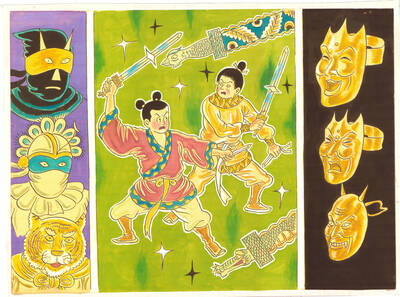
April 22 to April 28 The true identity of the mastermind behind the Demon Gang (魔鬼黨) was undoubtedly on the minds of countless schoolchildren in late 1958. In the days leading up to the big reveal, more than 10,000 guesses were sent to Ta Hwa Publishing Co (大華文化社) for a chance to win prizes. The smash success of the comic series Great Battle Against the Demon Gang (大戰魔鬼黨) came as a surprise to author Yeh Hung-chia (葉宏甲), who had long given up on his dream after being jailed for 10 months in 1947 over political cartoons. Protagonist


 RSS
RSS