


Engineers from around the world come to Malcolm Gray for lessons about how to dispose of their nuclear waste.
Gray acknowledges there are technical matters that aren't completely resolved. No country has actually started burying its waste yet, after all. But the science isn't really going to be the hard part, he tells them.
"To get the social acceptance is the difficult and tricky thing," says Gray, a Vienna, Austria-based engineer who manages the International Atomic Energy Agency's (IAEA) training and development program for high-level radioactive waste disposal.
Though 33 countries have spent nuclear fuel from electricity production, only the US, with Yucca Mountain, and Finland, with Olkiluoto, have singled out actual sites for its burial.
The question of what to do with the world's nuclear waste is a growing concern as more countries look to nuclear power to solve their long-term energy needs and the Bush administration considers the global role the US will play in keeping that power source safe from terrorists.
The Department of Energy last week unveiled major nuclear waste legislation it hopes will accelerate progress on the stalled Yucca Mountain project and plans this summer to submit a new timetable for when the government will begin accepting waste for burial.

Though it is years behind schedule, the US is unique in that it even tries to maintain deadlines, says Charles Fairhurst, a professor emeritus who headed the civil engineering department at the University of Minnesota.
"The United States, we always have timetables," says Fairhurst, who once chaired a National Academy of Sciences panel on waste isolation. "We're always setting deadlines which we've never met."
"A lot of countries don't give timetables, so the issue doesn't become quite as focused."
Fairhurst has been a consultant to the Swiss nuclear waste program, an adviser to the French, and was also involved in the Swedish project.
"A number of countries are making good progress, but for various reasons, they don't feel under the same time pressures as the US," he says.
At the end of last year, there were about 284,000 tons of spent fuel in storage worldwide, with about 54,000 tons of it in the US, said Steven Kraft, senior director of used fuel management at the Nuclear Energy Institute, a policy organization for the commercial nuclear industry.

PHOTO: AFP
There's one conclusion that all of the countries who have a plan, even a loose one, can agree on. Waste that could be radioactive for tens of thousands of years should be buried in the ground.
A number of nations considered a range of options that included shooting the waste into the sun, embedding it under polar ice sheets and burrowing it below the ocean floor.
But burying it in dry, stable ground is considered the safest option for both transporting it and disposing of it by every country that has made any decisions.
"Of the 33 nations that currently have inventories of used fuel, 23 have specific plans to develop a geological depository," Kraft said. "The others don't seem to have any plans just yet."
What nations are grappling with is site selection.
The scientific question centers on whether they should go with clay, salt, granite or some other formation that will keep the radioactive waste safe from seepage, penetration and disruption as it takes centuries to cool.

PHOTO: NY TIMES NEWS SERVICE
Many countries are so small they don't have as many choices as the US had before settling on Yucca Mountain, which is made up of layers of volcanic tuff in rural Nevada. It was picked over sites across the country including salt domes and granite mines.
In one of the nation's least populated areas, Yucca's choice still has many critics vexed that it was chosen for political reasons more than its geologic suitability.
"Politics trumped science," said Kevin Kamps, a waste specialist at the Nuclear Information and Resource Service. "We need a genuine search for a geology that can contain waste for the duration of the hazard. ... We have not found that geology yet."

PHOTO: AFP
Though Yucca is mired in lawsuits and doubt, the objections have been rather tame compared to what protesters in some countries have pulled off.
"I'd have to say that in the US, even though there's widespread resistance, we just haven't seen the huge numbers that some of these countries have," Kamps said. "That may still be to come if shipments were to start, for example."
Kamps said one of the more dramatic examples of how the public can quash a site came a couple years ago in Italy. Italians had years earlier decided to stop using nuclear energy because of the Chernobyl disaster, which occurred 20 years ago this month. But the Italians still needed a place to store the waste they'd created at four reactors.
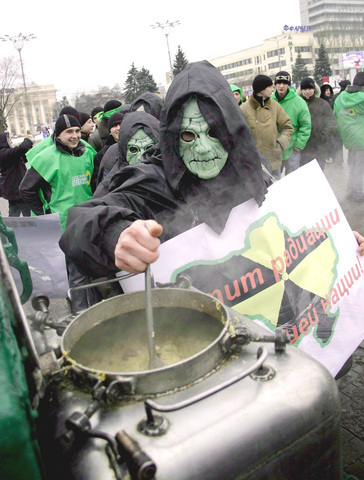
When the Italian government announced it had picked a site near the Mediterranean on Italy's southernmost tip, 100,000 people took to the streets within days to protest. They used vehicles and farm animals to block roadways, according to news reports at the time. Within two weeks, the whole idea was killed.
South Korea faced candlelight vigils nightly for months and protesters were harmed, Kamps said, and the government eventually backed down as well.
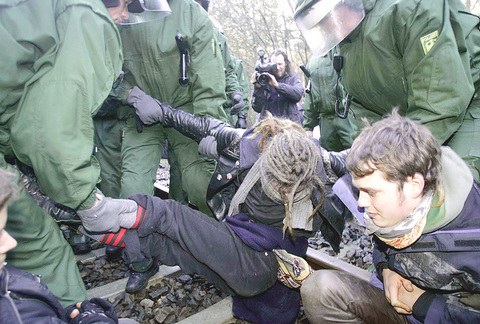
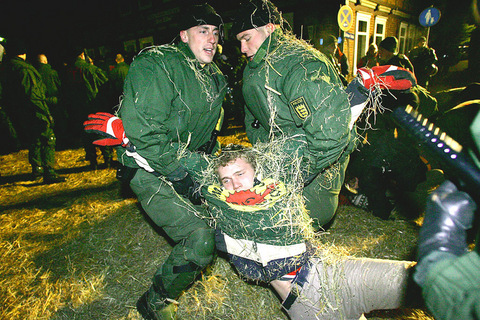
German protests have become notorious over the last decade. Anti-nuclear demonstrators strap themselves to train tracks when waste is being transported between a reprocessing center in France to a centralized storage spot in Germany, and when they're disrupted by police, they repeat the protest at another place along the track. A French environmentalist died in one such protest in 2004.
The Germans decided to phase out atomic energy, though their legislators are still bickering about the decision. And they've been struggling with finding a permanent repository over the strong public objections.
"They were perfectly acceptable," Gray said of earlier identified German sites. "It's a classic problem."
Canada and probably the UK, which recently formed a new national agency on the subject, will continue to rely on storage while they do more in-depth studies of long-term repositories, Gray said.
"Storage as an option is more acceptable than disposal for the time-being," Gray said.
France, which walked away from a site several years ago and is re-evaluating where to go next, in the meantime is reprocessing its waste in a centralized location. While the French reprocess fuel for the Germans and Japanese and other nations, the waste has to be returned to the countries of origin.
The Japanese have a new reprocessing plant they are testing but don't have a candidate disposal site yet, Kraft said.
Reprocessing makes the product smaller, but the waste is no less radioactive than before.
"The waste, a small constituent of spent fuel itself, is what drives all the requirements for disposal and storage," Kraft said. "With reprocessing, you do have a smaller item to deal with. Radiation and heat levels are the same, that's the key point."
The Finnish bedrock at Olkiluoto is crystalline rock. Having secured the site, the Finns now are working on excavation and licensing.
"I know the Finnish people have come to seem to be more accepting and see the financial benefits and have trust that it's going to be done correctly," Kraft said.
Aside from the IAEA, which doesn't have any binding authority over nations, there's no international governing body whose job is to make sure there's a long-term plan for nuclear waste, which, with a few exceptions of centralized storage spots, is simply being stored at all of the sites where it was generated. There are more than 100 sites in the US alone.
Still, the international agency is trying to do its part, training engineers from countries as varied as China, South Korea, South Africa, Argentina, Lithuania, Slovakia and Slovenia on both the scientific and social challenges of nuclear waste disposal.
"(The IAEA) can make suggestions and give guidelines, but the real control comes from the individual national authorities," said Gray, who operates a series of underground laboratories at various research facilities in the US, Sweden, Switzerland and Belgium.
He says he's encouraged by the efforts of growing countries to come up with a plan for their waste.
Gray said China plans to add 23 new reactors to the few it has already and is incorporating waste management early on its plans. "They're being very, very responsible for their attitudes in that regard," he said.
Several trainees from India also have taken part in the international program, he said.
"They do have a large waste management section in the research institute," Gray said.
The international cooperation is important because so few people worldwide have the technological knowledge to deal with nuclear waste, he said.
"Fundamentally it will end up being an international concern," Gray said.
More than 400 nuclear power plants are in operation worldwide.

Last week, Viola Zhou published a marvelous deep dive into the culture clash between Taiwanese boss mentality and American labor practices at the Taiwan Semiconductor (TSMC) plant in Arizona in Rest of World. “The American engineers complained of rigid, counterproductive hierarchies at the company,” while the Taiwanese said American workers aren’t dedicated. The article is a delight, but what it is depicting is the clash between a work culture that offers employee autonomy and at least nods at work-life balance, and one that runs on hierarchical discipline enforced by chickenshit. And it runs on chickenshit because chickenshit is a cultural
My previous column Donovan’s Deep Dives: The powerful political force that vanished from the English press on April 23 began with three paragraphs of what would be to most English-language readers today incomprehensible gibberish, but are very typical descriptions of Democratic Progressive Party (DPP) internal politics in the local Chinese-language press. After a quiet period in the early 2010s, the English press stopped writing about the DPP factions, the factions changed and eventually local English-language journalists could not reintroduce the subject without a long explanation on the context that would not fit easily in a typical news article. That previous
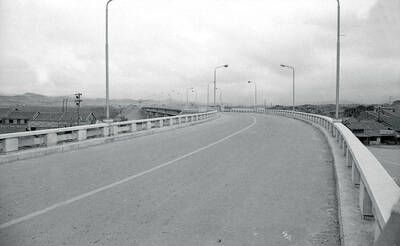
April 29 to May 5 One month before the Taipei-Keelung New Road (北基新路) was set to open, the news that US general Douglas MacArthur had died, reached Taiwan. The military leader saw Taiwan as an “unsinkable aircraft carrier” that was of huge strategic value to the US. He’d been a proponent of keeping it out of Chinese Communist Party (CCP) hands. Coupled with the fact that the US had funded more than 50 percent of the road’s construction costs, the authorities at the last minute renamed it the MacArthur Thruway (麥帥公路) for his “great contributions to the free world and deep
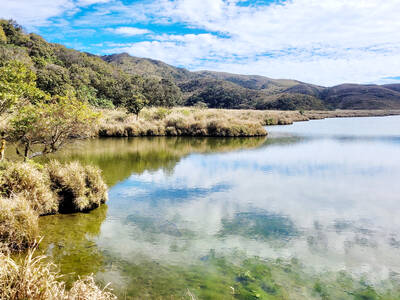
Years ago, I was thrilled when I came across a map online showing a fun weekend excursion: a long motorcycle ride into the mountains of Pingtung County (屏東) going almost up to the border with Taitung County (台東), followed by a short hike up to a mountain lake with the mysterious name of “Small Ghost Lake” (小鬼湖). I shared it with a more experienced hiking friend who then proceeded to laugh. Apparently, this road had been taken out by landslides long before and was never going to be fixed. Reaching the lake this way — or any way that would


 RSS
RSS