


Old ladies and gents gliding around a tearoom under yellowing chandeliers in Blackpool, England. Tanned guys with fixed-grins in tight suits beaming at their sequined partners. Fred Astaire in a penguin suit, gals in gowns and musicals from the 1950s. Put all these images out of your mind.
Ballroom dancing is back in fashion with Burn the Floor Dance Evolution, a spectacular show that opened yesterday in Taipei at Sun Yat-sen Memorial Hall (國父記念館) and which will run every night until next Sunday.
Burn the Floor puts 16 world-class dancing couples under the laser lights and in a Hollywood setting. It covers a range of dance styles very loosely organized under the ballroom and latin banner, including: salsa, jive, waltz, the twist, cha cha, jitterbug, samba and quickstep. Even disco, rock 'n' roll and hip hop get in the mix.
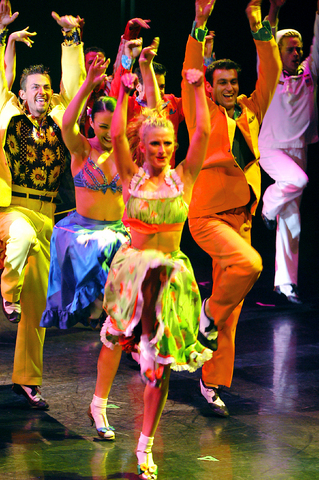
PHOTO: NEW ASPECT
The dances are organized in sections -- swing, fantasy waltz, industrial cha cha, big-band salsa, passionate-tango -- each of which has a plot and drives the set forward. The interaction of the dancers also adds to the story line of the performance.
"It's like looking at a painting by [Claude] Monet," said artistic director Jason Gilkison at a press conference earlier this week. "The closer you look the more there is to see."
Bringing ballroom dancing up-to-date was the aim of the show's producer Harley Medcalf, who conceived the idea at Elton John's 50th birthday party nine years ago. A line of 16 dancers was the highlight of the event -- not a bad achievement when you consider the star of the show turned up in the back of a furniture truck because his elaborate Louis XIV costume and wig was too big for the car.
The idea was transformed into a reality by: choreographer Anthony van Laast; designer Bonita Bryg, who came up with 618 lavish costumes and 342 pairs of shoes; lighting and controlled explosions from Patrick Woodroffe; and an extravagant set design by Marc Fischer. Universal films backed the project and it premiered in 1999.
Obviously, Burn the Floor was intended to catch the spread of dance fever stoked by Michael Flatley and Riverdance, but it had its problems and these came to a head in 2000 when the US tour was cut short.
There was too much razzle dazzle and too little emphasis on the dancers, it was decided, and championship dancer Jason Gilkison stepped up to turn the show around. At the press conference in Taipei, he said pyrotechnics had got in the way.
"There were so many effects then, we couldn't see the dancers, the sweat flying, the real excitement. It was so spectacular it was nearly soulless. Because of all the production elements, it covered up the focus of what we were doing. The dancers looked all the same, like Riverdance. We've still got the stairs, the props and the mirror balls but what you see now is the dance."
Asked by the Taipei Times whether the show was now a pumped-up, extreme sports version of ballroom dancing, Gilkison said: "It's a fine line between the two because we put together the energy [of sports] and combine it with the passion and artistry of the dancehall. We give the dancers the freedom of the floor."
Cast member Jonathon Doone, who first visited Taiwan 10 years ago for a competition and has been with Burn for six years, said everyone wanted to express themselves.
"As one of the dancers I can tell you that we don't want to be cookie-cut. Everyone has their own style. ... And if you have too many effects then you lose the ability to communicate with the audience directly."
"We wanted to have that feel of a smoky club and keep the balance so that a big show succeeds. It's all about satisfying the audience and dancers' demands," Gilkison said.
A consultant to the promoter -- New Aspect International Cultural and Educational -- and an experienced dance teacher and performer, Kent Chou (周志坤) said he had seen the show in Japan and recommended it.
"It's been a long time since we have seen some new steps, that are fresh, light and shiny. This dance style is fashionable, very fresh and different. It's individual and is a new way of expression," Chou said.
"The fox trot and dance steps like that were our grandparents' way of dancing and we recreate those styles for the clubbing generation," Gilkison said.
As the saying goes: "The more things change, the more things stay the same."
During the Martial Law period (1948 to 1987) in Taiwan going to dance halls was banned because it was viewed as a form of "illegal assembly." Ballroom dancing was also mixed up with what was called "social dancing" -- which sometimes involved prostitution.
"Yes, it's funny," Chou said after the press conference. "Twenty-six to 27-years ago the police used to catch us and arrest us if we went dancing. Now we can see the sunshine."
"Before it was illegal to dance and now there's freedom of expression. We Taiwanese do not have to restrict ourselves and this intimate relationship between a man and woman, so sexual, can now be communicated."
Judge for yourself at Burn the Floor Dance Evolution.
Burn the Floor fact box:
Where: Sun Yat-sen Memorial Hall (國父紀念館), 505, Renai Rd Sec 4, Taipei (台北市仁愛路4段505號)
When: The show runs every night to April 16, at 7:30, with matinees on Saturday and Sunday at 2:30pm
Tickets: NT$700 to NT$3,600 from www.artsticke.com.tw or (02) 3393 9888

In late October of 1873 the government of Japan decided against sending a military expedition to Korea to force that nation to open trade relations. Across the government supporters of the expedition resigned immediately. The spectacle of revolt by disaffected samurai began to loom over Japanese politics. In January of 1874 disaffected samurai attacked a senior minister in Tokyo. A month later, a group of pro-Korea expedition and anti-foreign elements from Saga prefecture in Kyushu revolted, driven in part by high food prices stemming from poor harvests. Their leader, according to Edward Drea’s classic Japan’s Imperial Army, was a samurai

The following three paragraphs are just some of what the local Chinese-language press is reporting on breathlessly and following every twist and turn with the eagerness of a soap opera fan. For many English-language readers, it probably comes across as incomprehensibly opaque, so bear with me briefly dear reader: To the surprise of many, former pop singer and Democratic Progressive Party (DPP) ex-lawmaker Yu Tien (余天) of the Taiwan Normal Country Promotion Association (TNCPA) at the last minute dropped out of the running for committee chair of the DPP’s New Taipei City chapter, paving the way for DPP legislator Su
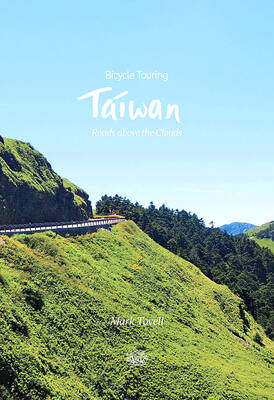
It’s hard to know where to begin with Mark Tovell’s Taiwan: Roads Above the Clouds. Having published a travelogue myself, as well as having contributed to several guidebooks, at first glance Tovell’s book appears to inhabit a middle ground — the kind of hard-to-sell nowheresville publishers detest. Leaf through the pages and you’ll find them suffuse with the purple prose best associated with travel literature: “When the sun is low on a warm, clear morning, and with the heat already rising, we stand at the riverside bike path leading south from Sanxia’s old cobble streets.” Hardly the stuff of your
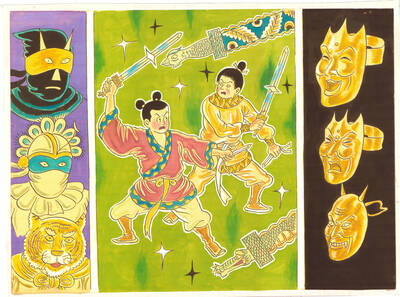
April 22 to April 28 The true identity of the mastermind behind the Demon Gang (魔鬼黨) was undoubtedly on the minds of countless schoolchildren in late 1958. In the days leading up to the big reveal, more than 10,000 guesses were sent to Ta Hwa Publishing Co (大華文化社) for a chance to win prizes. The smash success of the comic series Great Battle Against the Demon Gang (大戰魔鬼黨) came as a surprise to author Yeh Hung-chia (葉宏甲), who had long given up on his dream after being jailed for 10 months in 1947 over political cartoons. Protagonist


 RSS
RSS