


There was no hesitation when preschool teacher Alex Campbell began the process of filling her lower leg with a bright orange koi swimming in a blue pond of labyr-inthine waves. The intricate tattoo is not hidden under schoolmarm tights or practical slacks. Instead it has become part of the lesson plan in her class at Corner Co-op Nursery School in Brookline, Massachusetts.
Campbell's students followed the process of their teacher getting a tattoo firsthand -- or as close as a four-year-old can get to firsthand without stepping into a tattoo parlor. They talked about sketching, needles, and, most importantly, not touching Campbell's leg the day after she was tattooed.
Campbell, who seldom wore skirts before getting her calf tattooed, has switched over to a wardrobe that is far more skirt-friendly to display her pricey body art. Her next step is getting a full arm tattoo (those in the know refer to a full arm tattoo as a sleeve).
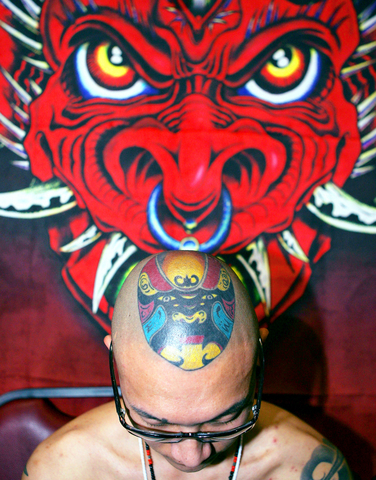
"I asked a few parents about how they'd feel about a teacher with tattoos on her arm, and they were fine with it," the 37-year-old Brookline resident says.
As tattooing reaches a mainstream crest thanks to shows such as Miami Ink, Inked, and even Meet the Barkers and Prison Break, professionals such as Campbell are bringing more elaborate -- and more visible -- body art into the workplace. For Campbell, the tattoos were a non-issue at school, and even became a teaching tool that resonated with the tykes in her class. In the current tattoo-friendly climate, a number of white collar professionals are finding that body art is a helpful tool at the office -- a way to give a subtle nod and a wink to co-workers or clients that they run with a crowd that owns the new Arctic Monkeys CD or lives a life with more attitude and flair than most. In some workplace circles, visible tattoos have become the new power suit.
"Usually the tattoos are an asset," says Sean Cunningham, a creative director at Mullen Advertising in Wenham who has an entire arm solidly tattooed. "Because of what I do here, people are fine with tattoos. Sometimes I actually think they feel better when they see my arm because they almost expect an artist to be tattooed."
These are not spur-of-the-moment tattoos that happen after a night on the town consuming mug after mug of liquid confidence. At Fat Ram's Pumpkin Tattoo in Jamaica Plain, where Campbell had her koi tattooed, it takes six months to procure an appointment with owner Ram Hannan. He charges US$200 an hour for his time, and large tattoos take several hours to complete in sessions spread over multiple days. The investment, which inevitably totals in the thousands of dollars, is often an important form of self-expression for those who endure the needle for long stretches. But for some, the unforeseen benefit is an increased level of cache at work.
"The taboo has been broken," says Ami James, whose tattoo parlor is the focus of the TLC reality show Miami Ink. "It's not just our show, but a lot of factors have eased the stigma. Everywhere you look, football players, basketball players, rock stars are tattooed. I think what Miami Ink has done is show that lots of ordinary people are getting them too. We see every kind of person in the shop."
Joe Summers Jr., a psychiatric evaluator with Cape Cod Hospital who has two full tattooed sleeves, has found his ink to be a helpful tool when working with patients. A burly, goateed former marine who looks as if he could break open a coconut with his bare hands and then crush it into a pina colada, Summers makes no attempt to cover his tattoos at work. He's found that the tattoos put clients at ease during psychiatric evaluations.
"I deal with a lot of adolescents," Summers says. "When they hear an evaluator is coming, I think they expect they're going to see a pompous stuffed shirt. Instead, they see me coming around the corner. It's a definite icebreaker. The kids open up to me more when they see the tattoos."
For 22-year-old Mae Legassey, who is in the process of getting her entire back tattooed and who sports a visible tattoo on her foot, the ink has been helpful with previous gigs such as marketing. She currently works in a medical office, and she says the tattoos have done nothing but elicit compliments from co-workers. Genetics researcher Kristin O'Malley has found that her double helix tattoos work as an effective icebreaker with colleagues who approach her to talk about her scientifically accurate body art.
It is part of an ever-increasing openness toward ink that has exploded over the past 15 years. When Myrna Armstrong at the Texas Tech University Health Sciences Center began studying tattoos in the late 1980s, attitudes toward them were wound tightly around stereotypes of convicts, sailors, and carny folk. More recently, however, she's found that tattoos have crossed firmly into popular culture. The studies she has conducted have found that nearly 25 percent of subjects are sporting some kind of tattoo, and those numbers are not restricted to bike messengers and indie rockers.
"It has caused a lot of companies to look at their dress codes," she says of new attitudes toward tattooing.
For all the white collar professionals who are getting visible tattoos, the numbers getting more expansive sleeve, back, and leg work under the collar is also exploding. Ken Dean, an artist at Pino Bros. Ink in Cambridge says it's often the corporate executives who are getting the most extreme and intense tattoos applied to their bodies.
"It makes sense because these are the guys that have the money to do this. It can be expensive when you have that much work done," Dean says. "They also have the perfect cover. They have to wear suits all the time."
Despite tattoos entering the public eye at ever-increasing levels, there are still vast numbers of professionals who find it necessary to keep their own hidden. Sebastian Rivas, a 23-year-old real estate agent with a full chest tattoo and tattooed arms, is afraid revealing his tattoos could deter potential clients. Colleen Nimblett, who works at Southern New Hampshire Bank and Trust Co in Salem, New Hampshire, is not allowed to show her tattoos at work. She recently got a new tattoo on her ankle, which means she is now restricted to pants, opaque tights, or knee-high boots in the office.
"It's so strange because it seems like everyone in the bank has a tattoo somewhere," she says. "Whenever there's a company party, you see everybody's tattoos. But there's this policy that we can't show them at work."
Companies such as Starbucks and Blockbuster don't allow visible tattoos on employees who work with the public, but the decision to hide or show a tattoo extends far up the corporate ladder. A 47-year-old woman who replied to a Boston.com discussion board about professionals with tattoos, under the condition of anonymity, went on at length about why showing her tattoos would be disastrous.
"To reveal my tattoos on the job would spell doom for my professional career," she wrote. "I've worked too hard, particularly as a woman competing in a field in which the major players are still men, to allow that to happen."
It is the dichotomy of personal expression and professional advancement that stymies some white collar workers when it comes to displaying their tattoos. Joe Chernov, a 35-year-old who sports two full sleeves of tattoos, set aside his reser-vations and decided to let his tattoos help plot the direction of his career.
"They're a good filter," says Chernov, who works as public relations director for BzzAgent. "If people have a problem with my tattoos, then it's not really a place that I want to be working. Nothing against those companies, but they're not for me."

In late October of 1873 the government of Japan decided against sending a military expedition to Korea to force that nation to open trade relations. Across the government supporters of the expedition resigned immediately. The spectacle of revolt by disaffected samurai began to loom over Japanese politics. In January of 1874 disaffected samurai attacked a senior minister in Tokyo. A month later, a group of pro-Korea expedition and anti-foreign elements from Saga prefecture in Kyushu revolted, driven in part by high food prices stemming from poor harvests. Their leader, according to Edward Drea’s classic Japan’s Imperial Army, was a samurai

The following three paragraphs are just some of what the local Chinese-language press is reporting on breathlessly and following every twist and turn with the eagerness of a soap opera fan. For many English-language readers, it probably comes across as incomprehensibly opaque, so bear with me briefly dear reader: To the surprise of many, former pop singer and Democratic Progressive Party (DPP) ex-lawmaker Yu Tien (余天) of the Taiwan Normal Country Promotion Association (TNCPA) at the last minute dropped out of the running for committee chair of the DPP’s New Taipei City chapter, paving the way for DPP legislator Su

It’s hard to know where to begin with Mark Tovell’s Taiwan: Roads Above the Clouds. Having published a travelogue myself, as well as having contributed to several guidebooks, at first glance Tovell’s book appears to inhabit a middle ground — the kind of hard-to-sell nowheresville publishers detest. Leaf through the pages and you’ll find them suffuse with the purple prose best associated with travel literature: “When the sun is low on a warm, clear morning, and with the heat already rising, we stand at the riverside bike path leading south from Sanxia’s old cobble streets.” Hardly the stuff of your
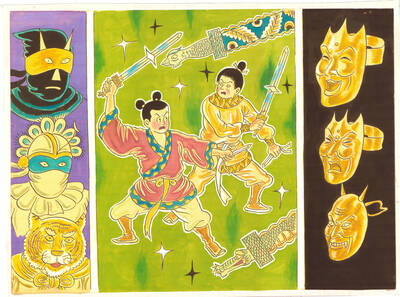
April 22 to April 28 The true identity of the mastermind behind the Demon Gang (魔鬼黨) was undoubtedly on the minds of countless schoolchildren in late 1958. In the days leading up to the big reveal, more than 10,000 guesses were sent to Ta Hwa Publishing Co (大華文化社) for a chance to win prizes. The smash success of the comic series Great Battle Against the Demon Gang (大戰魔鬼黨) came as a surprise to author Yeh Hung-chia (葉宏甲), who had long given up on his dream after being jailed for 10 months in 1947 over political cartoons. Protagonist


 RSS
RSS