


One of the most abiding features of Ang Lee's (
The booming oil city of Calgary, famous for its annual stampede, is where the crew stayed during the making of the film two years ago and it gets a special mention in the film credits. As does the Calgary Gay Rodeo Association, which advised and consulted on the rodeo sequences featuring Jake Gyllenhaal as the rough-rider Jack Twist. Members of the group appear in several sequences.
"We are the only gay rodeo association in Canada," said member Tim Cyr, "but it's part of a huge circuit throughout the US. We have the best turn out on the circuit, and to be a part of it is a great feeling."
This year's 10-day Calgary Stampede takes place July 7 to July 16 in Stampede Park. Originally established as an agricultural fair in 1886, the modern event starts with a grand parade through the city streets and features a wide range of events, the most famous of which are probably the chuckwagon race, and the bull riding and calf roping events, which both feature so strongly in Brokeback Mountain.
Ten-gallon hats and cowboy boots are, needless to say, de rigueur for the Stampede.
But it is Kananaskis Country -- a favorite place for Calgarians wanting to avoid overcrowded Banff and Lake Louise -- which is the setting for the beautiful outdoor scenes which make up most of the movie. The changeable Rockies weather was apparently a problem during the filming and I've known days which have started with drizzling rain turning to stinging sleet and snow and ending up in warm sunshine.
Ang Lee, who won an Oscar with Crouching Tiger, Hidden Dragon, said of the Canadian Rockies locations: "You realize when you place the camera that you have to tilt it up a little bit; the sky is so grand. It's not only the big landscape, but the big sky."
Randy Quaid, the seasoned US actor who plays the taciturn Joe Aguirre, who employs Ennis Del Mar (Heath Ledger) and Jack Twist as sheep herders, was particularly impressed by the locations on what was his first visit to this part of Canada. "I loved the mountains, and even the wind. It's gorgeous big sky country," he said.
Most of the riverside camping sequences in Brokeback Mountain were shot in K Country, near the former coal mining and now mountaineering and skiing center of Canmore, to the west of Calgary.
Highway 40 -- the Kananaskis Trail -- to the east of Canmore will take you into the heart of the mountains to the tranquil Kananaskis Lakes and past many scenes recognizable from the movie.
There's one shot in the film when Jack (Jake Gyllenhaal) is returning for his annual assignation with Ennis (Heath Ledger) on Brokeback Mountain where his pick-up swings round into the mountains at a turn-off into the Peter Lougheed regional park.
Other shots were used from around the shores of the Kananaskis Lakes in Lougheed park, which are completely surrounded by snow-covered peaks with such formidable names as Indefatigable, Invincible and Inflexible. As was the tradition in the days of Empire, these mountains were named after British Navy warships which took part in the Battle of Jutland in 1916. Others in the Upper Kananaskis Lake area, which also feature in the film, take the names of French Commanders from the first world war -- Foch, Joffre and Sarrail.
Highway 742 -- the Smith-Dorrien/Spray Trail -- is the alternative way to approach Kananaskis Country from Canmore. It takes you up through the mountain pass of Whiteman's Gap and the imposing Chinaman's Peak -- named after the Chinese cook, Ha Ling, who first climbed it for a US$50 bet.
Jack and Ennis' spectacular nude cliff-top leap into a river was shot at the appropriately named Sheep River Falls in the Elbow Sheep Wildland Provincial Park near Okotoks, south of Calgary. We drove to this idyllic spot, passing the house-sized, isolated glacial erratic, said to be the largest in the world and emphatically known as The Big Rock, to reach the Blue Rock campsite in Sheep Valley.
Camping there in the wilderness, the only sounds the thundering waterfall and the rushing river, we felt something of the same sense of peace that the fictional Ennis and Jack must have felt on their Brokeback Mountain.

As mega K-pop group BTS returns to the stage after a hiatus of more than three years, one major market is conspicuously missing from its 12-month world tour: China. The omission of one of the group’s biggest fan bases comes as no surprise. In fact, just the opposite would have been huge news. China has blocked most South Korean entertainment since 2016 under an unofficial ban that also restricts movies and the country’s popular TV dramas. For some Chinese, that means flying to Seoul to see their favorite groups perform — as many were expected to do for three shows opening
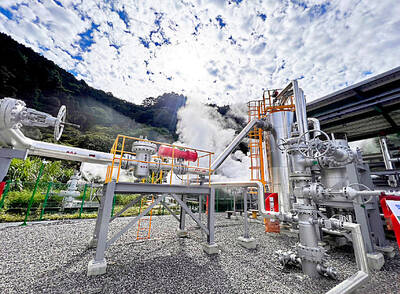
Taiwan’s semiconductor industry consumes electricity at rates that would strain most national grids. Taiwan Semiconductor Manufacturing Co (TSMC) alone accounted for more than 9 percent, or 2,590 megawatts (MW), of the nation’s power demand last year. The factories that produce chips for the world’s phones and servers run around the clock. They cannot tolerate blackouts. Yet Taiwan imports 97 percent of its energy, with liquefied natural gas reserves measured in days. Underground, Taiwan has options. Studies from National Taiwan University estimate recoverable geothermal resources at more than 33,000 MW. Current installed capacity stands below 10 MW. OBSTACLES Despite Taiwan’s significant geothermal potential, the

The entire Li Zhenxiu (李貞秀) saga has been an ugly, complicated mess. Born in China’s Hunan Province, she moved to work in Shenzhen, where she met her future Taiwanese husband. Most accounts have her arriving in Taiwan and marrying somewhere between 1993 and 1999. She built a successful career in Taiwan in the tech industry before founding her own company. She also served in high-ranking positions on various environmentally-focused tech associations. She says she was inspired by the founding of the Taiwan People’s Party (TPP) in 2019 by Ko Wen-je (柯文哲), and began volunteering for the party soon after. Ko

Chinese Nationalist Party (KMT) Chair Cheng Li-wun (鄭麗文) returned from her trip to meet People’s Republic of China (PRC) dictator Xi Jinping (習近平) bearing “a gift” for the people of Taiwan: 10 measures the PRC proposed to “facilitate the peaceful development of cross-strait relations.” “China on Sunday unveiled 10 new incentive measures for Taiwan,” wrote Reuters, wrongly. The PRC’s longstanding habit with Taiwan relations is to repackage already extant or once-existing policies and declare that they are “new.” The list forwarded by Cheng reflects that practice. NEW MEASURES? Note the first item: establishing regular communication mechanisms between the Chinese Communist Party


 RSS
RSS