


In 1959, a newspaper article about the murder of the Clutter family in the tiny town of Holcomb, Kansas, caught the eye of the novelist Truman Capote. He spent most of the next half-dozen years following the case, which ended with the execution of Dick Hickock and Perry Smith and the subsequent publication of In Cold Blood, Capote's best-selling mutation of the true crime potboiler into bona fide literature.
Bennett Miller's Capote is a fascinating and fine-grained reconstruction of that period in its subject's life, a time when he pursued literary glory and flirted with moral ruin. "This is the beginning of a great love affair -- between Truman and himself," someone says, but the film suggests that Capote's obsession with the Clutter murders, and his drive to alchemize their ugly pointlessness into deathless prose, might better be described as a Faustian bargain.
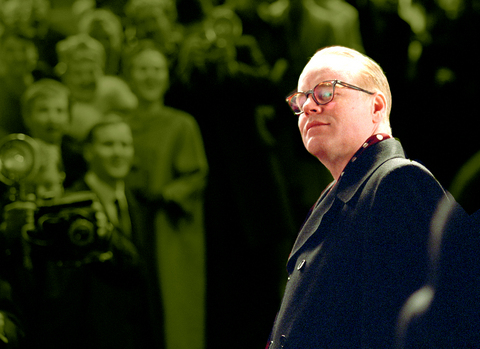
In any case, Capote is, principally, the story of a writer's vexed, all-consuming relationship with his work, and therefore with himself. This makes for better drama than you might expect. Capote's human connections are, for the most part, secondary and instrumental, which makes Philip Seymour Hoffman's performance all the more remarkable, since he must connect with the audience without piercing the membrane of his character's narcissism. Not only does Hoffman achieve an impressive physical and vocal transformation -- mimicking Capote's chirpy drawl and appearing to shrink to his elfin stature -- but he also conveys, with clarity and subtlety, the complexities of Capote's temperament.
PHOTOS: AP
"It appears that with his curious voice, his ways, he decided to brazen it out, to be himself with an ornamental courage and an impressive conceit," Elizabeth Hardwick once wrote, and Hoffman bears out her insight. There is neediness and vulnerability to Hoffman's Capote, but his dominant traits are guile, vanity and the self-confident toughness of the outsider.
A gay man in the era of Kennedy/Rat Pack machismo, a Southerner in New York, a New Yorker in Kansas, he walks into every new situation sure of who he is and sure that he will soon prove himself to be, once again, the most interesting person in the room. His whispery, stuttering self-presentation serves as a feint, deflecting notice from his essential steeliness. Prefiguring the talk show and tabloid self-parody he would later become, this Capote drinks, gossips, teases and whines, but mostly he works, with methodical intensity and ruthless discipline.
The movie's deep subject, crisply delineated in Dan Futterman's fine script (drawn from Gerald Clarke's biography) and dramatized without undue didacticism by Miller, is the risk and cost of this work. Following a hunch, Capote persuades William Shawn, editor of The New Yorker (played by Bob Balaban), to send him to Kansas. He brings along his childhood friend, Nelle Harper Lee (Catherine Keener), to be his "research assistant and personal bodyguard," and the two of them, using New York glamour, Southern charm and Scotch whiskey, try to separate the residents of Holcomb from their natural reticence. They interview friends of the Clutters and befriend the lead investigator on the case, Alvin Dewey (Chris Cooper), and his star-struck wife, Marie (the wonderful Amy Ryan), who even in the wake of an appalling crime cannot contain her delight at having a famous writer in her living room.
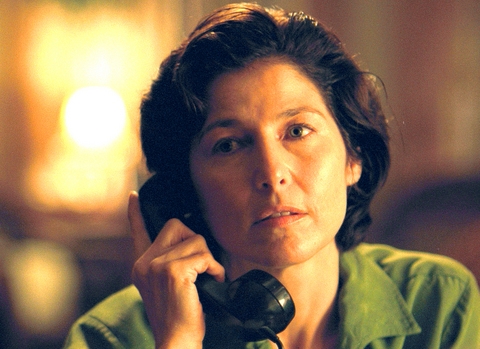
All of these characters -- as well as Jack Dunphy (Bruce Greenwood), Capote's longtime lover -- are supporting players in the Truman show, enduring his egoism with stoical good humor and occasional impatience. Keener performs the role of foil with particular grace. Through her wary, witty performance, she becomes the bridge that connects Capote with the audience: we take our cues from her as we try to figure out when he should be indulged and when he should be censured.
Both Keener's character and Greenwood's are novelists in their own right, something Capote seems only vaguely and intermittently aware of, less and less so as In Cold Blood takes over his life. As it does, his other relationships are overshadowed by his fascination with Perry Smith (Clifton Collins Jr.), whose story Capote believes will be the key to the book and whose sensitive, sociopathic temperament is the dark mirror-image of his own. If Hoffman must address the challenge of impersonating a real, well-known person, Collins has to face the more complicated task of incarnating a real, obscure person who is also a character in a "nonfiction novel" and in a previous film (Richard Brooks's 1967 adaptation of In Cold Blood, in which Smith was played by Robert Blake).
Perhaps because of this, Smith never quite achieves full human gravity. He is caught between whoever he was before he met Capote and the literary figure into which Capote made him. Still, in dramatizing this process -- in showing how Smith was seduced, betrayed and immortalized by the writer's attention -- Capote unflinchingly faces the moral abyss at the heart of the journalistic enterprise. Capote's disinclination to help in Smith's and Hickock's judicial appeals, allegedly because only their deaths would allow him the ending he needed, has long been part of his legend. The filmmakers neither let him off the hook nor turn him into a scapegoat, preferring to view him with a full and appropriate measure of ambiguity.
In setting out for Kansas, Capote believed himself to be tracing the violent intersection of "two Americas": the conservative, stable world of the Clutters and the lawless underworld represented by their killers. That may be the theme of In Cold Blood, but the collision portrayed in Capote -- the cultural friction that gives it a frisson of contemporary relevance -- is a rather different one, between everyday American life and death and the equally American machinery that turns it into news, spectacle and sometimes art.

In late October of 1873 the government of Japan decided against sending a military expedition to Korea to force that nation to open trade relations. Across the government supporters of the expedition resigned immediately. The spectacle of revolt by disaffected samurai began to loom over Japanese politics. In January of 1874 disaffected samurai attacked a senior minister in Tokyo. A month later, a group of pro-Korea expedition and anti-foreign elements from Saga prefecture in Kyushu revolted, driven in part by high food prices stemming from poor harvests. Their leader, according to Edward Drea’s classic Japan’s Imperial Army, was a samurai

The following three paragraphs are just some of what the local Chinese-language press is reporting on breathlessly and following every twist and turn with the eagerness of a soap opera fan. For many English-language readers, it probably comes across as incomprehensibly opaque, so bear with me briefly dear reader: To the surprise of many, former pop singer and Democratic Progressive Party (DPP) ex-lawmaker Yu Tien (余天) of the Taiwan Normal Country Promotion Association (TNCPA) at the last minute dropped out of the running for committee chair of the DPP’s New Taipei City chapter, paving the way for DPP legislator Su

It’s hard to know where to begin with Mark Tovell’s Taiwan: Roads Above the Clouds. Having published a travelogue myself, as well as having contributed to several guidebooks, at first glance Tovell’s book appears to inhabit a middle ground — the kind of hard-to-sell nowheresville publishers detest. Leaf through the pages and you’ll find them suffuse with the purple prose best associated with travel literature: “When the sun is low on a warm, clear morning, and with the heat already rising, we stand at the riverside bike path leading south from Sanxia’s old cobble streets.” Hardly the stuff of your
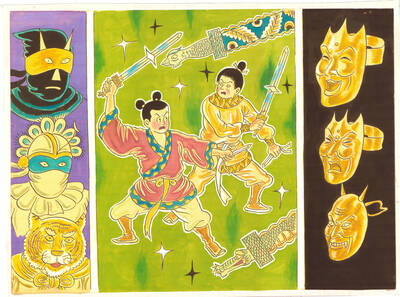
April 22 to April 28 The true identity of the mastermind behind the Demon Gang (魔鬼黨) was undoubtedly on the minds of countless schoolchildren in late 1958. In the days leading up to the big reveal, more than 10,000 guesses were sent to Ta Hwa Publishing Co (大華文化社) for a chance to win prizes. The smash success of the comic series Great Battle Against the Demon Gang (大戰魔鬼黨) came as a surprise to author Yeh Hung-chia (葉宏甲), who had long given up on his dream after being jailed for 10 months in 1947 over political cartoons. Protagonist


 RSS
RSS