


The bi-annual International Theater Festival will open next Saturday in Taipei. The two-month-long festival featuring workshops to be held at the National Experimental Theater (
Performers have drawn inspiration from the likes of Anton Chekhov, Lu Xun (
Five troupes, from Taiwan, Hong Kong, France, Denmark and Canada, will present their "soul and mind" on stage.
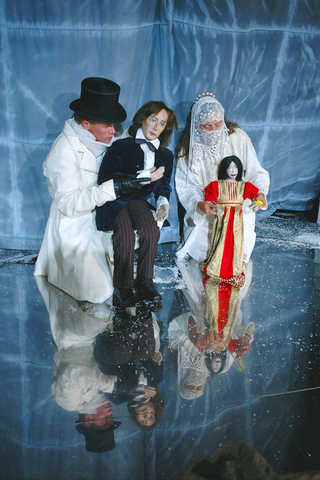
PHOTOS COURTESY OF NATIONAL CHIANG KAI-SHEK CULTURAL CENTER
Ticket sales have been brisk for many shows and organizers are confident that the festival will prove popular even though it clashes with the Phantom of the Opera musical, which is currently on stage at the National Theater.
So far, tickets for the four performances by the Odin Theatret from Demark are sold out and tickets for another much-talked-about play, Knock on Heaven's Door (
According to Wang Mo-lin (
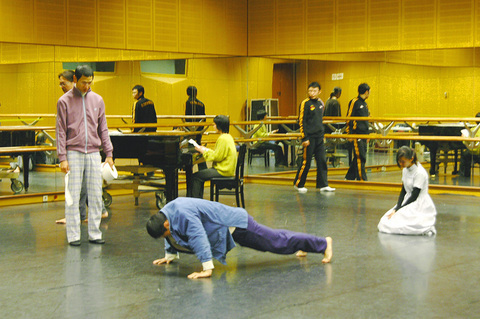
This is the first time, however, that his group has been able to remove the barriers that prevent cultural exchanges based on equal status between Taiwan and China, Wang said.
China's government has previously refused to allow cultural exchanges that infer Taiwan is a separate country.
The behind-the-scenes negotiations and final breakthrough did not come easily.
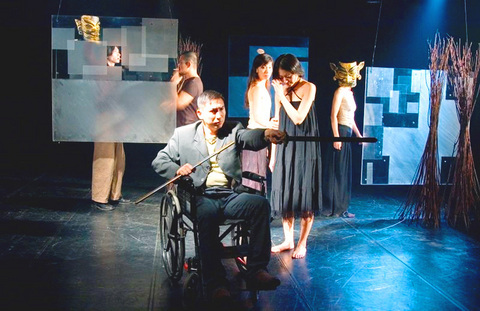
Right after the National Theater of Taiwan approved the idea of producing a play that addressed the sensitive topic of national identity, which affects both Taiwanese and Chinese citizens, Wang and French director Francois-Michel Pesenti of the Theatre Du Point Aveugle organized a meeting in Paris about two years ago to explore the possibility of staging Knock on Heaven's Door.
Subsequently, Wang held auditions in Beijing and conducted negotiations in Shanghai to gain the Chinese authorities' approval.
The play is based on Pesenti's personal observations on the relationship between Taiwan and China over the last 10 years.
Interestingly, the script of the play was adapted from several of Chekov librettos.
The cast consists of nine actors: six Taiwanese and three Chinese.
"Bring[ing] to light what people are trying to hide in society is the duty of a playwright," Pesenti said at a recent press conference.
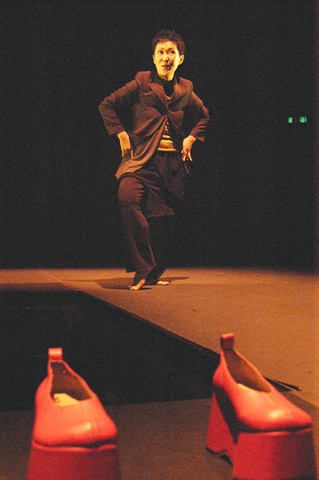
Pesenti first collaborated with local experimental groups for his play 1949: Suppose 6 Were 9 in 1996.
Beginning March 9, The M.O.V.E. Theater Group of Taiwan is set to explore the different values accorded to love and various professions.
For the play Hero Lost, director Fu Hong-cheng (
Fu uses masks in his play that are reminiscent of cultural relics found in Sichuan province, China.
Hero Lost explores the contemporary cultural value of love and seeks to inspire audience members to re-examine what constitutes the personality of heroes.
Through the use of visual effects, the play attempts to connect "realty and [the] abstract,
language and action, and finally form a super realistic modern myth," Fu said.
The Odin Teatret, which will present its new masterpiece Andersen's Dream in late March, won respect in Taiwan on its first visit to the island in 2002.
Teatret's founder Eugenio Barba created one of the world's most famous theatrical institutes, The International School of Theatre Anthropology, to provide extensive training for actors and actresses in body movement and voice control. The play was produced under the guidance of Eugenio Barba last year in commemoration of the bicentenary of Hans Christian Andersen's birth.
The show, filled with live music and human voices, demonstrates the abilities of the Odin Teatret. Nine heavyweight members of the company will come to Taipei to perform on stage together. In addition, the production team is going to transport the audience in a unique way by bringing in a round theater directly from Demark so that local audiences will be able to experience the authentic Odin Teatret.
The Hong Kong-based Theatre Ensemble, led by award-winning leading actress Olivia Yan (
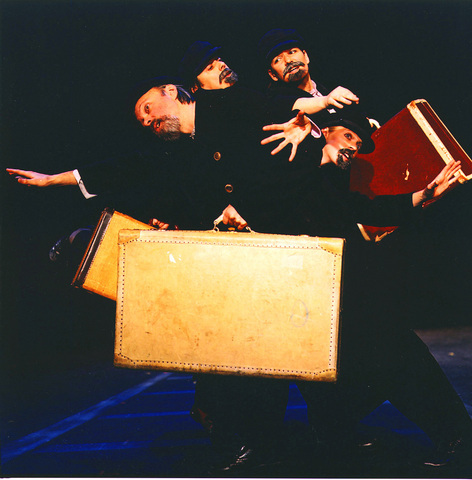
Chekhov's Shorts, presented by the Theatre Smith-Gilmou of Canada in late April, has been adapted from five novels by Anton Chekhov and narrates the bittersweet story of a journey by four travelers on a train to the Russian ice flows.
"With only four performers carrying four briefcases and playing a dozen roles in 105 minutes, they vividly portray the familiar characters with complex emotions that connect each other," the press release said.
The play, centered on one of Chekhov's short stories On the Train and parts of plots from Kashtanka, Man in a Shell, Sleepyhead and Rothchild's Fiddle, will skillfully bring out the very essence and charm of Chekhov's original masterpieces. The troupe was founded in 1980 and has won prestigious awards such as the Dora Award and The Chalmer's Best Canadian Play Award, in its 25-year history.
For detailed performance schedules, visit www.ntch.edu.tw/pro/2006theater. For those interested in attending workshops to meet the directors and producers Francois-Michel Pesenti, Eugenio Barba and Julia Varley, call (02) 3393 9722 for Theatre Du Point Aveugle Workshop and (02)2896 1000, X 3426 for Odin Teatret Workshop.

In late October of 1873 the government of Japan decided against sending a military expedition to Korea to force that nation to open trade relations. Across the government supporters of the expedition resigned immediately. The spectacle of revolt by disaffected samurai began to loom over Japanese politics. In January of 1874 disaffected samurai attacked a senior minister in Tokyo. A month later, a group of pro-Korea expedition and anti-foreign elements from Saga prefecture in Kyushu revolted, driven in part by high food prices stemming from poor harvests. Their leader, according to Edward Drea’s classic Japan’s Imperial Army, was a samurai

The following three paragraphs are just some of what the local Chinese-language press is reporting on breathlessly and following every twist and turn with the eagerness of a soap opera fan. For many English-language readers, it probably comes across as incomprehensibly opaque, so bear with me briefly dear reader: To the surprise of many, former pop singer and Democratic Progressive Party (DPP) ex-lawmaker Yu Tien (余天) of the Taiwan Normal Country Promotion Association (TNCPA) at the last minute dropped out of the running for committee chair of the DPP’s New Taipei City chapter, paving the way for DPP legislator Su

It’s hard to know where to begin with Mark Tovell’s Taiwan: Roads Above the Clouds. Having published a travelogue myself, as well as having contributed to several guidebooks, at first glance Tovell’s book appears to inhabit a middle ground — the kind of hard-to-sell nowheresville publishers detest. Leaf through the pages and you’ll find them suffuse with the purple prose best associated with travel literature: “When the sun is low on a warm, clear morning, and with the heat already rising, we stand at the riverside bike path leading south from Sanxia’s old cobble streets.” Hardly the stuff of your
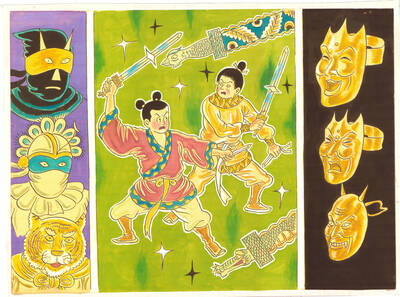
April 22 to April 28 The true identity of the mastermind behind the Demon Gang (魔鬼黨) was undoubtedly on the minds of countless schoolchildren in late 1958. In the days leading up to the big reveal, more than 10,000 guesses were sent to Ta Hwa Publishing Co (大華文化社) for a chance to win prizes. The smash success of the comic series Great Battle Against the Demon Gang (大戰魔鬼黨) came as a surprise to author Yeh Hung-chia (葉宏甲), who had long given up on his dream after being jailed for 10 months in 1947 over political cartoons. Protagonist


 RSS
RSS