


More than 100 years after a British force torched the capital of the old kingdom of Benin and carted off the exquisite Benin Bronzes, an international campaign is being launched for a museum to lure back some of sub-Saharan Africa's lost artistic heritage.
Based in Benin, once the gateway of the slave trade and now one of Africa's most democratic countries, the future Museum of Returned African Art would exhibit a small share of the countless artistic jewels that have disappeared from the region over the past 150 to 200 years.
"We are not accusing anyone of anything and we are not using words like `looting' or anything like that," said Juha Vakkuri, a Finnish author of several works on Africa who chairs African Art Returns, a group he set up to found the museum.

PHOTO: AFP
Through acquisitions of new works and by cooperating with the world's great museums, missionary societies, and private collectors, he hopes to amass a sufficient quantity of works of African art to fill the museum by its completion in 2009 in Grand-Popo, Benin.
The campaign, waged through the Internet, international media and the global network of museums, has as its first goal the acquisition by 2008 of 500 works of art, which would be stored in Finland until displayed.
Private sponsors and the Finnish government are set to finance the US$120,000 operating budget for next year. In future years, the annual budget rises to around US$450,000, half from Nordic governments and half from private sources. The scheme also counts on an acquisition budget of about US$110,000.
Vakkuri, speaking in an interview in Paris while in the initial stages of fund-raising, said he would not be asking top museums to surrender the central works of their African collections.
Instead, institutions may be asked at first to help with training of African museum staff and curators.
Later, they may be asked to produce virtual exhibitions of their collections for display within the museum.
Finally, exhibitions of foreign museums' African collections, long-term loans of art and eventually "the million-dollar question" of property transfers are envisaged.
The central challenge will be gaining trust, Vakkuri said.
Curators must be convinced that the Museum of Returned African Art has the security and technological sophistication to house significant works of art safely and to return them in an undamaged state.
A working group of Finnish and African architects is now being assembled to design the building, Vakkuri said.
In Europe, the enemy of African works of art is the dry museum rooms where some extraordinary wooden pieces are literally cracking apart. In Africa, the museum will have to shut out humidity, which could ruin ancient works of art in metal.
"Now it is time to build a museum in Africa where the pieces will survive," Vakkuri said.
"It is extremely important if one thinks in democratic terms that those Africans who cannot afford to go to Europe or to America have a chance to see their own cultural heritage in Africa." For that reason, the museum will also organize touring exhibitions within Africa.
It is also question of pride for a continent that lost some of its greatest works to pillage, theft and the illicit art trade.
Debate still rages, for example, about the Benin Bronzes, considered by many to be a case that mirrors the Elgin Marbles, the extraordinary collection of marble sculptures removed from the Parthenon in Greece by the orders of Thomas Bruce, Seventh Earl of Elgin, and still housed in the British Museum.
In 1897, Admiral Sir Harry Rawson led a "punitive expedition" against the Kingdom of Benin as a reprisal for the killing of eight British representatives.
Benin City, capital of that empire lying in what is now southwestern Nigeria, was conquered and burned. Its art, much of it adorning a stunning royal palace, was destroyed or dispersed.
The Benin Bronzes, portrait figures, busts and depictions of animals, humans and royal court life created in iron, carved ivory and brass, were seized and given to the British Foreign Office.
Two hundred were transferred to the British Museum and many other hundreds spread to collections around the world as London auctioned them off to pay the costs of the expedition.
The humiliation of the fall of Benin was intense. According to some accounts, the king, Oba Ovonramwen, was forced to kneel and eat dust before the British military resident.
Nigeria bought back about 50 of the Benin Bronzes in the 1950s, 1960s and 1970s and has called in vain for the return of the remainder.
Ironically, the dispersal of the Benin Bronzes also shattered the European concept of African art as a relatively elementary form of tribal craft, not on the same level as Western art.
The definition of art in Africa still poses a challenge.
"None of the older stuff produced in Africa was called art," said Vakkuri, who expects to get some examples of the Benin Bronzes for the museum.
"It was not exhibited or used as a work of art. It had a religious function. It had a philosophical function. It had a magical function. And still, it is so incredibly beautiful and crafted that it is art."

In late October of 1873 the government of Japan decided against sending a military expedition to Korea to force that nation to open trade relations. Across the government supporters of the expedition resigned immediately. The spectacle of revolt by disaffected samurai began to loom over Japanese politics. In January of 1874 disaffected samurai attacked a senior minister in Tokyo. A month later, a group of pro-Korea expedition and anti-foreign elements from Saga prefecture in Kyushu revolted, driven in part by high food prices stemming from poor harvests. Their leader, according to Edward Drea’s classic Japan’s Imperial Army, was a samurai

The following three paragraphs are just some of what the local Chinese-language press is reporting on breathlessly and following every twist and turn with the eagerness of a soap opera fan. For many English-language readers, it probably comes across as incomprehensibly opaque, so bear with me briefly dear reader: To the surprise of many, former pop singer and Democratic Progressive Party (DPP) ex-lawmaker Yu Tien (余天) of the Taiwan Normal Country Promotion Association (TNCPA) at the last minute dropped out of the running for committee chair of the DPP’s New Taipei City chapter, paving the way for DPP legislator Su
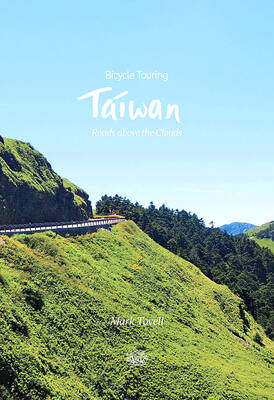
It’s hard to know where to begin with Mark Tovell’s Taiwan: Roads Above the Clouds. Having published a travelogue myself, as well as having contributed to several guidebooks, at first glance Tovell’s book appears to inhabit a middle ground — the kind of hard-to-sell nowheresville publishers detest. Leaf through the pages and you’ll find them suffuse with the purple prose best associated with travel literature: “When the sun is low on a warm, clear morning, and with the heat already rising, we stand at the riverside bike path leading south from Sanxia’s old cobble streets.” Hardly the stuff of your
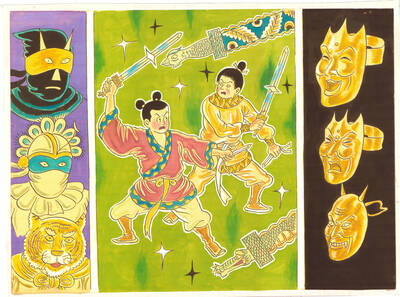
April 22 to April 28 The true identity of the mastermind behind the Demon Gang (魔鬼黨) was undoubtedly on the minds of countless schoolchildren in late 1958. In the days leading up to the big reveal, more than 10,000 guesses were sent to Ta Hwa Publishing Co (大華文化社) for a chance to win prizes. The smash success of the comic series Great Battle Against the Demon Gang (大戰魔鬼黨) came as a surprise to author Yeh Hung-chia (葉宏甲), who had long given up on his dream after being jailed for 10 months in 1947 over political cartoons. Protagonist


 RSS
RSS