


Michael San Jule-Robinson not only knows what his technology does for him, he's quite aware of what it says about him: Environmentally conscious. Efficient. Hip.
His silver Toyota Prius makes an immediate statement, he said, unlike Honda's hybrids, which don't look much different from other Hondas.
As he quietly zips along Denver streets, San Jule-Robinson, an Army veteran stationed for two years in Israel and Egypt, says his auto choice essentially shouts that Americans' wasteful energy consumption damages the environment and keeps the nation hooked on foreign oil and embroiled in all the nasty politics that come with it.
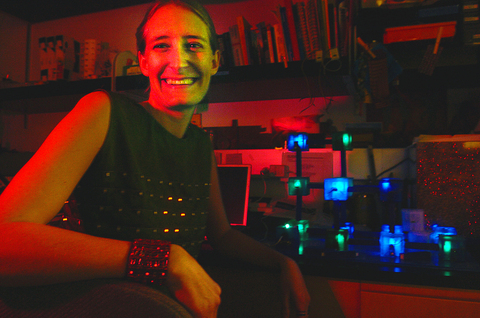
PHOTO: NY TIMES NEWS SERVICE
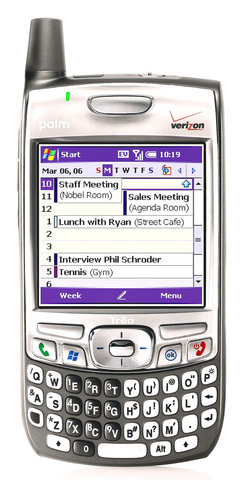
Then there's his Treo -- a small, sleek gadget almost always clipped to his belt. It's a phone, camera, digital calendar and center for instant messaging and e-mail rolled into one. "It speaks to my efficiency," he said.
What about the Bluetooth headset San Jule-Robinson, 38, keeps perched in his ear to have hands-free phone conversations? "People can see I'm on the cutting edge of technology," he said.
And the jazz ringtone on his phone?
"All of this technology might make me look uptight, but I'm really laid-back," San Jule-Robinson said with a hearty laugh.
With the same care that people have chosen their wardrobes and household furnishings for millennia, they're increasingly using technology as a means of personal expression -- deliverance, if you will, from mainstream to "mystream."
The intersection of tech and fashion is pushing individual style into new realms, giving rise to new fields of research and retailers that sell the tech lifestyle.
Even paragons of fashion and humdrum appliance makers are in on the chic techie act. Coach and Kate Spade sell mobile phone covers. Levis recently unveiled a new brand of jeans with special pockets to accommodate an iPod. Kenmore offers boldly colored clothes dryers that shut themselves off when they sense a load is dry.
"Sedona is about making a bold statement," a Kenmore advertisement for the orangey dryer states. "This fiery hot color transforms a mundane chore into a chance to flaunt your individuality."
Tech and fashion were bound to collide -- and did so for three chief reasons, according to Michael Gartenberg, vice president and research director of JupiterResearch, a division of Jupitermedia Corp, based in Darien, Connecticut.
First, as the importance of a machine's features has been lost on consumers, companies have had to come up with other ways to stand out in a crowd.
Second, the markup on computer accessories -- such as those stylish carrying cases and plug-ins that convert a phone into a camera -- is huge compared with the markup on computers themselves.
And third, mature markets tend to fragment -- as evidenced by hundreds of brands of toothpaste that all do the same thing.
"Don't forget that it's ingrained in Americans to express their individuality," said Matt Swanston, director of emerging technologies for the Consumer Electronics Association. "In some ways, it's now the challenge (of tech makers) to keep up with that insatiable desire to be different."
Case in point: mobile phone ringtones. Last year, nearly 25 percent of American mobile phone users -- that's about 30 million people -- replaced the generic ringtone manufacturers programmed into their devices (hip-hop tunes were the most popular ringtones last year for those keeping track).
But many people who have spent as much as US$2.50 for a ringtone balk at the notion of paying the same price to download the entire song.
A contradiction? Not necessarily, Gartenberg recently said in a blog. "One's for personalization, and one is about entertainment," he wrote. "Different things with different value propositions."
The melding of tech and fashion also has spawned plenty of geek-chic retailers, such as X-TremeGeek.com. The company peddles slippers embedded with small lights to illuminate dark hallways and blue lights for faucets that "turn water into something cool, like an ionized plasma stream!"
A whirl around the Web also turns up boxer shorts emblazoned with computer error messages and doormats stating that there's no place like a specific IP address.
"We're used to seeing all of this stuff for hunters and gearheads, and it's just the computer guys' turn," Swanston said. "We laughed at them in high school, but not anymore. They're the epitome of cool."
Leah Buechley, a doctoral candidate in computer science at the University of Colorado at Boulder, will take that as a compliment.
Her research focuses in part on wearable computing -- and her Web site provides step-by-step instructions on how to sew a tank top embedded with LED lights that change colors.
She also has embedded circuitry into jewelry and, with help from other scholars, devised an electronic form of quilting that allows fabric squares to be "snapped together to generate a variety of ... flows of light."
She envisions the day when people will be able to change the color of their shirts or bedspreads to reflect their moods.
"All of this leads to the greater personalization that people are so hungry for," she said. "Artistic and scientific engineering concerns have never seemed that far apart to me. It takes similar creativity to innovate in design and technology."

In late October of 1873 the government of Japan decided against sending a military expedition to Korea to force that nation to open trade relations. Across the government supporters of the expedition resigned immediately. The spectacle of revolt by disaffected samurai began to loom over Japanese politics. In January of 1874 disaffected samurai attacked a senior minister in Tokyo. A month later, a group of pro-Korea expedition and anti-foreign elements from Saga prefecture in Kyushu revolted, driven in part by high food prices stemming from poor harvests. Their leader, according to Edward Drea’s classic Japan’s Imperial Army, was a samurai

The following three paragraphs are just some of what the local Chinese-language press is reporting on breathlessly and following every twist and turn with the eagerness of a soap opera fan. For many English-language readers, it probably comes across as incomprehensibly opaque, so bear with me briefly dear reader: To the surprise of many, former pop singer and Democratic Progressive Party (DPP) ex-lawmaker Yu Tien (余天) of the Taiwan Normal Country Promotion Association (TNCPA) at the last minute dropped out of the running for committee chair of the DPP’s New Taipei City chapter, paving the way for DPP legislator Su

It’s hard to know where to begin with Mark Tovell’s Taiwan: Roads Above the Clouds. Having published a travelogue myself, as well as having contributed to several guidebooks, at first glance Tovell’s book appears to inhabit a middle ground — the kind of hard-to-sell nowheresville publishers detest. Leaf through the pages and you’ll find them suffuse with the purple prose best associated with travel literature: “When the sun is low on a warm, clear morning, and with the heat already rising, we stand at the riverside bike path leading south from Sanxia’s old cobble streets.” Hardly the stuff of your
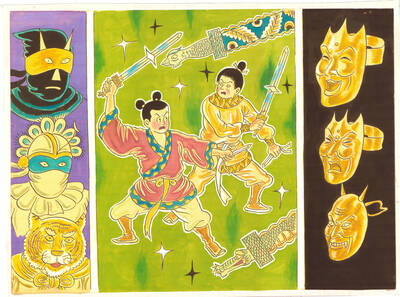
April 22 to April 28 The true identity of the mastermind behind the Demon Gang (魔鬼黨) was undoubtedly on the minds of countless schoolchildren in late 1958. In the days leading up to the big reveal, more than 10,000 guesses were sent to Ta Hwa Publishing Co (大華文化社) for a chance to win prizes. The smash success of the comic series Great Battle Against the Demon Gang (大戰魔鬼黨) came as a surprise to author Yeh Hung-chia (葉宏甲), who had long given up on his dream after being jailed for 10 months in 1947 over political cartoons. Protagonist


 RSS
RSS