


One day in 1527, Paracelsus let it be known that he would reveal the greatest secret of medicine to the inhabitants of Basle. The esteemed doctors and academics of the university, dressed in their rich robes and fur hats, gathered to hear his words of wisdom. Secretly they hoped the roving physician and alchemist would make a fool of himself -- already they could feel the warm glow of Schadenfreude.
In his hands he bore the great secret -- a dish which he held aloft for all the learned company to see. It contained "steaming human excrement." As the outraged audience hurried away in disgust, Paracelsus's words echoed after them: "If you will not hear the mysteries of putrefactive fermentation, you are unworthy of the name of physicians!"
He did indeed believe that the essential truth of alchemy was expressed in the axiom "decay is the beginning of all birth."
Confronting his enemies with "a bowl of shit" carried a less esoteric but equally eloquent message.
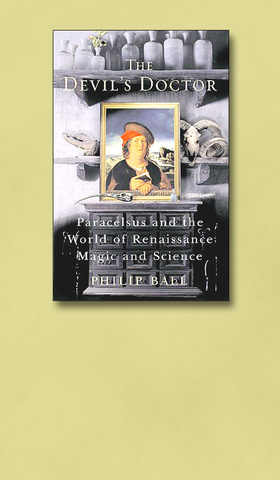
This memorable anecdote is told by Philip Ball in his wonderfully rich biography, and it is revealing of both Paracelsus's character and his ideas. His stay in Basle had started out well. Many students had attended his unofficial courses. He told them that doctors didn't need "eloquence or knowledge of language and books," but "profound knowledge of Nature and her works."
But wherever he lived, it was not long before this fiery iconoclast began ruffling feathers. According to Carl Jung, "Paracelsus was a little too sure that he had his enemy in front of him, and did not notice that it was lodged in his own bosom."
To his enemies, Paracelsus was the "forest-ass of Einsiedeln." Theophrastus Bombast von Hohenheim was born in 1493 in Einsiedeln, Switzerland, and died in Salzburg in 1541. Afterwards the rumor persisted that he had risen from the dead. His father had been a physician from Swabia in Germany. Theophrastus's experiences at universities such as Freiburg and Heidelberg taught him that he was not born to live in an ivory tower. How is it, he asked, that "the higher colleges managed to produce so many high asses?"
Medicine in the early Renai-ssance had advanced little since Roman times. For instance, physi-cians did not think it necessary to examine patients, relying instead on a urine sample for diagnosis.
"All they can do is to gaze at piss," said Paracelsus scornfully. He accused them of "villainy and knavery" and said that if people realized how they were being deceived, medics would be stoned in the street. They, in turn, accused him of drunkenness.
His written works, most of which were only published posthumously, could be "para-noid, repetitive, vain and self-aggrandising." But beneath the bluster and posturing were genuine insights.
Paracelsus turned his back on Aristotle and Galen and embraced experience as his mentor. He taught that "every land is a leaf of the Codex of Nature, and he who would explore her must tread her books with his feet." Paracelsus brought "a new, questing spirit" to natural philosophy. He investi-gated the plague at considerable risk to himself, devised a "chemical diagnosis of madness" and, although celibate, wrote about "the diseases of women" at a time when medics turned a blind eye to their suffering.
This militant medic, whom his opponents accused of being "the Luther of physicians" engaged in a life-long battle against academic doctors who learnt their medicine from dusty tomes rather than practical experience. His book of medical alchemy, Archidoxa ("Arch-Wisdom"), is a "physician's cookbook of remedies". In it he moves towards modern chemotherapy, using chemicals to treat illness rather than attempting to rebalance the body's humors according to ancient and defunct Galenic principles.
For Paracelsus, alchemy was not merely about the creation of gold, but was a medical and mystical philosophy that explained the functioning of the body (the transformation of food into flesh, blood and excrement) as well as the more general principles that revealed the mysteries of the earth.
He was an intellectual vagabond: a pacifist who always carried a great broadsword by his side, even in bed, and a footloose intellectual who traveled from Ireland to Moscow, and from Algiers to Uppsala.
Yet writers from Blake to Borges have been captivated by his words, and he has become "a cipher for arcane and occult knowledge."
Ball succeeds in convincing us that, despite his arcane ideas, his vision of the "strangeness and the beauty of the magical universe" remains both inspiring and important. As Paracelsus himself wrote, "it is a divine gift to investigate in the light of Nature."

In late October of 1873 the government of Japan decided against sending a military expedition to Korea to force that nation to open trade relations. Across the government supporters of the expedition resigned immediately. The spectacle of revolt by disaffected samurai began to loom over Japanese politics. In January of 1874 disaffected samurai attacked a senior minister in Tokyo. A month later, a group of pro-Korea expedition and anti-foreign elements from Saga prefecture in Kyushu revolted, driven in part by high food prices stemming from poor harvests. Their leader, according to Edward Drea’s classic Japan’s Imperial Army, was a samurai

The following three paragraphs are just some of what the local Chinese-language press is reporting on breathlessly and following every twist and turn with the eagerness of a soap opera fan. For many English-language readers, it probably comes across as incomprehensibly opaque, so bear with me briefly dear reader: To the surprise of many, former pop singer and Democratic Progressive Party (DPP) ex-lawmaker Yu Tien (余天) of the Taiwan Normal Country Promotion Association (TNCPA) at the last minute dropped out of the running for committee chair of the DPP’s New Taipei City chapter, paving the way for DPP legislator Su
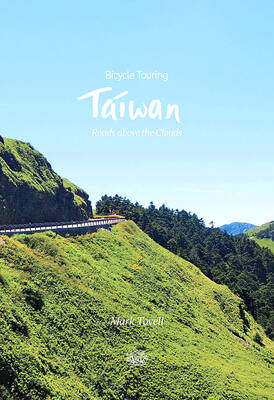
It’s hard to know where to begin with Mark Tovell’s Taiwan: Roads Above the Clouds. Having published a travelogue myself, as well as having contributed to several guidebooks, at first glance Tovell’s book appears to inhabit a middle ground — the kind of hard-to-sell nowheresville publishers detest. Leaf through the pages and you’ll find them suffuse with the purple prose best associated with travel literature: “When the sun is low on a warm, clear morning, and with the heat already rising, we stand at the riverside bike path leading south from Sanxia’s old cobble streets.” Hardly the stuff of your
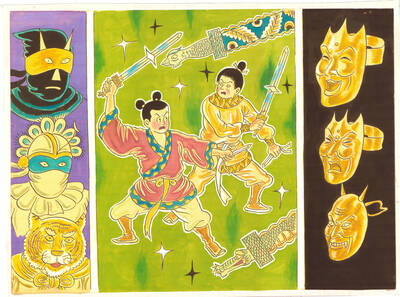
April 22 to April 28 The true identity of the mastermind behind the Demon Gang (魔鬼黨) was undoubtedly on the minds of countless schoolchildren in late 1958. In the days leading up to the big reveal, more than 10,000 guesses were sent to Ta Hwa Publishing Co (大華文化社) for a chance to win prizes. The smash success of the comic series Great Battle Against the Demon Gang (大戰魔鬼黨) came as a surprise to author Yeh Hung-chia (葉宏甲), who had long given up on his dream after being jailed for 10 months in 1947 over political cartoons. Protagonist


 RSS
RSS