


It is not every day that a concept car rewrites the rules of more than 100 years of motoring. In development for four years by a team of architects and engineers led by William Mitchell, former head of the school of architecture at the Massachusetts Institute of Technology (MIT), as part of his Smart Cities research group, a new MIT car is borne of a complete rethink of people's relationship with their cars in the ever-expanding cities of the future.
Mitchell expects we will share cars that will be easier to drive in congested cities, will be pollution-free and can be customized at will.
The city car concept, with styling input by architect Frank Gehry, will be completed and delivered by MIT to General Motors early next year.
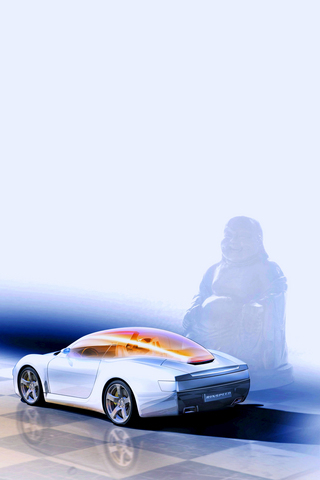
"Primarily we're interested in urban living," said Ryan Chin, an architect and engineer at MIT's media lab and a member of Mitchell's research group."Everything scales down from what we think the city of the future is."
The Smart Cities group focused on how cars could be better adapted to get round familiar problems of city life, namely congestion, pollution and parking. Motor companies are well aware of the issue.
But the group felt the companies had missed the point, even with city cars such as the Smart, the iconic two-passenger cars introduced by Swatch and Mercedes in 1998.
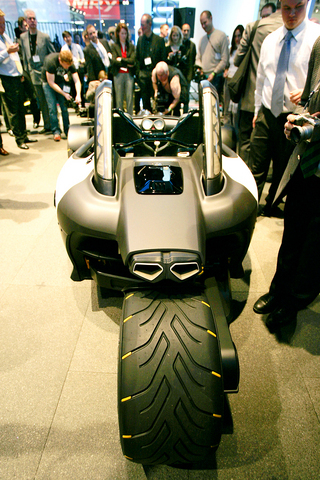
PHOTO: AP
"We have to think of city cars as not just small-footprint vehicles that can squeeze into tight spaces but ones that can work in unison and also be almost like a parasite that leeches on to mass-transit systems," Chin said.
While Smart changed the way people think about parking and size, the MIT engineers felt that, as it had not been widely adopted and congestion and pollution problems had got no better, its success had been limited.
So the MIT team started from scratch to come up with their own concept: a stackable, shareable, electric, two-passenger car.
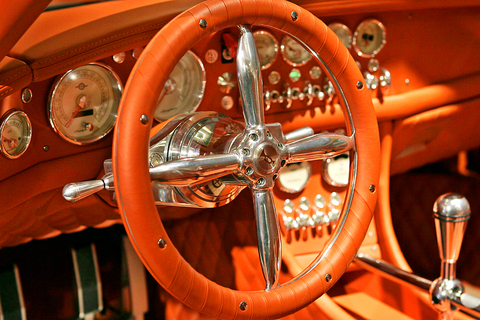
PHOTO:AP
"Imagine a shopping cart -- a vehicle that can stack -- you can take the first vehicle out of a stack and off you go," Chin said. "These stacks would be placed throughout the city. A good place would be outside a subway station or a bus line or an airport, places where there's a convergence of transportation lines and people."
The precedent for this type of shared personal transport is demonstrated with bicycle-sharing schemes in European towns and the ZipCar and FlexCar projects on the east and west coasts of the US respectively.
The MIT concept car is a complete rethink of vehicle technology. For a start, there is no engine, at least in the traditional sense. The power comes from devices called wheel robots.
"These are self-contained wheel units that have electric motors inside," Chin said. "The interesting thing is that the wheel can turn a full 360 degrees so you can have omni-directional wheel movements. You can rotate the car while you're moving, any direction can be front or back and you can do things like crabbing or translate sideways. It's almost like you imagine yourself driving a computer chair."
The wheel robots, complete with their own suspension, remove the need for a drive shaft and even the engine block, freeing up designers to make new use of the space in the car.
"Essentially the car will comprise four wheel-robots plus a customizable chassis," Chin said. "The frame can be built specifically for each customer."
Add wafer-thin, programmable displays that cover the interior and exterior of the car like a layer of paint, and you have a vehicle that can be customized at will.
"You can imagine signalling being not just a static signal light but something more dynamic," said Chin, who suggests the words "reversing" or "turning left" could roll across the car's body to declare the driver's intentions. "From a heating and cooling point of view, you might want your car to be darker or lighter depending on weather. On the interior, you can customize your dashboard for each person. If I'm an elderly person, I probably want a very large speedometer so I can see it; if I'm a race-car driver, maybe all I want is a tachometer."
The close proximity of cars in cities increases the risk of accidents, and the MIT car has a host of radical ideas to deal with this problem. Chief safety features include responsive seats that do away with the need for seat belts and air bags: these are based around a spine at the back of the seat with a number of "fingers" to embrace a passenger and hold them in place if the car detects that it is involved in an accident. And the cabin would absorb the impacts of crashes using new materials.
"There is a new development in fluids that can be magnetized so that they move from liquid to solid state within a nanosecond. You can imagine using these fluids as a way of absorbing energy in an impact," Chin said.
Over the next few months the MIT team will complete the final design and present their results to General Motors, which will build the first prototype. Beyond that, Chin is already trying to arrange a public test in the Far East.
"We might do this in Hong Kong or in Singapore," he said. "The interest in those places is that they are very dense, have mass transit and limited range. An island like Hong Kong would be a perfect place to test this because you have all those conditions."
Whether the city car concept appears on garage forecourts as designed by the Smart Cities group or whether the technologies are taken forward individually remains to be seen. Chin says the group would be happy with either outcome.
Last week, Viola Zhou published a marvelous deep dive into the culture clash between Taiwanese boss mentality and American labor practices at the Taiwan Semiconductor (TSMC) plant in Arizona in Rest of World. “The American engineers complained of rigid, counterproductive hierarchies at the company,” while the Taiwanese said American workers aren’t dedicated. The article is a delight, but what it is depicting is the clash between a work culture that offers employee autonomy and at least nods at work-life balance, and one that runs on hierarchical discipline enforced by chickenshit. And it runs on chickenshit because chickenshit is a cultural
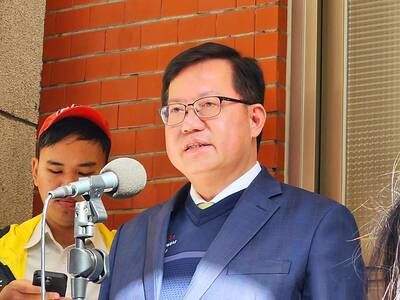
By far the most jarring of the new appointments for the incoming administration is that of Tseng Wen-tsan (鄭文燦) to head the Straits Exchange Foundation (SEF). That is a huge demotion for one of the most powerful figures in the Democratic Progressive Party (DPP). Tseng has one of the most impressive resumes in the party. He was very active during the Wild Lily Movement and his generation is now the one taking power. He has served in many of the requisite government, party and elected positions to build out a solid political profile. Elected as mayor of Taoyuan as part of the
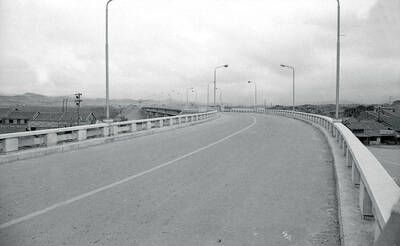
April 29 to May 5 One month before the Taipei-Keelung New Road (北基新路) was set to open, the news that US general Douglas MacArthur had died, reached Taiwan. The military leader saw Taiwan as an “unsinkable aircraft carrier” that was of huge strategic value to the US. He’d been a proponent of keeping it out of Chinese Communist Party (CCP) hands. Coupled with the fact that the US had funded more than 50 percent of the road’s construction costs, the authorities at the last minute renamed it the MacArthur Thruway (麥帥公路) for his “great contributions to the free world and deep
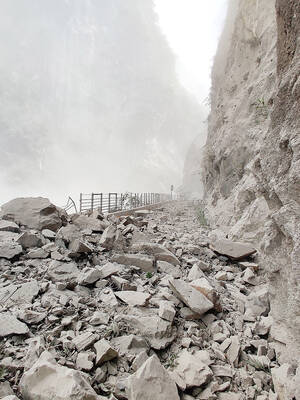
Moritz Mieg, 22, lay face down in the rubble, the ground shaking violently beneath him. Boulders crashed down around him, some stones hitting his back. “I just hoped that it would be one big hit and over, because I did not want to be hit nearly to death and then have to slowly die,” the student from Germany tells Taipei Times. MORNING WALK Early on April 3, Mieg set out on a scenic hike through Taroko Gorge in Hualien County (花蓮). It was a fine day for it. Little did he know that the complex intersection of tectonic plates Taiwan sits


 RSS
RSS