


At the beginning of her Harvard biochemistry class, Debrah Rud proudly told her students that her year-old son was sporting his first haircut. At the end of class one recent afternoon, she warned that if anyone failed to tell her where to return the last homework assignment, "it will just get lost in my apartment and Jack will color on it."
Then, in the elevator with three freshmen, Rud burst out excitedly, "I have to go pick up my little man!" The three younger women exclaimed in adoring unison, "Aw!"
As a graduate student at Harvard University and also a mother, Rud hopes to inspire female undergraduates to pursue both a career in science and a family. The trouble is, she's still figuring out if she herself can have both.
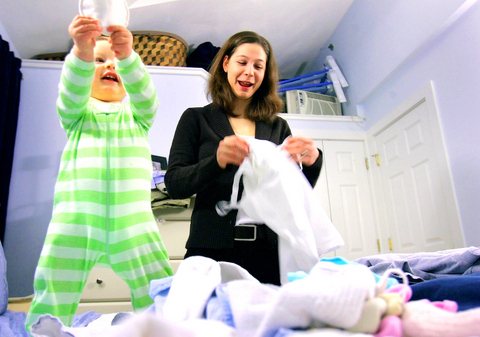
PHOTOS: NY TIMES
Rud nearly dropped out of her doctorate program after she gave birth, and she still fears that her family would suffer if she devoted herself to an academic research career.
The career choices of young women like Rud will to a great extent determine whether their generation will approach equality with men in university science departments.
In Rud's field, biology, women are 46 percent of the doctorate recipients from the nation's top 50 biology departments. But they make up only 30 percent of assistant professors and 15 percent of full professors. A similar "leaky pipeline" is seen in other sciences, as well. A sizable number of the women who train in the sciences never enter the academic profession -- and the desire for more family time is a major reason.

A rare breed
"I don't know how many tenured female professors there are who have children and are a really big part of their children's lives," said Rud, 27. "I don't know of any who go to soccer games and sometimes pick up their kids from school. I don't need to be there for all of it -- frankly it's a little mind-numbing -- but I want to be there for some of it."
Rud is a little unusual in having given birth to her first child in graduate school, but her soul-searching was echoed by more than two dozen other young female scientists in interviews with the Globe. Many of them are preoccupied with the question of whether to stay in academia at all, or whether to settle for less prestigious instructor positions.
These women, most of them studying in the booming field of life sciences, often describe working in laboratories where women are a robust minority, or even a majority, of graduate students and post-doctoral fellows. Few of them say they have experienced much discrimination. The primary barrier, they say, is the conflict between lab and family under the grueling demands of today's academic culture.
Career barriers
While it was Harvard president Lawrence Summers' suggestion last January that women lack the same "intrinsic aptitude" for science as men that drew international attention, Summers also cited "the high-powered job hypothesis" as the biggest obstacle to women's advancement.
"A large part of what is observed," he said, is women in their mid-20s deciding "that they don't want to have a job that they think about 80 hours a week."
Princeton University president Shirley Tilghman, a molecular biologist, has spoken about how in her field, women are nearly half of new doctorate recipients, but only a quarter of faculty job applicants at top-tier universities.
"It does not take much imagination to recognize that the drop coincides with prime child-bearing years," Tilghman said in a speech this year at Columbia University.
The typical scientist is 32 by the time he or she earns a doctorate. In most cases in the life sciences, graduates then have to spend several more years as low-paid postdoctoral fellows, or "postdocs," before getting their first academic jobs.
In a 2000 survey of University of California at Berkeley postdocs, most of whom were scientists, 60 percent of married women with children said they were considering leaving academia.
Rud's adviser, James DeCaprio, said few of the graduate students and postdocs he has trained, male or female, have gone on to academic research positions. Those who have made it tend to work about 70 hours a week. The rest end up choosing business or law school, the pharmaceutical industry, or teaching in less prestigious positions.
"If you work 80 hours a week, you will be twice as successful" than if you work 40 hours, he said, explaining that more hours translates directly into more experiments, and more discoveries. "They move the science along faster than the competition."
DeCaprio called Rud smart and creative, and said she has "as good a chance as anybody to be extraordinarily successful." What happens will depend mostly on how many hours she is able, or willing, to put in at her bench.
Raised in Pasadena, California, by a single mother, Rud always knew she wanted children. Her love for science came later. Today, Rud gushes about the elegance of biological systems -- how clever viruses are, for example. "It's like an art critic discussing a work of art," said her husband, Ryan Rud, an English teacher at English High School in Boston.
Female role model
Debrah Rud's mentors have mostly been male, but she credits a woman with inspiring her to consider a science career. In college at the University of California at Los Angeles, she signed up for a chemistry class taught by "E.A. Carter," and was taken aback when a stylish woman showed up to teach. She was doubly impressed when she found out Emily Carter was a mother. "I could identify with her, as opposed to the scientist in the lab coat with goggles and exploding beakers," Rud said.
Still, like many of her peers, Rud found herself in graduate school uncertain about what she wanted to do with her life, except that she and her husband wanted to start their family early.
Her pregnancy brought her confusion to the boiling point. She worried about the hours it would take to succeed -- hours away from her family.
At the same time, she wasn't sure if she loved the repetitive work at the lab bench, altering the salt levels in experiments, for example. And she couldn't imagine taking a job in a pharmaceutical company lab, where she'd have better hours but feel like "a drone."

In late October of 1873 the government of Japan decided against sending a military expedition to Korea to force that nation to open trade relations. Across the government supporters of the expedition resigned immediately. The spectacle of revolt by disaffected samurai began to loom over Japanese politics. In January of 1874 disaffected samurai attacked a senior minister in Tokyo. A month later, a group of pro-Korea expedition and anti-foreign elements from Saga prefecture in Kyushu revolted, driven in part by high food prices stemming from poor harvests. Their leader, according to Edward Drea’s classic Japan’s Imperial Army, was a samurai

The following three paragraphs are just some of what the local Chinese-language press is reporting on breathlessly and following every twist and turn with the eagerness of a soap opera fan. For many English-language readers, it probably comes across as incomprehensibly opaque, so bear with me briefly dear reader: To the surprise of many, former pop singer and Democratic Progressive Party (DPP) ex-lawmaker Yu Tien (余天) of the Taiwan Normal Country Promotion Association (TNCPA) at the last minute dropped out of the running for committee chair of the DPP’s New Taipei City chapter, paving the way for DPP legislator Su

It’s hard to know where to begin with Mark Tovell’s Taiwan: Roads Above the Clouds. Having published a travelogue myself, as well as having contributed to several guidebooks, at first glance Tovell’s book appears to inhabit a middle ground — the kind of hard-to-sell nowheresville publishers detest. Leaf through the pages and you’ll find them suffuse with the purple prose best associated with travel literature: “When the sun is low on a warm, clear morning, and with the heat already rising, we stand at the riverside bike path leading south from Sanxia’s old cobble streets.” Hardly the stuff of your

April 22 to April 28 The true identity of the mastermind behind the Demon Gang (魔鬼黨) was undoubtedly on the minds of countless schoolchildren in late 1958. In the days leading up to the big reveal, more than 10,000 guesses were sent to Ta Hwa Publishing Co (大華文化社) for a chance to win prizes. The smash success of the comic series Great Battle Against the Demon Gang (大戰魔鬼黨) came as a surprise to author Yeh Hung-chia (葉宏甲), who had long given up on his dream after being jailed for 10 months in 1947 over political cartoons. Protagonist


 RSS
RSS