


In 1959, Dave Brubeck was the first artist to sell 1 million copies of a jazz instrumental. He was on the cover of Time magazine and played in front of presidents and popes. Take Five is still one of the world's best known jazz tracks, and Brubeck, who turns 85 this month, is still composing and touring.
Yet Brubeck continues to be more interested in the present and the future than many of his fans. He's still between the rock and the hard place he's occupied for most of his five-decade career. When the wiry, donnish, California-born jazz pianist played Portsmouth in 2003 on one of his endless world tours, he took one look at the sea of white hair in his audience and threw half his new tunes off the set-list. He's never stopped composing, but those old hits are what his audiences expect.
That's how it's been since his catchily tricksy jazz instrumentals perched alongside Ben E. King and the Everly Brothers in the pop charts of the early 1960s.
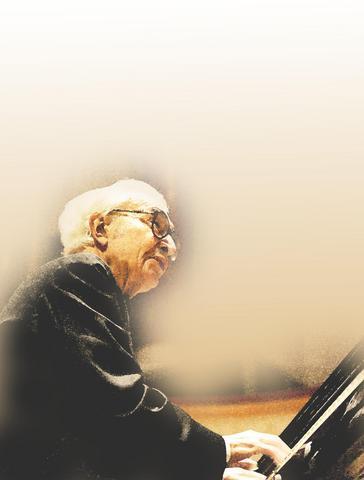
Since then, the classically-influenced Brubeck has written for choirs and symphony orchestras, for ballets and chamber groups, for his own long-running quartet and the ensemble featuring his three sons that gets together for high days and holidays.
Take Five has found its way into movies like Mighty Aphrodite, Pleasantville and Constantine, and into the aural wallpaper of restaurants and elevators everywhere -- but it still sounds playfully fresh, turning the remarkable trick of swinging freely despite a treacherous metre.
Composed by Brubeck's then saxophonist Paul Desmond, Take Five was the triumph among a remarkable group of instrumentals the Brubeck group recorded at the height of its stardom between 1958 and 1967. They featured unconventional rhythms (Take Five was in 5/4, Blue Rondo a La Turk in 9/8), coolly jazzy, smoky-sax melody, percussively emphatic piano-playing, and often a smattering of classical borrowings.
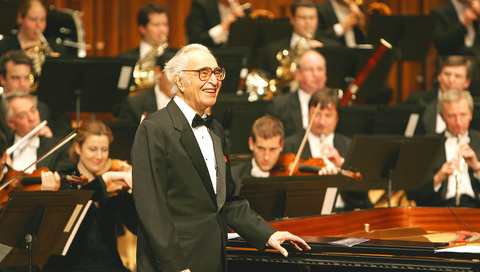
PHOTO: AP
But Brubeck's journey had its hitches. Some jazz diehards loathed his music for its apparent betrayal of jazz's bluesy roots, and for what they saw as dilettantist flattery of an aspirational audience in its classical references.
Posterity, however, has decreed that Brubeck today stands alongside Sonny Rollins, Ornette Coleman, Cecil Taylor and a handful of others as fully functioning practi-tioners who several generations of listeners now realize made a difference. With the heat of the jazz-versus-class-ical battle long subsided, Brubeck's best pieces are now widely acclaimed for their originality and openness to many genres and cultures.
Brubeck grew up on a California ranch, learned classical piano from his mother, and switched from veterinarian studies to music after his first college year. The College of the Pacific's music faculty thought he was gifted, but so bad at sight- reading that, before they'd give him a degree, they made him promise never to teach music.

PHOTO: EPA
A conscientious objector in the second world war, he was given an army band to run instead, studied with the classical composer Darius Milhaud, and founded his first quartet in 1951 -- with a young alto saxophonist called Paul Desmond, whose playing sounded like a soft whisper. A mid-1950s album, Jazz Goes to College, sold over 100,000 copies and made Brubeck the first jazz musician to be featured on the cover of Time.
Driven by Joe Morello, a phenomenal polyrhythmic drummer who seemed to have a separate brain operating each one of his limbs (Take Five had been spawned by one of his practice routines) the Brubeck group made complex rhythms and classical devices, like the rondo and the fugue, its trademark. The album Time Out, released in 1959, was a huge seller and the group globe-trotted for a decade, not splitting until 1967. Brubeck's awards, citations and concerts for world leaders (he even played the 1988 Reagan-Gorbachev Moscow summit) became too numerous to count.
Long interested in large-scale composition, Brubeck uncorked a torrent of masses, cantatas and jazz/classical crossovers.
The second-generation of Brubecks also join the patriarch on jazz sets.
Darius Brubeck, a jazz teacher, composer and performer, recalls a conversation he had with the musicologist Gunther Schuller, who championed the work of radicals like Ornette Coleman and George Russell, and coined the term "third stream" in the 1950s to describe crossovers of classical music and jazz.
"Schuller said you don't hear the term `third stream' used any more," Darius said. "Because now it's everywhere. It's not a style, but a skill-set -- it just means musicians who have the flexibility to play outside specific idioms. "Dave was controversial from the standpoint that people wanted to stick to a certain type of narrative about jazz, and what he was doing contradicted it."
London Symphony Orchestra musicians Gerald Newson and Maurice Murphy, both of whom have worked extensively with Brubeck senior, confirm that transition and Brubeck's part in it.
"He was one of those who put jazz on the concert platform, and encouraged musicians from different disciplines to work together," Newson said.
Murphy, the orchestra's principal trumpeter, said: "Freelance sessions these days are likely to have two jazzers and two straight players in the trumpet section, not all classical. We learn from each other, and there's a total mutual respect. I think Brubeck has had a lot to do with that over the years, he makes different styles blend wonderfully."
But why, at 85, does Brubeck stay on the roundabout of hotel rooms and departure lounges, when he could be taking in the view from his studio window in Connecticut?
"In jazz, if you don't have a working group, you can't improvise," Darius Brubeck said. "Then what you do just becomes your act. So that's a stark choice for him. Not going on the road means you don't play jazz, and he doesn't want to give that up."

Sept.16 to Sept. 22 The “anti-communist train” with then-president Chiang Kai-shek’s (蔣介石) face plastered on the engine puffed along the “sugar railway” (糖業鐵路) in May 1955, drawing enthusiastic crowds at 103 stops covering nearly 1,200km. An estimated 1.58 million spectators were treated to propaganda films, plays and received free sugar products. By this time, the state-run Taiwan Sugar Corporation (台糖, Taisugar) had managed to connect the previously separate east-west lines established by Japanese-era sugar factories, allowing the anti-communist train to travel easily from Taichung to Pingtung’s Donggang Township (東港). Last Sunday’s feature (Taiwan in Time: The sugar express) covered the inauguration of the

The corruption cases surrounding former Taipei Mayor and Taiwan People’s Party (TPP) head Ko Wen-je (柯文哲) are just one item in the endless cycle of noise and fuss obscuring Taiwan’s deep and urgent structural and social problems. Even the case itself, as James Baron observed in an excellent piece at the Diplomat last week, is only one manifestation of the greater problem of deep-rooted corruption in land development. Last week the government announced a program to permit 25,000 foreign university students, primarily from the Philippines, Indonesia and Malaysia, to work in Taiwan after graduation for 2-4 years. That number is a

In a stark demonstration of how award-winning breakthroughs can come from the most unlikely directions, researchers have won an Ig Nobel prize for discovering that mammals can breathe through their anuses. After a series of tests on mice, rats and pigs, Japanese scientists found the animals absorb oxygen delivered through the rectum, work that underpins a clinical trial to see whether the procedure can treat respiratory failure. The team is among 10 recognized in this year’s Ig Nobel awards (see below for more), the irreverent accolades given for achievements that “first make people laugh, and then make them think.” They are not

This Qing Dynasty trail takes hikers from renowned hot springs in the East Rift Valley, up to the top of the Coastal Mountain Range, and down to the Pacific Short vacations to eastern Taiwan often require choosing between the Rift Valley with its pineapple fields, rice paddies and broader range of amenities, or the less populated coastal route for its ocean scenery. For those who can’t decide, why not try both? The Antong Traversing Trail (安通越嶺道) provides just such an opportunity. Built 149 years ago, the trail linked up these two formerly isolated parts of the island by crossing over the Coastal Mountain Range. After decades of serving as a convenient path for local Amis, Han settlers, missionaries and smugglers, the trail fell into disuse once modern roadways were built


 RSS
RSS