


Recently the Taipei Fine Arts Museum has hit upon a successful blockbuster formula that attracts overflowing crowds to see its exhibitions.
By hosting a wide-ranging variety of exhibitions, from the functional -- fashion, jewelry, and furniture design -- to the more esoteric, such as sound art and conceptual art, this winning combination is similar to that of New York's Metropolitan Museum of Art in that it merges the high with the low, the accessible with the inaccessible. Thus, ultimately, providing something to suit everyone's taste.
Currently on view is La Vie Moderne, Paris 1925 to 1937 from the Collection of the Musee d'Art Moderne de la Ville de Paris (MAMVP), an exhibition that combines both the cutting edge in art with the practical in design.
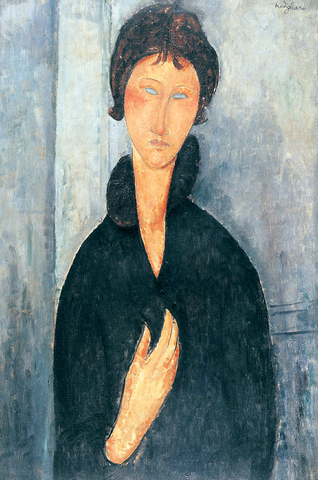
PHOTO COURTESY OF TFAM
This looks like an expensive show too, as the works on loan -- paintings, sculptures, furniture and objets d'art -- are exceptional examples of early European modernism and art deco, which was all the rage in Paris between the two World Wars. In the 1920s, Paris was the place to be if you were an artist.
The exhibition gives equal weight to both the paintings and the furniture. This was a delightful surprise, as an exhibition originating from a modern art museum would tend to emphasize the paintings in their collection.
This breezy didactic exhibition also gives the viewer a glimpse into what artistic French life was like back then. It wasn't called the "jazz age" for nothing. Life was carefree. Cities were growing and automobiles provided a newfound mobility.
Also, women were discarding traditional roles and enjoying their independence. Several women artists included in the exhibition had noteworthy art careers.
Suzanne Valadon's creamy painting of a violin with deep saturated colors still looks lively to this day. Romaine Brooks' portrait of a Duchess shows the early feminist spirit that these early 20th century women held. An interesting gender twist in this exhibition is that the paintings done by the women seem robust, while the ones painted by the men are rendered delicately.
There is a great sampling of oil paintings that include an obscure Matisse painting of a dancer, to works by lesser-known painters, such as the brightly hued Calypso Island by Andre Devambez.
The furniture on view is also sumptuous. Jacques-Emile Ruhlmann's Egyptian-style writing desk, made out of exotic materials such as Macassar ebony, ivory and gray sharkskin is simple and elegant. Two carpets on view are also strikingly elegant and timeless. Paul Leleu's circular gray, red and white wool carpet looks contemporary, even though it was made in 1935.
That is one of the points the exhibition makes: good design is timeless. In addition, several lamps, chairs, wall screens, and sofas are on display. The blue velvet and gold-varnished bronze-legged sofa by Paul Follot is a knockout and so is Michel Dufet's pair of python-skin upholstered chairs.
Gustav Miklos' bronze Grand Mask shows how strong the influence of African art was on modernist art. The smooth head with its high, rounded forehead, simple curved eyes and elongated nose, resembles a tribal Dogon sculpture. This African influence is also seen in the famous painting by Modigliani titled Woman with Blue Eyes and which is the piece de resistance of the entire exhibition.
Painted in 1918, the painting still contains a hauntingly vibrant and erotic charge. Perhaps eyes painted without black pupils seem ghostly but the painterly dabs of umber tones definitely bring this woman back to earth.
Factbox:
What: La Vie Moderne, Paris 1925 to 1937
Where: Taipei Fine Arts Museum,181, Zhongshan N Rd, Sec 3, Taipei (
Telephone: (02) 2595 7656
When: To Feb. 5
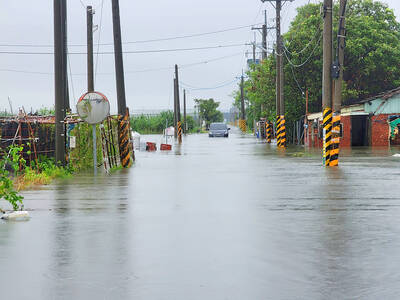
Water management is one of the most powerful forces shaping modern Taiwan’s landscapes and politics. Many of Taiwan’s township and county boundaries are defined by watersheds. The current course of the mighty Jhuoshuei River (濁水溪) was largely established by Japanese embankment building during the 1918-1923 period. Taoyuan is dotted with ponds constructed by settlers from China during the Qing period. Countless local civic actions have been driven by opposition to water projects. Last week something like 2,600mm of rain fell on southern Taiwan in seven days, peaking at over 2,800mm in Duona (多納) in Kaohsiung’s Maolin District (茂林), according to
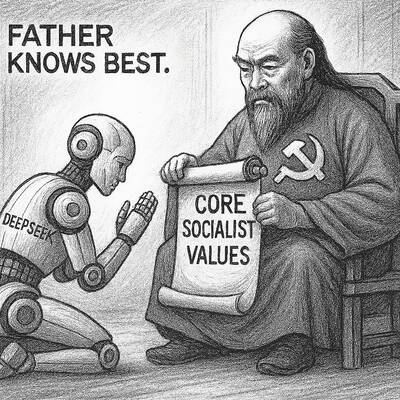
It’s Aug. 8, Father’s Day in Taiwan. I asked a Chinese chatbot a simple question: “How is Father’s Day celebrated in Taiwan and China?” The answer was as ideological as it was unexpected. The AI said Taiwan is “a region” (地區) and “a province of China” (中國的省份). It then adopted the collective pronoun “we” to praise the holiday in the voice of the “Chinese government,” saying Father’s Day aligns with “core socialist values” of the “Chinese nation.” The chatbot was DeepSeek, the fastest growing app ever to reach 100 million users (in seven days!) and one of the world’s most advanced and
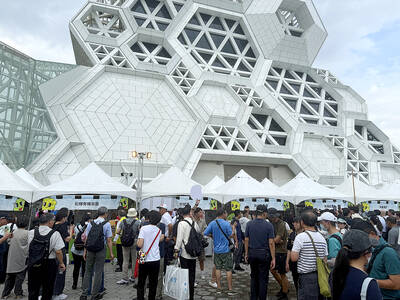
The latest edition of the Japan-Taiwan Fruit Festival took place in Kaohsiung on July 26 and 27. During the weekend, the dockside in front of the iconic Music Center was full of food stalls, and a stage welcomed performers. After the French-themed festival earlier in the summer, this is another example of Kaohsiung’s efforts to make the city more international. The event was originally initiated by the Japan-Taiwan Exchange Association in 2022. The goal was “to commemorate [the association’s] 50th anniversary and further strengthen the longstanding friendship between Japan and Taiwan,” says Kaohsiung Director-General of International Affairs Chang Yen-ching (張硯卿). “The first two editions
It was Christmas Eve 2024 and 19-year-old Chloe Cheung was lying in bed at home in Leeds when she found out the Chinese authorities had put a bounty on her head. As she scrolled through Instagram looking at festive songs, a stream of messages from old school friends started coming into her phone. Look at the news, they told her. Media outlets across east Asia were reporting that Cheung, who had just finished her A-levels, had been declared a threat to national security by officials in Hong Kong. There was an offer of HK$1m (NT$3.81 million) to anyone who could assist


 RSS
RSS