


MGM in the mid-1940s was a reporter's paradise. The mammoth sound stages were abuzz with at least eight features at once, with such names as Gable, Astaire, Stewart, Garland, Rooney, Kelly, Garson, Barrymore and Ball. All were available for interviews, or at least a brief chat between scenes.
It was on sets such as these that I began hearing a different sort of chat, as well -- an odd-sounding language spoken only by film crews that originated in the silent era and continues today.
MGM's Stage 30 contained the most impressive set: the pool of MGM's amphibious star, Esther Williams. Typically, she and a couple dozen other bathing beauties would be splashing about. When the director approved a particular setup, an assistant would announce over a loudspeaker: ``Hit the kliegs.''
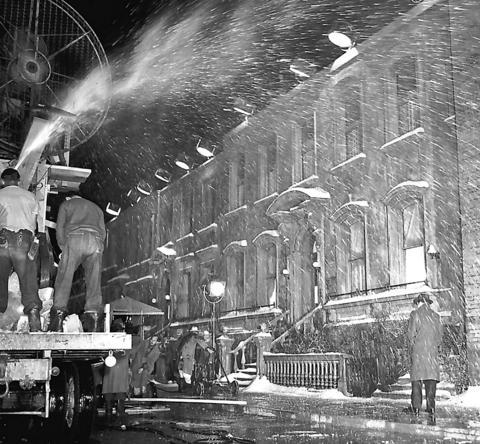
PHOTOS: AP
On catwalks high above the stage, a dozen or more huge spots called klieg lights -- named after their 1920s inventors, the Kliegl brothers -- began to flash on, creating the illusion of sunlight on the cobalt water.
As the shooting day continued, grips, gaffers and best boys would scurry around making references to ``singles,'' ``blondes,'' ``babies'' and ``obies'' without as much as a smirk.
I had no idea what any of it meant. Thank goodness at least the stars spoke English.
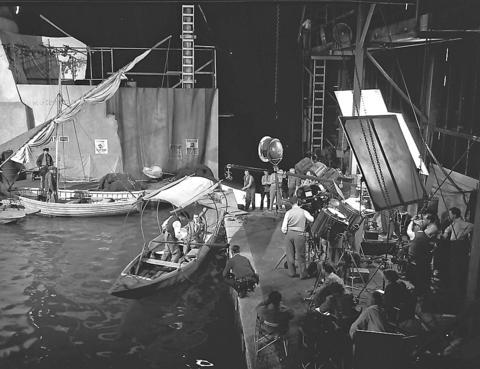
But as I later discovered, the stars themselves inspired some of this strange set slang.
Emmy-winning director of photography George Spiro Dibie explains an ``obie,'' for instance, is a light placed atop the camera to shine in the actor's eyes and create a pleasant highlight. It was named for Merle Oberon, who favored the device.
When a cameraman wants a 50mm lens, he calls for a ``Jack Lord,'' the actor who played the detective hero of TV's Hawaii Five-O. Get the connection -- Five-O, 50mm?
A ``John Ford,'' Dibie says, is a shot favored by the legendary director in which an actor is seen from a distance, then walks toward the camera and into his own close-up.
If a ``DP'' -- that's director of photography -- calls for ``a cowboy shot,'' he may not necessarily be working on a Western, noted Dibie.
``When cowboys duel on a Western street, where do they go for their guns? Their holsters. So you have to photograph down almost to their knees. That's why we call it a cowboy shot,'' he says.
Even for a Hollywood veteran like Dibie, it took awhile to get it all down. He recalls working on the set of 1970s On a Clear Day, You Can See Forever and being told that a close-up of Barbra Streisand needed to be a ``3-shot.''
``For me, a 3-shot would be three actors in the scene,'' says Dibie. ``I was wrong. A 3-shot meant eyes and bosom.''
No version of this lingo has ever made much sense to me, despite a lifetime on movie sets.
A new paperback by New York-based camera operator Dave Knox offers some answers: A gaffer is the chief lighting technician; the best boy is the second electrician, working under the gaffer, and a grip is the jack of all trades, building sets, moving cameras and cables, and whatever else needs doing.

In late October of 1873 the government of Japan decided against sending a military expedition to Korea to force that nation to open trade relations. Across the government supporters of the expedition resigned immediately. The spectacle of revolt by disaffected samurai began to loom over Japanese politics. In January of 1874 disaffected samurai attacked a senior minister in Tokyo. A month later, a group of pro-Korea expedition and anti-foreign elements from Saga prefecture in Kyushu revolted, driven in part by high food prices stemming from poor harvests. Their leader, according to Edward Drea’s classic Japan’s Imperial Army, was a samurai

The following three paragraphs are just some of what the local Chinese-language press is reporting on breathlessly and following every twist and turn with the eagerness of a soap opera fan. For many English-language readers, it probably comes across as incomprehensibly opaque, so bear with me briefly dear reader: To the surprise of many, former pop singer and Democratic Progressive Party (DPP) ex-lawmaker Yu Tien (余天) of the Taiwan Normal Country Promotion Association (TNCPA) at the last minute dropped out of the running for committee chair of the DPP’s New Taipei City chapter, paving the way for DPP legislator Su

It’s hard to know where to begin with Mark Tovell’s Taiwan: Roads Above the Clouds. Having published a travelogue myself, as well as having contributed to several guidebooks, at first glance Tovell’s book appears to inhabit a middle ground — the kind of hard-to-sell nowheresville publishers detest. Leaf through the pages and you’ll find them suffuse with the purple prose best associated with travel literature: “When the sun is low on a warm, clear morning, and with the heat already rising, we stand at the riverside bike path leading south from Sanxia’s old cobble streets.” Hardly the stuff of your
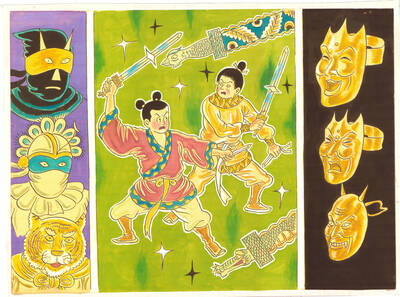
April 22 to April 28 The true identity of the mastermind behind the Demon Gang (魔鬼黨) was undoubtedly on the minds of countless schoolchildren in late 1958. In the days leading up to the big reveal, more than 10,000 guesses were sent to Ta Hwa Publishing Co (大華文化社) for a chance to win prizes. The smash success of the comic series Great Battle Against the Demon Gang (大戰魔鬼黨) came as a surprise to author Yeh Hung-chia (葉宏甲), who had long given up on his dream after being jailed for 10 months in 1947 over political cartoons. Protagonist


 RSS
RSS