


"Young at heart" is an expression that literally fits Seah Chiang Nee, Southeast Asia's first heart transplant patient who celebrates the 20th anniversary of his landmark operation last week.
At 65, the Singaporean former newspaper editor has a 37-year-old Australian heart beating inside his stooped frame.
Seah's new lease on life started on Oct. 12, 1985 when surgeons at St. Vincent's Hospital in Sydney removed his failing organ in a five-and-a-half hour operation and replaced it with the heart of a 17-year-old boy who had just died.
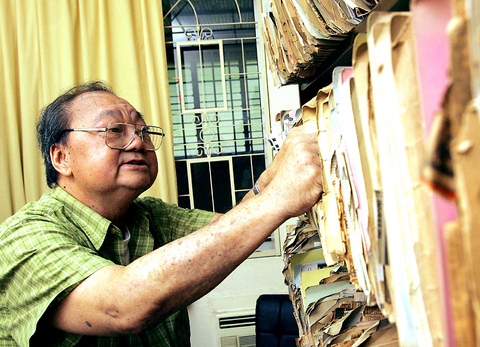
PHOTO: AFP
Driven by a fervent will to live and with the help of modern medicine, Seah's borrowed time has now lasted two decades, making him the region's longest-surviving heart transplant patient.
"I'll try to live it as a normal day," he insisted in an interview ahead of the 20th anniversary of his landmark surgery.
This means waking up early, taking his usual 30-minute morning walk and spending most of the day polishing his Web site, www.littlespeck.com, an on-line publication containing political views that would not normally see print in the pro-government Singapore media.
"I don't think we're going for a celebration. Maybe just a quiet dinner with my wife," Seah said.
"I think it's so long now that whatever initial charisma [there was] has already been lost. I have tried all these years not to remember that I am a heart transplant patient. I want to live as normal a life as possible so I don't think about that at all."
One milestone Seah can vividly remember is being among billions of people worldwide who welcomed the new millennium -- an event he never imagined he would live to experience.
Seah remembers that after his operation, he was content to be able to live four or five years longer.
So, as he watched the live television countdown at midnight on Dec. 31, 1999, his heart beat increasingly faster.
"I never imagined that I could live through the turn of the century, which to me was an important mark -- you can tell your grandchildren, `I lived through that period,'" he says.
"It was a fantastic feeling that the millennium had changed and I'm still around."
Asked about the next milestone he looks forward to, Seah replies with a sense of realism.
"I am very grateful for what I already have. I'm not a greedy guy," he says.
"At 65, you don't talk of dreams and visions anymore. You talk about hopes, you talk about wishes. Dreams and visions are for younger people -- you've got to be realistic about it."
So what are these hopes and wishes?
"To live through life, see my son graduate and hope that Singapore will prosper. That's my only mission in life -- to make sure that he graduates," Seah says, referring to 25-year-old Pei Kwang, who is enrolled at a US university for a life sciences course.
Does death frighten him now?
"I don't think it frightens me at all. Twenty years is a long, long time and I'm already very grateful," he replies.
It was not always smooth sailing for the extroverted Seah, who in his professional prime reported on the Vietnam war from what was then Saigon, held various foreign postings, ran an independent newspaper in Singapore and travelled throughout the region to cover summits and other assignments.
Before his operation, if it wasn't for a locked window, he would have jumped off the sixth floor of a Singapore hospital to end months of wracking chest pains as his heart slowly weakened due to a viral infection.
"I wanted to open the window and jump. I just couldn't take it anymore," he says. "That's when I discovered why hospital windows are locked -- for a good reason."
The years after the operation have not been easy. He has had to take a barrage of drugs to suppress rejection of his "foreign" heart.
Currently, he pops a dozen pills daily. The medication, including steroids, has puffed up his face and affected his kidneys, which he says are just 40 percent functional.
Apart from his sheer will power to go on living, Singapore's excellent health care system has also helped prolong his life, Seah admits.
Doctors have to manage just the right dosage of medicine to suppress rejection of the transplanted heart and at the same time minimize toxic levels in the blood which would damage the kidneys.
Still, he says his kidneys are withering and it's "only a matter of time" before they give up. He undergoes regular medical health checks, including one that evaluates the effect of some of the medication on his bones.
The surgery has also restricted Seah's once fast-paced life as a journalist, including stints as a wire agency correspondent, bureau chief in Bangkok for an Asian magazine and news editor for the Hong Kong Standard newspaper.
He also served for four years as foreign editor of Singapore's Straits Times, before being recruited as the chief editor for another newspaper, the short-lived Monitor.
Seah has remained a journalist at heart, voraciously keeping himself updated on the latest news. Newspaper cutouts yellowed by time are arranged in folders on a shelf in his office to complement his digital library.
From the moment he recovered, Seah has refused to be slowed down and dislikes being treated as a heart transplant patient.
He now writes a column twice a week for Malaysia's most widely circulated English-language newspaper, The Star, and single-handedly publishes his Web site, which he set up in 2000, long before the word "blog" became popular.
Seah recalled that when he returned to Singapore after his operation, he was greeted at the airport by nurses who brought a wheelchair.
"I told myself, `God! Is this what they think of me? How am I going to get a job?'" he recalls.
Seah says he discovered the identity of his donor by chance, when he saw his name at a hospital bulletin board.
Unfortunately, he has had no chance to thank the donor's family as Australian law forbids the identities of both donor and recipient to be divulged. If he had any message to the family now, what would it be?
"I would like to say thanks very much," he says, adding that the organ donation may have made "an impact in the society that I live in."

In late October of 1873 the government of Japan decided against sending a military expedition to Korea to force that nation to open trade relations. Across the government supporters of the expedition resigned immediately. The spectacle of revolt by disaffected samurai began to loom over Japanese politics. In January of 1874 disaffected samurai attacked a senior minister in Tokyo. A month later, a group of pro-Korea expedition and anti-foreign elements from Saga prefecture in Kyushu revolted, driven in part by high food prices stemming from poor harvests. Their leader, according to Edward Drea’s classic Japan’s Imperial Army, was a samurai

The following three paragraphs are just some of what the local Chinese-language press is reporting on breathlessly and following every twist and turn with the eagerness of a soap opera fan. For many English-language readers, it probably comes across as incomprehensibly opaque, so bear with me briefly dear reader: To the surprise of many, former pop singer and Democratic Progressive Party (DPP) ex-lawmaker Yu Tien (余天) of the Taiwan Normal Country Promotion Association (TNCPA) at the last minute dropped out of the running for committee chair of the DPP’s New Taipei City chapter, paving the way for DPP legislator Su
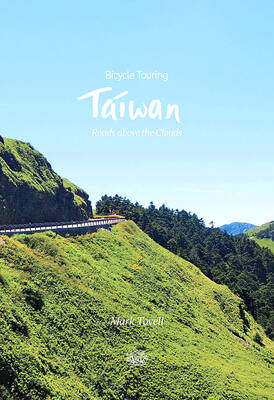
It’s hard to know where to begin with Mark Tovell’s Taiwan: Roads Above the Clouds. Having published a travelogue myself, as well as having contributed to several guidebooks, at first glance Tovell’s book appears to inhabit a middle ground — the kind of hard-to-sell nowheresville publishers detest. Leaf through the pages and you’ll find them suffuse with the purple prose best associated with travel literature: “When the sun is low on a warm, clear morning, and with the heat already rising, we stand at the riverside bike path leading south from Sanxia’s old cobble streets.” Hardly the stuff of your
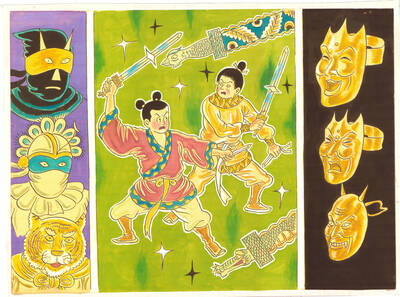
April 22 to April 28 The true identity of the mastermind behind the Demon Gang (魔鬼黨) was undoubtedly on the minds of countless schoolchildren in late 1958. In the days leading up to the big reveal, more than 10,000 guesses were sent to Ta Hwa Publishing Co (大華文化社) for a chance to win prizes. The smash success of the comic series Great Battle Against the Demon Gang (大戰魔鬼黨) came as a surprise to author Yeh Hung-chia (葉宏甲), who had long given up on his dream after being jailed for 10 months in 1947 over political cartoons. Protagonist


 RSS
RSS