


Hugh K.S. Lee (李國修), Ping-Fong Acting Troupe's (屏風表演班) unorthodox and brilliant director and actor has begun to question the wisdom of divorce as the only way of resolving the problem of extramarital affairs.
His new play, Last Night When Stars Were Bright (昨夜星辰) , will start a tour of the country from tonight.
The issue is probed from the perspective of two generations of people intertwined and involves four love stories. Lee based his plot on his own observations of people around him.
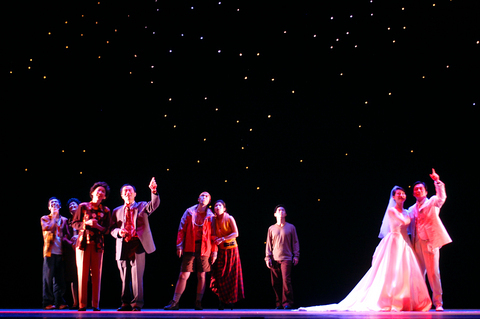
PHOTO COURTESY OF PING-FONG ACTING TROUPE
The social background of the play deserves special attention and involves the "Safeguard the Diaoyutai Movement" (保釣運動), an anti-Japanese campaign over ownership of the Diaoyutai islets, in 1971; and the "Wild Lilly Movement" (野百合運動), a student hunger strike, to call for the abolishment of the National Assembly and other political reforms, in 1990.
Both movements provide the platform for some young, married enthusiasts to fall in love again when they are surrounded by feelings of revolutionary romanticism.
Leading actress Ting Wei's
Ting Wei, living under the shadow of her parents' "cold war," develops a negative attitude toward marriage, but is dating Ren Jun
The Wild Lilly Movement draws Ting Wei and Ren Jun closer and they have an affair which results in Ting Wei's pregnancy.
The play finally reaches its climax when both of them have to yield to pressure from each of their families by agreeing to get married. As the date of the marriage approaches, will they fulfill their parents' wishes and commit to a marriage without true love?
Lee's play has a fade-in and fade-out approach by dividing the stage into two blocks, where characters in the play can freely move through time and space to act out the different yet related crises that each family is facing.
Lee seems to suggest the sweet moments in one's marriage do not come easily, or without having to undergo difficulties. Lee therefore arranges his plot to show at the end that the troubled couples return to their original marriages by overcoming their own bitter feelings.
Performance notes:
What: Last Night When Stars Were Bright, by the Ping-Fong Acting Troupe
Where: National Theater Hall
When: 10/07 and 10/08 at 7:30pm; 10/10 to 10/15 at 7:30pm; 10/08 and 10/09 at 2:30pm; 10/15 to 10/16 at 2:30pm.
There are shows from October to December in Kaohsiung, Tainan, Hsinchu, Chiayi and Taichung.
Ticket Reservation: (02)3393 9888
Web site: www.pingfong.com.tw

Sept.16 to Sept. 22 The “anti-communist train” with then-president Chiang Kai-shek’s (蔣介石) face plastered on the engine puffed along the “sugar railway” (糖業鐵路) in May 1955, drawing enthusiastic crowds at 103 stops covering nearly 1,200km. An estimated 1.58 million spectators were treated to propaganda films, plays and received free sugar products. By this time, the state-run Taiwan Sugar Corporation (台糖, Taisugar) had managed to connect the previously separate east-west lines established by Japanese-era sugar factories, allowing the anti-communist train to travel easily from Taichung to Pingtung’s Donggang Township (東港). Last Sunday’s feature (Taiwan in Time: The sugar express) covered the inauguration of the

The corruption cases surrounding former Taipei Mayor and Taiwan People’s Party (TPP) head Ko Wen-je (柯文哲) are just one item in the endless cycle of noise and fuss obscuring Taiwan’s deep and urgent structural and social problems. Even the case itself, as James Baron observed in an excellent piece at the Diplomat last week, is only one manifestation of the greater problem of deep-rooted corruption in land development. Last week the government announced a program to permit 25,000 foreign university students, primarily from the Philippines, Indonesia and Malaysia, to work in Taiwan after graduation for 2-4 years. That number is a

In a stark demonstration of how award-winning breakthroughs can come from the most unlikely directions, researchers have won an Ig Nobel prize for discovering that mammals can breathe through their anuses. After a series of tests on mice, rats and pigs, Japanese scientists found the animals absorb oxygen delivered through the rectum, work that underpins a clinical trial to see whether the procedure can treat respiratory failure. The team is among 10 recognized in this year’s Ig Nobel awards (see below for more), the irreverent accolades given for achievements that “first make people laugh, and then make them think.” They are not

This Qing Dynasty trail takes hikers from renowned hot springs in the East Rift Valley, up to the top of the Coastal Mountain Range, and down to the Pacific Short vacations to eastern Taiwan often require choosing between the Rift Valley with its pineapple fields, rice paddies and broader range of amenities, or the less populated coastal route for its ocean scenery. For those who can’t decide, why not try both? The Antong Traversing Trail (安通越嶺道) provides just such an opportunity. Built 149 years ago, the trail linked up these two formerly isolated parts of the island by crossing over the Coastal Mountain Range. After decades of serving as a convenient path for local Amis, Han settlers, missionaries and smugglers, the trail fell into disuse once modern roadways were built


 RSS
RSS