


The UN health agency warned on Friday against "scaremongering" over an expected global flu pandemic, a day after one of its officials said it could claim 150 million lives.
Dick Thompson, spokesman for the World Health Organization's (WHO) anti-flu operations, said it is nearly impossible to predict the death toll of a global crisis that experts fear could be fueled by Asia's bird flu outbreak.
People should be wary of any figure they hear, because all are based on "guesswork," he said.
"We can't be dragged into further scaremongering," Thompson said.
His comments came a day after David Nabarro, the newly-appointed UN coordinator for avian and human influenza, said a pandemic could kill "anything between five and 150 million."
That was highest figure cited by a UN official as the world body steps up its campaign to get governments to brace for a pandemic, which experts say is long overdue.
"What David Nabarro was talking about was a range of expert opinions," Thompson said.
"You could pick almost any number -- there's this vast range -- and any of these numbers could be right."
The WHO's official estimate is that 2 million to 7.4 million people could die, said Thompson.
But that is just a guideline figure, he said.
It is provided primarily to help international preparations, such as drug stockpiling and quarantine plans, intended to lessen the impact once a pandemic emerges.
Seasonal epidemics of flu in different regions of the world kill an estimated 250,000 to 500,000 people a year, according to the WHO.
But global pandemics, caused by new variants of the virus, claimed millions of lives in the last century.
Such outbreaks occur roughly every 40 years, and the last was in 1968, when the estimated toll was up to 4 million, Thompson said.
Fears about the risk of a deadlier and far more infectious type of flu in humans have been growing because of the spread of the H5N1 strain of bird flu in poultry and wildfowl in Asia and parts of the ex-Soviet Union.
The H5N1 variant has been known to scientists for decades as a latent killer within the world's bird populations.
However, it became a global concern when in Hong Kong in 1997 it first mutated into a form lethal to humans, killing six people.
It resurfaced in 2003 in poultry flocks across Asia, and has since caused more than 60 human deaths. Millions of chickens and ducks were culled in efforts to halt the disease's spread.
Although human-to-human transmission has been limited, experts fear that H5N1 could combine with common human flu viruses that spread easily.
Predicting exactly how to fight such a mutant strain is a tall order, Thompson said.
"We won't know until this virus emerges," he said.
"There's no pandemic virus at the moment, so vaccine companies are in a bind" as they try to develop a treatment for a hypothetical strain.
The existing anti-viral drug Tamiflu is seen an effective way of slowing down a pandemic strain when it arises -- provided cases are discovered early and intervention is swift.
The WHO is stockpiling supplies of Tamiflu to help cash-strapped developing countries deal with an outbreak and stop further spread, after a donation from its Swiss manufacturer, Roche.
More than 30 governments have also ordered millions of doses from the pharmaceutical giant.

In late October of 1873 the government of Japan decided against sending a military expedition to Korea to force that nation to open trade relations. Across the government supporters of the expedition resigned immediately. The spectacle of revolt by disaffected samurai began to loom over Japanese politics. In January of 1874 disaffected samurai attacked a senior minister in Tokyo. A month later, a group of pro-Korea expedition and anti-foreign elements from Saga prefecture in Kyushu revolted, driven in part by high food prices stemming from poor harvests. Their leader, according to Edward Drea’s classic Japan’s Imperial Army, was a samurai

The following three paragraphs are just some of what the local Chinese-language press is reporting on breathlessly and following every twist and turn with the eagerness of a soap opera fan. For many English-language readers, it probably comes across as incomprehensibly opaque, so bear with me briefly dear reader: To the surprise of many, former pop singer and Democratic Progressive Party (DPP) ex-lawmaker Yu Tien (余天) of the Taiwan Normal Country Promotion Association (TNCPA) at the last minute dropped out of the running for committee chair of the DPP’s New Taipei City chapter, paving the way for DPP legislator Su

It’s hard to know where to begin with Mark Tovell’s Taiwan: Roads Above the Clouds. Having published a travelogue myself, as well as having contributed to several guidebooks, at first glance Tovell’s book appears to inhabit a middle ground — the kind of hard-to-sell nowheresville publishers detest. Leaf through the pages and you’ll find them suffuse with the purple prose best associated with travel literature: “When the sun is low on a warm, clear morning, and with the heat already rising, we stand at the riverside bike path leading south from Sanxia’s old cobble streets.” Hardly the stuff of your
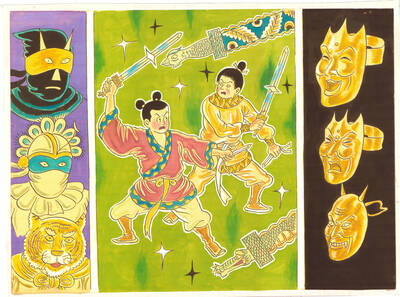
April 22 to April 28 The true identity of the mastermind behind the Demon Gang (魔鬼黨) was undoubtedly on the minds of countless schoolchildren in late 1958. In the days leading up to the big reveal, more than 10,000 guesses were sent to Ta Hwa Publishing Co (大華文化社) for a chance to win prizes. The smash success of the comic series Great Battle Against the Demon Gang (大戰魔鬼黨) came as a surprise to author Yeh Hung-chia (葉宏甲), who had long given up on his dream after being jailed for 10 months in 1947 over political cartoons. Protagonist


 RSS
RSS