


For almost three decades, the occasionally brilliant, sometimes maddening French filmmaker Catherine Breillat has created a startlingly original body of films about female sexuality. Like Freud, Breillat is fascinated by the question, What do women want? For Freud the answer was in the Oedipal complex and the little girl's realization that she is, as he put it, a failed boy. Anatomy was destiny and more or less end of story. For Breillat, anatomy may be destiny, but it has also been the impetus to an ongoing story about men and women at play and at war in the field of desire.
The title of Breillat's latest provocation, Anatomy of Hell, which she adapted from her book Pornocracy, indicates that Breillat has yet to tire of Freud's question. In this film, alas, it appears that the question may have finally exhausted her resources and maybe her sense. Once again, she gives us a man and a woman engaged in a bruising slugfest hinged to sexual difference. This time the battleground is an artfully dilapidated chateau of the sort that is familiar from old horror movies and gauzy fashion magazine layouts, and the combatants are a woman identified only as "the girl,'' and played by the French actress Amira Casar, and "the guy,'' played by the Italian pornography star Rocco Siffredi, a sculptured slab whose talents are almost exclusively instrumental.
The two meet cute Breillat-style when the girl desultorily takes a razor blade to one of her wrists in the bathroom of a gay disco. After the guy helps with her wounds, she propositions him: in return for money, he will spend four evenings with her. Glazed with boredom, stupidity or perhaps just numb from all that dancing, he agrees, and the unlikely duo embark on a round of anguished talk and some bad sex. Editorial discretion limits what I can say about the carnal encounters, save that they are graphic, at times clinical in aspect and awkwardly choreographed. Unpleasure rather than pleasure is the name of Breillat's game, which I assume explains the already-infamous scene in which a garden tool suddenly appears where no garden tool should.

PHOTOS: NY TIMES
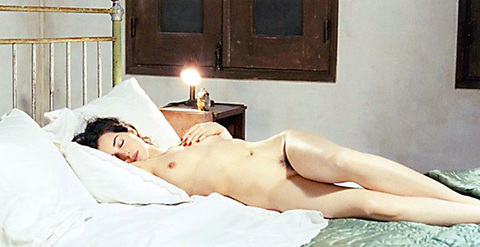
The rest of the film is equally and painfully foolish. On their first night, the girl leads the guy into a bedroom, whereupon she strips off her clothes and assumes a supine position that invokes such classic nudes as Manet's Olympia. In that painting of a prostitute, her maid and an incurious cat, which shocked Paris when it was unveiled in 1865, Manet created a radically desentimentalized and defiantly independent image of female sexuality. Staring out from the canvas, the prostitute appears as free of shame as of clothes and ready for anything. Breillat's nude, by contrast, directs her gaze outward with an air of grudging petulance, as if she were weary of having to haul herself (yet again) onto this altar of female degradation.
Although some of Breillat's films, including 36 Fillette and Fat Girl, convey an uncomfortably raw sense of the real world in their vibe and preoccupations, other of her films traffic in a deadpan surrealism that recalls a late-period if less amusing Luis Bunuel. As in Breillat's similarly themed and more successful outrage Romance, the lead actress's performance in Anatomy of Hell is almost entirely drained of affect; Casar is as limp as a rag doll and just as expressive. As he did in Romance, Siffredi's appearance in the new film seems predicated on his Pavlovian physicality. The characters' dialogue, in turn, is so stilted and ridiculous that it is impossible to know if Breillat is attempting some kind of Brechtian alienation effect or has just gone off the deep end.
The film's philosophy of the bedroom suggests this second possibility. "The fragility of female flesh inspires disgust or brutality,'' the man says on seeing the woman naked. "Women depend on one or the other.'' To which the woman, in turn, asks: "What should we fear more? Nothingness or brutality?'' It should be easy to dismiss this Manichaeism, to argue that between nothingness and brutality there exists a world of possibility for men and women. But such arguments have no place in this movie because Breillat doesn't just recycle musty ideas about men and women's essential, bestial, obscene natures; she seeks male approval and then punishes her on-screen avatar for seeking such approval. That Breillat uses a gay man to indulge such masochism, a man who very likely wouldn't give a woman a second look, is especially gutless.
This is a depressing turn for a filmmaker who has always hewed to her own course. It has been Breillat's independence that has made her work so much more interesting than many films in what the critic James Quandt has christened the New French Extremity. Heavy on sex and death and sometimes some frenzied combination of the two, these films include misanthropic anti-entertainments like Gaspar Noe's Irreversible and Bruno Dumont's Twentynine Palms, which both seek to punish their audiences as brutally as their characters and exploit rape to justify their nihilism. Breillat shares with these filmmakers an almost juvenile interest in rocking bourgeois sensibilities, but in contrast to someone like Noe, she has always used shock to express ideas, not to camouflage an absence of ideas.
In her earlier features, most of which serve as a better introduction to this gifted filmmaker than this film, Breillat's disregard for social pieties and insistence on tearing away the veil from female sexuality has made for galvanizing viewing. I can think of few other filmmakers who have so fearlessly risked legitimacy (and laughter) to pursue their personal vision. At her best, Breillat comes to each of her films as naked as any of her female characters; she strips herself bare for her art and beliefs, and it is this passionate commitment that has helped gloss over her occasional missteps. But Anatomy of Hell is more than a lapse; it is a brutal self-parody of a filmmaker who, having stripped down to the nitty-gritty once too often, may finally have nothing left to show.

In late October of 1873 the government of Japan decided against sending a military expedition to Korea to force that nation to open trade relations. Across the government supporters of the expedition resigned immediately. The spectacle of revolt by disaffected samurai began to loom over Japanese politics. In January of 1874 disaffected samurai attacked a senior minister in Tokyo. A month later, a group of pro-Korea expedition and anti-foreign elements from Saga prefecture in Kyushu revolted, driven in part by high food prices stemming from poor harvests. Their leader, according to Edward Drea’s classic Japan’s Imperial Army, was a samurai

The following three paragraphs are just some of what the local Chinese-language press is reporting on breathlessly and following every twist and turn with the eagerness of a soap opera fan. For many English-language readers, it probably comes across as incomprehensibly opaque, so bear with me briefly dear reader: To the surprise of many, former pop singer and Democratic Progressive Party (DPP) ex-lawmaker Yu Tien (余天) of the Taiwan Normal Country Promotion Association (TNCPA) at the last minute dropped out of the running for committee chair of the DPP’s New Taipei City chapter, paving the way for DPP legislator Su

It’s hard to know where to begin with Mark Tovell’s Taiwan: Roads Above the Clouds. Having published a travelogue myself, as well as having contributed to several guidebooks, at first glance Tovell’s book appears to inhabit a middle ground — the kind of hard-to-sell nowheresville publishers detest. Leaf through the pages and you’ll find them suffuse with the purple prose best associated with travel literature: “When the sun is low on a warm, clear morning, and with the heat already rising, we stand at the riverside bike path leading south from Sanxia’s old cobble streets.” Hardly the stuff of your
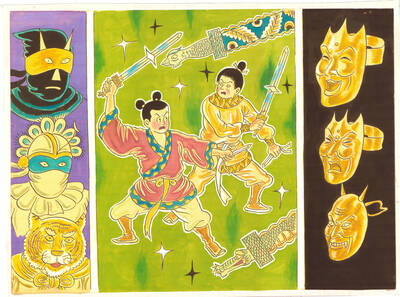
April 22 to April 28 The true identity of the mastermind behind the Demon Gang (魔鬼黨) was undoubtedly on the minds of countless schoolchildren in late 1958. In the days leading up to the big reveal, more than 10,000 guesses were sent to Ta Hwa Publishing Co (大華文化社) for a chance to win prizes. The smash success of the comic series Great Battle Against the Demon Gang (大戰魔鬼黨) came as a surprise to author Yeh Hung-chia (葉宏甲), who had long given up on his dream after being jailed for 10 months in 1947 over political cartoons. Protagonist


 RSS
RSS