


"Do you know about compost toilets?" asked Henrietta Hunt, just before she showed me to my yurt. No, I had to admit, I didn't.
"Well," says Henrietta. "They work best if you don't pee in them." Right. So where exactly ...? She gestured towards the cork and olive trees scattered around the nine acres of Spanish sierra countryside she shares with her husband Ed. "Anywhere, really."
I am telling you this because if you can't handle a bit of al fresco peeing, you are not going to enjoy the Abubilla Yurt Hotel.
PHOTOS: AGENCIES
Ditto the nervous motorist: getting there involves kilometers of hairpin mountain roads and a long boneshaking farm track more suited to a four-wheel drive than a hire car.
For the intrepid traveler, however, it offers an escape into rural Andalucia; a back-to-nature holiday in the unspoilt Grazalema mountains. While only two hours north of the Mediterranean coast, it is a world away from everything we associate with package holidays in Spain.
Abubilla consists of just two guest yurts (a circular tent, still common among the nomadic tribes of central Asia). Each has its generous patch of private garden with tree-shaded seating and mountain views (the Grazalemas in one direction, the distant Serrania de Ronda in the other). And though yurts are not the best-looking tents (a dome of pale yak-roped canvas sprinkled with tree droppings), they are among the finest in five-star camping.
Indeed, our yurt, the Afghani option (the other is native Mongolian), proved larger than the Ronda hotel room we slept in the night before. Roughly 4.5m in diameter, it is made of wands of willow, which form latticed walls, with slender roof beams supporting a bent-wood crown. It has steps up to a double door, through which we could see the mountains from the comfort of our double bed, and a proper wooden floor. There is a window cut into canvas, a domed ceiling lined with red wool trimmed with tapestry, sheepskin rugs, wicker chairs, ethnic furniture and textiles.
The yurt's own compost loo (where a handful of sawdust does the job of a conventional flush) sits behind a muslin curtain in a small detached shed, which also houses a little bathroom with a gas-heated shower.
Abubilla (which means hoopoe, a type of bird common to this area) began as the eco home of Ed Hunt, who had camped in a yurt on his Andalucian land for three years, before meeting -- and marrying -- designer Henrietta. Together they built an alternative family home (three living yurts, four-month-old baby Florence, three dogs, two cats) alongside the holiday venture that supports them.
They opened the hotel in May this year, and admit to a few teething problems. They apologized, for example, for the rumbling generator which, due to a new solar panel being detained by customs, was a necessary byproduct of refrigerated drinks and pumped water.
They were sorry, too, that the pool (small and shallow but swimmable) was a bit "slippery." Built by an Australian barman, it had leaked like a sieve, they explained; thus, a slippery coating of waterproof paint had to be installed as a temporary measure. They are also still waiting for young vines and bougainvillea to climb the pergola where the guests eat breakfast. But these things will have developed or grown by the time a third, family-sized yurt arrives next year; and nobody is complaining.
According to the Hunts, most of their guests (ranging from a group of girls on a hen party to a family of four, and a pair of honeymooners) have proved unwilling to leave Abubilla. They tend to remain slumped in a hammock slung between two cork trees, laid out on a bamboo sunbed under a young olive, or lounging on the luminous green strip of lawn that encircles the pool.
The heat and drought of this summer has been a factor. At the beginning of August, in temperatures close to 40?C, I had no inclination to walk into the village, or climb the rocky Grazalema mountains which loom over Abubilla -- even if you can see as far as Gibraltar from its summit.
Instead, we drove from Cortes de la Frontera, along the precipitous roads that wind through the neighboring national parks (choose from spectacular rock formations or endless cork forests).
The walled town of Ronda, with its Moorish baths and dramatic gorge, is only a 40-minute drive away. And en route you can escape the heat, by literally plunging underground. The Cueva de la Pileta (grottos and ancient cave paintings, lit by kerosene lamps) and Cueva del Gato (giant stalactites, tunnels and ice-cold rock pools) are within a 10-minute drive.
Much nearer to home, Cortes de la Frontera is a standard Andalucian white village, with narrow streets, a smattering of bars and restaurants and plenty of local color. During an early evening drink with tapas, we watched teenagers doing wheelies on motorbikes; a bullfight on television in a bar; and a wedding procession -- which ended in a party that, according modern Spanish tradition, was held in a half-finished section of a construction site.
Alternatively, you can eat with the Hunts: three-course dinners (prawn salad with home-grown olives, monkfish and roasted vegetables, pear and almond tart) cooked by Henrietta in her yurt kitchen and served with wine and candlelight under the stars.
The word "hotel" is not perhaps, entirely appropriate, but the Abubilla experience is packed with nature's little luxuries: the pink glow of mountain scenery at dusk, the high-altitude fresh air (which even in August, cools at night to a comfortable duvet temperature) and the sound of tinkling goat-bells. And although the primitive toilet takes a bit of getting used to, I can't recall a loo with a better view.
Getting there:
Where to stay: Abubilla Yurt Hotel (yurthotel.com), at Cortes de la Frontera, is open until the end of October (and from March next year).
Yurts cost NT$2,900 per night or NT$17,500 per week B&B.
Getting there: Taipei transit to Hong Kong with Cathay Pacific to London and Malaga, Spain, with British Airways, in August.
Total cost, NT$36,000, through Lahoo Ticketing Tour.
Call Emily: (0933) 718 196.
Getting around: Hertz in Malaga (hertz.co.uk) offers a week's all-inclusive car hire from NT$8,851 in September.
Further information: Spanish Tourist Office (spain.info)

In late October of 1873 the government of Japan decided against sending a military expedition to Korea to force that nation to open trade relations. Across the government supporters of the expedition resigned immediately. The spectacle of revolt by disaffected samurai began to loom over Japanese politics. In January of 1874 disaffected samurai attacked a senior minister in Tokyo. A month later, a group of pro-Korea expedition and anti-foreign elements from Saga prefecture in Kyushu revolted, driven in part by high food prices stemming from poor harvests. Their leader, according to Edward Drea’s classic Japan’s Imperial Army, was a samurai

The following three paragraphs are just some of what the local Chinese-language press is reporting on breathlessly and following every twist and turn with the eagerness of a soap opera fan. For many English-language readers, it probably comes across as incomprehensibly opaque, so bear with me briefly dear reader: To the surprise of many, former pop singer and Democratic Progressive Party (DPP) ex-lawmaker Yu Tien (余天) of the Taiwan Normal Country Promotion Association (TNCPA) at the last minute dropped out of the running for committee chair of the DPP’s New Taipei City chapter, paving the way for DPP legislator Su
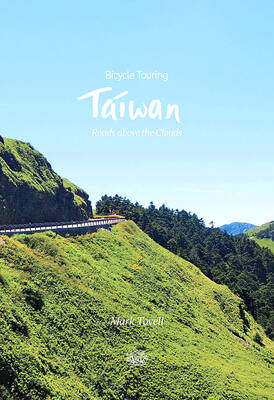
It’s hard to know where to begin with Mark Tovell’s Taiwan: Roads Above the Clouds. Having published a travelogue myself, as well as having contributed to several guidebooks, at first glance Tovell’s book appears to inhabit a middle ground — the kind of hard-to-sell nowheresville publishers detest. Leaf through the pages and you’ll find them suffuse with the purple prose best associated with travel literature: “When the sun is low on a warm, clear morning, and with the heat already rising, we stand at the riverside bike path leading south from Sanxia’s old cobble streets.” Hardly the stuff of your
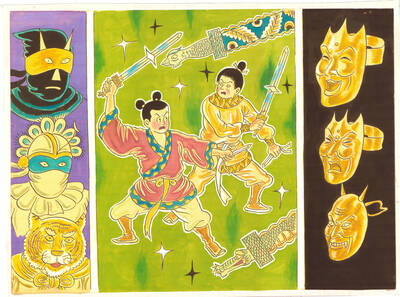
April 22 to April 28 The true identity of the mastermind behind the Demon Gang (魔鬼黨) was undoubtedly on the minds of countless schoolchildren in late 1958. In the days leading up to the big reveal, more than 10,000 guesses were sent to Ta Hwa Publishing Co (大華文化社) for a chance to win prizes. The smash success of the comic series Great Battle Against the Demon Gang (大戰魔鬼黨) came as a surprise to author Yeh Hung-chia (葉宏甲), who had long given up on his dream after being jailed for 10 months in 1947 over political cartoons. Protagonist


 RSS
RSS