


This book examines the phenomenon of the Taiwanese New Cinema via a close study of four of its directors -- Ang Lee, Edward Yang, Hou Hsiao-hsien and Tsai Ming-liang. Both authors have published books before on Asian film. Emilie Yueh-yu Yeh lectures on the topic at Hong Kong Baptist University, while Darrell William Davis teaches the it at the University of New South Wales, Sydney.
Taiwanese New Cinema is perceived as having begun in 1982. Today, argue the authors, we are in a "post-New Cinema" phase. Even though the key New Cinema directors are still making movies, these find audiences largely at foreign film festivals, and financing often from foreign agencies.
In their introduction the authors represent Taiwan as, among other things, an "island of greed." The book's subtitle is "A Treasure Island," and Yeh and Davis point out that it was seen by early European explorers as a lawless and marginal place that could be pillaged with impunity as it belonged to no one except fishermen and head-hunters. It has since become a site for "a procession of would-be owners claiming legitimacy." Their general remarks on Taiwan, it should be said, are among the best things in an excellent book.
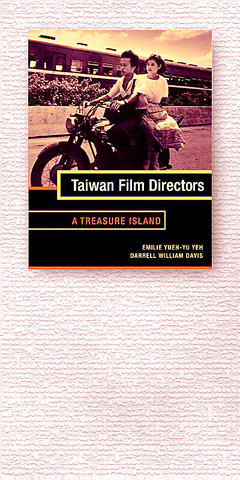
The big four
First Yeh and Davis offer two excellent long chapters on Taiwanese film in general, then examine the technical aspects of the sophisticated films of Edward Yang, take the films of Hou Hsiao-hsien ("Taiwan's preeminent director") as representative of the evolution of Taiwan cinema as a whole, and look at Ang Lee's attempts to, as they put it, "Confucianize" Hollywood.
I am insufficiently familiar with Taiwanese films to assess the value of all aspects of Taiwan Film Directors: a Treasure Island equally. But I do have some knowledge of Tsai Ming-liang's movies, and so will consider the chapter devoted to him in more detail.
The author responsible for this chapter takes the idea of "camp" as his or her guiding principle. (The division of work between the two writers is nowhere detailed, but it seems unlikely that they wrote all the chapters in equal collaboration). On the surface, this seems inappropriate to this director's controversial, repetitive, yet nonetheless often striking work. The theme running through such films as What Time Is It There?, Goodbye, Dragon Inn and The Wayward Cloud appears to be the progressive loss of the capacity for human feeling, especially love, in the context of the modern city. That the films are to be understood as a progression is underlined by the use of the same lead actor, Lee Kang-sheng, in many of them, as well as cross-references between the films and the consistent, often over-obvious, use of the same symbolic images, notably lifts, underpasses, public toilets and, most extensively, water.
First came an impossible love for someone who was going away, then a drifting world of casual sexual encounters, then recruitment into an active role in porn movies, all culminating in the extraordinary concluding sequence of The Wayward Cloud where Lee, copulating with a catatonic woman during the making of a pornographic sequence, finally achieves satisfaction with the body of another woman, the one who really loves him. The over-riding need for love in the human heart, and yet the comparative honesty of those who respond to modern urban conditions by seeking it only in the most oblique of ways, are surely the twin themes of this highly individual director's work.
Up-beat?
Given all this, how can "camp" be a useful approach? Here is someone who is characterized most of all by cries of horror at the alienated and lonely situation many modern city-dwellers find themselves in. These authors admit that most comment on these films has focused on this. However, unwilling to let Tsai get away with such a threnody of collapse, such a death-lament for a society buckled in on itself, they struggle instead to offer a dissenting up-beat alternative, however inappropriate it may seem on the surface.
Thus they write of "aestheticizing the local working class," taking an interest in a moment of cross-dressing in Vive l'Amour and the nostalgic performances of Grace Chang numbers from the 1950s and 60s in The Hole.
Hit and miss
This, in other words, is a revisionist view of Tsai, an attempt to challenge the received critical viewpoint. It could be argued that, not liking the equating of homosexuality with the hopelessness of any pursuit of genuine love, these critics instead strive to champion the playful gay element in Tsai's films, trying to see it as celebratory, rather than accepting it as a symptom of malaise -- even though this flies in the face of what Tsai himself says in interviews. (It's unfortunate that this book went to press before the release of The Wayward Cloud).
Tsai's films are reminiscent of Samuel Beckett's plays -- slow-moving, relatively plotless, frequently resorting in vaudeville techniques, and appealing to intellectuals rather than the marginal characters they mostly depict. To refer to these films as "camp" on account of their gay elements is as inappropriate as calling Beckett's plays testaments to Catholicism because of references in them to the thieves Christ was crucified with, and other items of Christian iconography. In each case, neither reading could be further from the truth.
Taiwanese New Cinema films have only appealed to local audiences in specific instances. And today, say the authors, distributors are mainly eager for a share of the spoils of Hollywood imports, which since 1997 have claimed 95 percent of the Taiwan box office. But these New Cinema movies have nonetheless strongly attracted foreign critics, and some local ones. This book is a highly intelligent and welcome guide to the movement as a whole, and to some of its major participants.

In late October of 1873 the government of Japan decided against sending a military expedition to Korea to force that nation to open trade relations. Across the government supporters of the expedition resigned immediately. The spectacle of revolt by disaffected samurai began to loom over Japanese politics. In January of 1874 disaffected samurai attacked a senior minister in Tokyo. A month later, a group of pro-Korea expedition and anti-foreign elements from Saga prefecture in Kyushu revolted, driven in part by high food prices stemming from poor harvests. Their leader, according to Edward Drea’s classic Japan’s Imperial Army, was a samurai

The following three paragraphs are just some of what the local Chinese-language press is reporting on breathlessly and following every twist and turn with the eagerness of a soap opera fan. For many English-language readers, it probably comes across as incomprehensibly opaque, so bear with me briefly dear reader: To the surprise of many, former pop singer and Democratic Progressive Party (DPP) ex-lawmaker Yu Tien (余天) of the Taiwan Normal Country Promotion Association (TNCPA) at the last minute dropped out of the running for committee chair of the DPP’s New Taipei City chapter, paving the way for DPP legislator Su
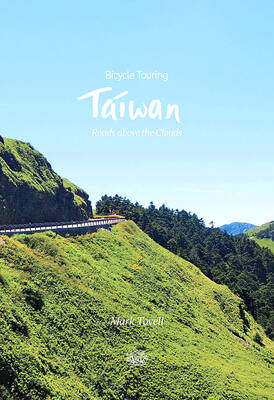
It’s hard to know where to begin with Mark Tovell’s Taiwan: Roads Above the Clouds. Having published a travelogue myself, as well as having contributed to several guidebooks, at first glance Tovell’s book appears to inhabit a middle ground — the kind of hard-to-sell nowheresville publishers detest. Leaf through the pages and you’ll find them suffuse with the purple prose best associated with travel literature: “When the sun is low on a warm, clear morning, and with the heat already rising, we stand at the riverside bike path leading south from Sanxia’s old cobble streets.” Hardly the stuff of your
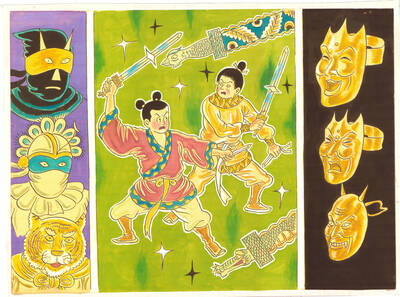
April 22 to April 28 The true identity of the mastermind behind the Demon Gang (魔鬼黨) was undoubtedly on the minds of countless schoolchildren in late 1958. In the days leading up to the big reveal, more than 10,000 guesses were sent to Ta Hwa Publishing Co (大華文化社) for a chance to win prizes. The smash success of the comic series Great Battle Against the Demon Gang (大戰魔鬼黨) came as a surprise to author Yeh Hung-chia (葉宏甲), who had long given up on his dream after being jailed for 10 months in 1947 over political cartoons. Protagonist


 RSS
RSS