


Far too many of the strikingly good-looking young women of Asmara spend far too much time hanging around the Intercontinental Hotel, an overwrought, air-conditioned behemoth gobbling up a nowhere land between the Eritrean capital and its modest airport.
Here, they drink Coke and flirt with well-fed Italian UN soldiers, who, when not carousing, perform important duties like flexing and oiling their gym-pumped muscles by the hotel's pools.
That's pools: plural; in a country that has been suffering a five- year drought. This is a country overrun by well-cushioned foreign soldiery, 4 x 4-borne charities and NGOs. There are so many of these that sometimes theirs are the only cars on the dusty roads leading into and out of this extraordinary, and largely bypassed, city set high on the East African escarpment, high enough to set your heart racing if you rush about on your first day here.
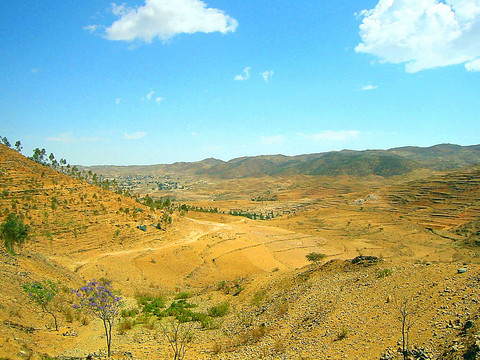
I mention the girls, the soldiers and the Intercontinental because this unholy triptych representing contemporary Asmaran life prompted me to wonder if Eritrea has ever truly shaken off its colonial yoke. This was an Italian colony from 1898, when the first gover-nor was appointed, until 1941 when the British won control of this blisteringly hot Red Sea country. It later became an Ethiopian dependency, until after a 30 year war, Isiais Afewerki and his plastic sandal-wearing Eritrean Peoples Liberation Front won control of their own country.
For the next seven years, Eritrea basked in a reputation of being one of the most open and tolerant countries in Africa before a renewed clash with Ethiopia led to a presidential clampdown and a return to the country of all those UN troops spooning with the local girls, and NGOs by the baffling-acronym load.
Even so, Asmara itself is one of the most enchanting cities in Africa. I nearly typed "Italy," for this is a city largely created by the Italians over a very short period, and one in which the surprised visitor will find astonishingly similar to some cities in southern Italy and especially those built on the Pontine marshes by Mussolini in the 1930s.
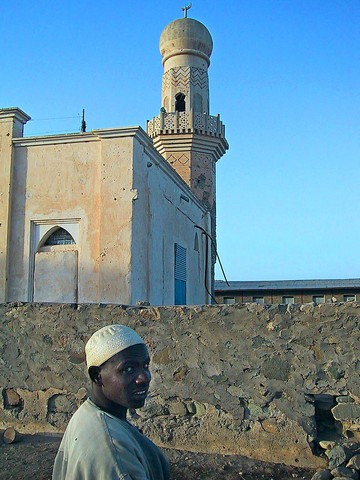
PHOTO: AFP
Here you can eat all the pizza, pasta and ice cream your stomach could possibly desire, along with goat stew mopped up by injera, a sponge-like local pancake that may, or may not, be made with wheat.
Pavement cafes proffer cappuccino and espresso from vintage Italian coffee machines along with saccharine-sweet Arabic mint tea and refreshing Asmara (formerly Melotti) beer.
At sunset, the city sets out on a passegiatta, old men in double- breasted suits doffing Borsolino hats as they stroll along wide pavements under royal palms. They address foreigners in the Italian they learned as boys when what is now an utterly convincing Italian modernist city of the 1930s was a frenetic building site. Between 1935 and 1941, young Italian architects, and seasoned contractors working to a detailed urban plan, built somewhere between 400 and 500 fine new designs here: theatres, cinemas, hotels, churches, mosques, covered markets, city halls and, of course, a Casa del Fascio.
PHOTO: NY TIMES
The Casa del Fascio, shaped in the guise of a giant rendered-concrete "F' is now a part of the ministry of education. It broods, although in ice cream colors, so it can't be all that broody, at one end of Harnet, or Independence Avenue, the broad thoroughfare that characterizes and sets the pace for this would-be east African Rome and which has changed its name with each new regime, indigenous or imperial.
Mussolini's architects did a fine job. Whatever the outrages and injustices of his Fascist regime, Asmara is a thoroughly well planned and good-looking city. Here is one place in the world where surely anyone might allow themselves to give in to the sometimes cold and remotely intellectual charms of modernism.
Colored like confectionery, bejeweled with purple jacaranda and red bougainvillea, and set under high blue skies, how could anyone take offence and wish for more obviously romantic "colonial" or mud-hut architecture?
This Italian modernism is, in large part, Asmara's saving grace. Many of the city's buildings might be 70 years old, yet they remain incorrigbly Modern with a capital M. Asmara is not wealthy -- far from it -- and yet with its lively cafe culture and the natural grace and good manners of its people, it feels absolutely nothing like the desperate and downtrodden African cities we know all too well from TV news reports and the fund-raising efforts of well-meaning pop stars.
There is something, too, very special, despite the current clampdown on civil liberties, in the tolerant way Asmarinos share their lives. Here, Muslims, Catholics, Coptic and Greek Orthodox Christians and a handful of Jews live and work, cheek by jowl. They all have fine buildings to celebrate their God: a 1920s Gothic cathedral, which seems much older, on Harnet Avenue for the Catholics; the twin-towered and richly mosaiced Coptic Mariam cathedral; the handsome Al Qurafi al Rashidin mosque at the head of the central market buildings dating from 1937; the pretty Greek Orthodox church of St George; and a modestly scaled neoclassical synagogue.
Ancient and hard-held beliefs exist alongside the ice cream world of 1930s Italy. If you want to see a film, try the Impero Cinema on Martyrs Avenue. It's a beautifully restored art deco monument, robed in the rich colors of a Roman emperor's toga. If you want music and nightclubs, there is plenty of that and those. As for restaurants, you can eat Sudanese and Indian as well as Asmarino-Italian.
To watch the city go by, sit at one of the outside tables at the Bar Impero or Pasticeria Moderna on Harnet Avenue. In fact, you will be watching the world go by, too. The Asmarino diaspora has been on a biblical scale in recent years. My mid-morning coffee at the Moderna was paid for one morning by a man who had lived the past 30 years in Oslo and missed the snow, while, across from us, a young man, recently back from New York sported baseball cap, hood, saggy trousers, high-rise trainers, mobile phone and a big, pouting sneer as if downtown Asmara was somehow da South Bronx. This look, by the way, is thought eccentric: smiles, smart dress and good manners, even when there is so little money, are the norm rather than pouting, sneering, global brand culture.
How the city has been so well preserved might seem something of a miracle in a poor country especially after so many decades of war.
Fighting, though, has nearly always been in blisteringly hot rural areas, along desert borders, up and down the coast, and through devilish mountains passes. When the British took Asmara in 1941, they had bombed just one building. Mind you, the miserable sods stripped the city of much of its industrial machinery along with other essential parts of its infrastructure.
Although ordinary soldiers had been delighted, and amazed, to find a modern city, all ice cream, cinemas, Alfa-Romeos and gorgeous girls, their superiors considered Asmara too good for the locals. Their attitude was that the Italians had overspent and that it was only right to strip the city of modern machinery that could be used more profitably elsewhere by insatiably business-minded Brits.
To this day, many of the seemingly modern buildings in the city center lack running water, bathrooms and lavatories. While, at the edge of the city, the choking Medeber market is witness to huge numbers of Asmarinos recycling absolutely anything that can be turned into something useful: beds from lorry springs, chairs and tables from oil cans.
The city center is now, effectively, a listed zone where new buildings will only rarely be allowed. The Cultural Assets Rehabilitation Programme was set up in 1996 to record the city's architecture and to educate children, as well as business people and developers across the country, to look after their unparalleled urban heritage. Asmara may yet become a Unesco World Heritage Site. It fully deserves to be.
Perhaps the most unexpected restoration has been that of the enchanting Eritrean State Railway, which spirals in death-defying fashion down the escarpment from Asmara to meet the Red Sea at Massawa, another fascinating, although heavily war-damaged city, and one of the very hottest on earth.
The narrow-gauge railway, built by the Italians, has been rebuilt without outside help. National pride has seen to that. The necessary expertise lay in the hands and memories of long retired railwaymen, who have returned to bring the railway back to life.
There are, of course, no cheap flights to Eritrea. Tourism is in its infancy. There is little water, most of it unsafe to drink. The country is poor. It can be very hot indeed. Border disputes might break out at any time. Yet, where else will you find a city like Asmara? Unthreatening. Unexpected. Africa with a Neapolitan ice-cream scoop.

In late October of 1873 the government of Japan decided against sending a military expedition to Korea to force that nation to open trade relations. Across the government supporters of the expedition resigned immediately. The spectacle of revolt by disaffected samurai began to loom over Japanese politics. In January of 1874 disaffected samurai attacked a senior minister in Tokyo. A month later, a group of pro-Korea expedition and anti-foreign elements from Saga prefecture in Kyushu revolted, driven in part by high food prices stemming from poor harvests. Their leader, according to Edward Drea’s classic Japan’s Imperial Army, was a samurai

The following three paragraphs are just some of what the local Chinese-language press is reporting on breathlessly and following every twist and turn with the eagerness of a soap opera fan. For many English-language readers, it probably comes across as incomprehensibly opaque, so bear with me briefly dear reader: To the surprise of many, former pop singer and Democratic Progressive Party (DPP) ex-lawmaker Yu Tien (余天) of the Taiwan Normal Country Promotion Association (TNCPA) at the last minute dropped out of the running for committee chair of the DPP’s New Taipei City chapter, paving the way for DPP legislator Su
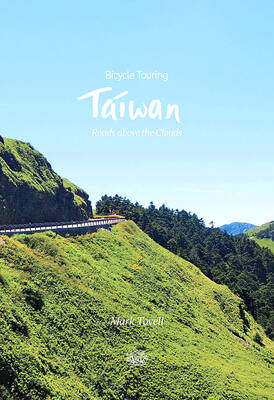
It’s hard to know where to begin with Mark Tovell’s Taiwan: Roads Above the Clouds. Having published a travelogue myself, as well as having contributed to several guidebooks, at first glance Tovell’s book appears to inhabit a middle ground — the kind of hard-to-sell nowheresville publishers detest. Leaf through the pages and you’ll find them suffuse with the purple prose best associated with travel literature: “When the sun is low on a warm, clear morning, and with the heat already rising, we stand at the riverside bike path leading south from Sanxia’s old cobble streets.” Hardly the stuff of your
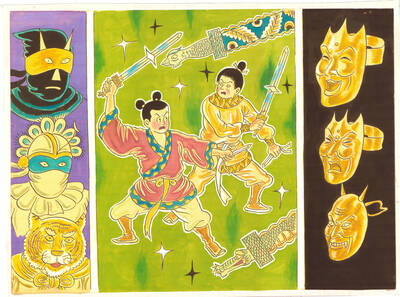
April 22 to April 28 The true identity of the mastermind behind the Demon Gang (魔鬼黨) was undoubtedly on the minds of countless schoolchildren in late 1958. In the days leading up to the big reveal, more than 10,000 guesses were sent to Ta Hwa Publishing Co (大華文化社) for a chance to win prizes. The smash success of the comic series Great Battle Against the Demon Gang (大戰魔鬼黨) came as a surprise to author Yeh Hung-chia (葉宏甲), who had long given up on his dream after being jailed for 10 months in 1947 over political cartoons. Protagonist


 RSS
RSS