


The Venice Biennale in Italy opens on Sunday. This granddaddy of international art exhibitions began in 1895 at a time when world fairs and international exhibitions started growing in popularity, and was founded with the idea that nations can showcase the best of their talents, just like the Olympics that were founded the following year.
The Venice Biennale is in two sections: national pavilions, and a curated international exhibition. The national pavilions are determined by the individual participating countries, so the Taiwan Pavilion is organized by the Taipei Fine Arts Museum and funded by the Taiwan government.
And even though this is an art exhibition, politics still come into play as in all the printed documentation -- such as catalogs and Web sites? -- Taiwan is listed not as a participating country but under the organization of the Taipei Fine Arts Museum, due of course to pressure from China.
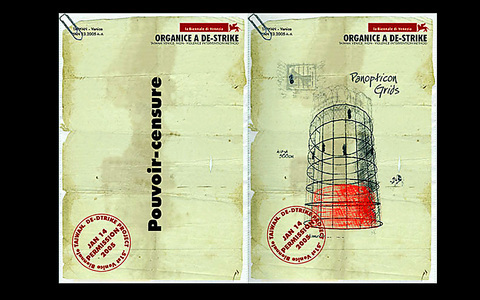
PHOTO COURTESY OF TFAM
The curator for the Taiwan Pavilion, Wang Chia-chi (
The Spectre of Freedom implies death and the desire to get rid of the limitations of life. The four artists in the exhibition, Kao Chung-li (
Kao Chung-li (
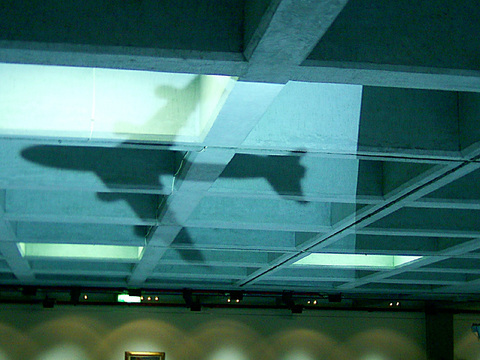
PHOTO COURTESY OF TFAM
Tsui Kuang-yu (崔廣宇) gained immediate recognition for his single channel videos where he, as both director and filmed subject, showed the absurdity of contemporary life in a Buster Keaton-meets-Chinese-Kung-fu-masters-metaphysical kind of way. The city is his stage, while his performance shows us how to simplify our lives in a consumerist society.
Lin Hsin-i (林欣怡) is known for her oversized digital self-portraits that combine futuristic images with cannibalism and eroticism. For Venice, she has an interactive Internet installation titled De-strike, housed in a Panopticon structure, in which she can observe the on-site action via a Webcam linking her studio in Taipei to this former Venetian prison.
Kuo I-chen (
Huge speakers periodically emit a low rumbling sound that grow ominously louder as if to signal an impeding disaster, stopping viewers in their tracks.
In addition to the works in the Taiwan Pavilion, artist Chen Chieh-jen (
His inclusion is a boost for Taiwan's contemporary art scene as his work was not a regional choice but was instead accepted to be part of the larger international discourse that the Venice Biennale represents.

In late October of 1873 the government of Japan decided against sending a military expedition to Korea to force that nation to open trade relations. Across the government supporters of the expedition resigned immediately. The spectacle of revolt by disaffected samurai began to loom over Japanese politics. In January of 1874 disaffected samurai attacked a senior minister in Tokyo. A month later, a group of pro-Korea expedition and anti-foreign elements from Saga prefecture in Kyushu revolted, driven in part by high food prices stemming from poor harvests. Their leader, according to Edward Drea’s classic Japan’s Imperial Army, was a samurai

The following three paragraphs are just some of what the local Chinese-language press is reporting on breathlessly and following every twist and turn with the eagerness of a soap opera fan. For many English-language readers, it probably comes across as incomprehensibly opaque, so bear with me briefly dear reader: To the surprise of many, former pop singer and Democratic Progressive Party (DPP) ex-lawmaker Yu Tien (余天) of the Taiwan Normal Country Promotion Association (TNCPA) at the last minute dropped out of the running for committee chair of the DPP’s New Taipei City chapter, paving the way for DPP legislator Su

It’s hard to know where to begin with Mark Tovell’s Taiwan: Roads Above the Clouds. Having published a travelogue myself, as well as having contributed to several guidebooks, at first glance Tovell’s book appears to inhabit a middle ground — the kind of hard-to-sell nowheresville publishers detest. Leaf through the pages and you’ll find them suffuse with the purple prose best associated with travel literature: “When the sun is low on a warm, clear morning, and with the heat already rising, we stand at the riverside bike path leading south from Sanxia’s old cobble streets.” Hardly the stuff of your
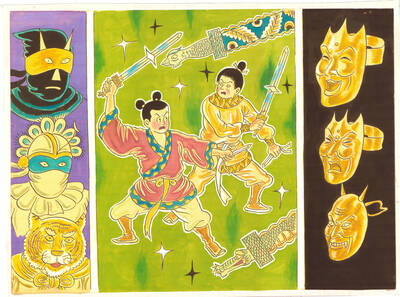
April 22 to April 28 The true identity of the mastermind behind the Demon Gang (魔鬼黨) was undoubtedly on the minds of countless schoolchildren in late 1958. In the days leading up to the big reveal, more than 10,000 guesses were sent to Ta Hwa Publishing Co (大華文化社) for a chance to win prizes. The smash success of the comic series Great Battle Against the Demon Gang (大戰魔鬼黨) came as a surprise to author Yeh Hung-chia (葉宏甲), who had long given up on his dream after being jailed for 10 months in 1947 over political cartoons. Protagonist


 RSS
RSS