


Paul Clark's efficient and intelligent survey titled Reinventing China looks at the films and careers of China's group of film directors who came to fame in the late 1980s and 1990s.
The fame was sometimes relative, but the most celebrated of them -- Zhang Yimou (
Clark, who is a Professor of Chinese at the University of Auckland, claims he got the idea for this new book while standing waist-deep at the quieter end of Hawaii's Waikiki Beach alongside Zhang and Chen -- enviable access to your celebrated subject-matter, you might think. But Clark is something of an authority on this subject and is the author of the much more extensive survey Chinese Cinema: Culture and Politics Since 1949.
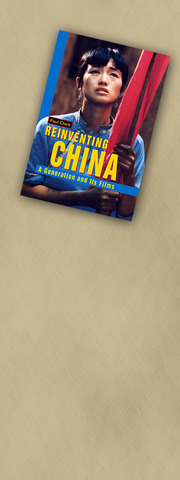
That book was published by Cambridge University Press in 1987 and it's a fair guess that Clark offered this new book, in many ways an up-dating of the older one, to the same publisher.
That it has ended up appearing under the imprint of the far smaller Chinese University Press in Hong Kong should not necessarily be seen as saying something about its relative quality. Publishers' criteria for taking on books change by the day and the Hong Kong outfit has done a good job in terms of presentation and paper quality.
Not only Zhang and Chen but all the eight other filmmakers featured in this book enrolled in the Beijing Film Academy in the same year, 1978, and graduated four years later. The academy was, at the time, China's only film school. The book, then, is in the way of being what Clark calls a "collective biography" of a generation. Mao Zedong had died in September 1976, and his widow and her associates had been arrested the following month. China was thus clearly set for change, and the halt to that change that was to come in Tiananmen Square on June 4, 1989, was still some way off. That a new kind of film was to emerge was virtually inevitable.
What was new about the films produced by this generation was that, for the first time in 40 years, they were not the products of a hard-line ideology. On the other hand, Clark makes the point that the students of this era had not had an unenviable upbringing. Their childhoods had taken place in the 1950s and early 1960s, what Clark calls "generally happy times," largely optimistic though inevitably politically-charged. These were the heady days of revolution, comparable to those early on in the revolutions in France and Russia, when all things seemed possible and the future a promised land.
All that disappeared in 1966 with the onset of the Cultural Revolution, followed in 1968 by the initiation of the scheme that was to influence a whole generation, the sending down to the countryside of 17 million of the nation's often relatively privileged urban youth.
Most of the filmmakers featured in this book were in their early teens in 1968. Not all their families were of equal revolutionary standing, however. Zhang's father had been an officer in Chiang Kai-shek's (蔣介石) Nationalist army prior to 1949 and earned a living doing odd jobs.
His status was further reduced by the fact that his eldest brother had fled to Taiwan in 1948. Zhang's mother was a professional dermatologist, but both parents were sent to the mountainous interior in the late 1960s -- a result of perceived anti-revolutionary crimes, and Zhang himself was labeled the "son of a dog" by Red Guards.
Chen's case was slightly different. His parents had both been involved in the film industry, but this didn't necessarily afford any protection. Chen, for example, had to attend mass criticism meetings denouncing his father and other leading members of the Beijing Film Studio. Clark sees this experience as lying behind the intense father-son relationships in many of the son's subsequent films.
The other filmmakers are less well-known, though enthusiasts will be familiar with several of them, especially Tian Zhuangzhuang, director of Horse Thief (1986) and The Blue Kite (1992), Wu Ziniu, director of Evening Bell (1988) and The Nanjing Massacre (1995), and Zhang Jianya, director of Ice River (1986) and Crash Landing (1999).
Taiwan appears here and there, notably in relation to two of Zhang's films. One of these, Codename Cougar (1989), featured the hi-jacking of a flight between Taipei and Seoul with the plane having to land in China and secret negotiations taking place between Taipei and Beijing. And the better-known Raise the Red Lantern of 1992 was a co-production with Taiwan -- its executive producer was the Taiwanese film director Hou Hsiao-hsien (
Reinventing China is a useful and meticulous book that has three major virtues. First, it offers an over-view of a crucial era of Chinese filmmaking, linking the social background, the filming activities and the personal biographies of the directors.
Second, it contains intelligent critiques of the films discussed, essentially all the important films of the time plus many others.
Lastly, it has the great advantage of personal contact with the 10 directors. All of them talked at length to Clark, not only about their adolescent experiences as re-located city youth, but also about the films they made as adults, what they intended to portray and occasionally how far they think they achieved their aims.
This is therefore both a handbook to consult before seeing the films of that era, and a work to read entire to put the individual films in their historical context. It may not represent a strikingly original approach, but it is cogent, intelligent and very well informed, and as such is definitely recommended.

Growing up in a rural, religious community in western Canada, Kyle McCarthy loved hockey, but once he came out at 19, he quit, convinced being openly gay and an active player was untenable. So the 32-year-old says he is “very surprised” by the runaway success of Heated Rivalry, a Canadian-made series about the romance between two closeted gay players in a sport that has historically made gay men feel unwelcome. Ben Baby, the 43-year-old commissioner of the Toronto Gay Hockey Association (TGHA), calls the success of the show — which has catapulted its young lead actors to stardom -- “shocking,” and says

The 2018 nine-in-one local elections were a wild ride that no one saw coming. Entering that year, the Chinese Nationalist Party (KMT) was demoralized and in disarray — and fearing an existential crisis. By the end of the year, the party was riding high and swept most of the country in a landslide, including toppling the Democratic Progressive Party (DPP) in their Kaohsiung stronghold. Could something like that happen again on the DPP side in this year’s nine-in-one elections? The short answer is not exactly; the conditions were very specific. However, it does illustrate how swiftly every assumption early in an

Inside an ordinary-looking townhouse on a narrow road in central Kaohsiung, Tsai A-li (蔡阿李) raised her three children alone for 15 years. As far as the children knew, their father was away working in the US. They were kept in the dark for as long as possible by their mother, for the truth was perhaps too sad and unjust for their young minds to bear. The family home of White Terror victim Ko Chi-hua (柯旗化) is now open to the public. Admission is free and it is just a short walk from the Kaohsiung train station. Walk two blocks south along Jhongshan
Francis William White, an Englishman who late in the 1860s served as Commissioner of the Imperial Customs Service in Tainan, published the tale of a jaunt he took one winter in 1868: A visit to the interior of south Formosa (1870). White’s journey took him into the mountains, where he mused on the difficult terrain and the ease with which his little group could be ambushed in the crags and dense vegetation. At one point he stays at the house of a local near a stream on the border of indigenous territory: “Their matchlocks, which were kept in excellent order,


 RSS
RSS