


Even the title is evocative: Mr and Mrs Smith calls to mind a classic Hollywood star vehicle of the past, the identically named 1941 movie directed by Alfred Hitchcock. In that picture, two stars of the era, Robert Montgomery and Carole Lombard, played a "squabbling Punch and Judy," according to the New York Times review.
Today's Mr and Mrs Smith, played by Brad Pitt and Angelina Jolie -- as everyone within range of a billboard or bus stop must know by now -- are still squabbling. But now they are hired killers, working for rival companies, who set out to assassinate each other.
Almost in spite of itself, the new movie remains a romantic comedy in the tradition that Hitchcock, Howard Hawks and Frank Capra perfected more than half a century ago. Those giant figures of Pitt and Jolie in the omnipresent marketing campaign descend from the heyday of Gable and Lombard, when such glamour treatment was lavished on major stars.
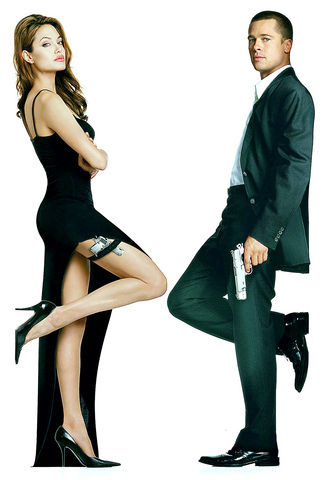
While movie stars now command far heftier salaries than those legendary performers ever dreamed of -- and still have a lock on the US' magazine covers -- it's actually rare to find a movie today that is motored by sheer star power. As films grew more expensive, studios got nervous about entrusting them to mere mortals. Instead, they began to shelter even the biggest stars with special effects, comic-book trappings or familiar franchises.
In the latest version of War of the Worlds, for example, Tom Cruise has to do little more than look terrified or ferociously determined as he battles alien invaders; the main attractions are the flying saucers and the spectacular conflagrations. In the new adaptation of the television series Bewitched, Nicole Kidman and Will Ferrell are depending on viewers' affection for beloved sitcom characters. The concept is the star, and the actors are really just along for a ride on the broomstick.
Pitt and Jolie, of course, will be surrounded by expensive special effects and ferocious gunbattles when Mr and Mrs Smith opens this week. But the pair will still have to banter, flirt, display their star wattage -- and put their oversized celebrity personas on the line.
In that sense this new movie is a lot more demanding than their other recent projects. Pitt was basically a piece of swinging weaponry in Troy, and he melted into the wisecracking ensembles of Ocean's Eleven and Ocean's Twelve, while Jolie struck poses as Lara Croft and spouted an indecipherable accent for her supporting role in the stillborn Alexander.
In their new movie, the two actors will have to face the music. They're both front and center in a battle-of-the-sexes comedy that depends on movie-star magnetism. The question audiences will answer is whether these two highly publicized stars have the sizzle to keep a vital romantic movie tradition alive. And an even more important question hangs in the balance: Does Hollywood still have the know-how to refresh one of its tastiest formulas?
When It Happened One Night swept the Oscars in 1934, it established a new kind of romantic comedy, one that depended on a battle of wits between two strong-willed lovers. In that movie, Claudette Colbert played a runaway heiress, and Clark Gable was a cynical newspaper reporter who didn't let on that he knew her real identity. In other words, their relationship was marked by suspicion and deception as well as by an undercurrent of desire, and that mixture of attraction and antagonism is what some of the best romantic movies possess.
Howard Hawks played many variations on this formula in films like Twentieth Century (with John Barrymore as a theatrical impresario and Carole Lombard as the temperamental actress he discovered) and His Girl Friday (with Cary Grant and Rosalind Russell as formerly married journalists wrangling in the newsroom).
Spencer Tracy and Katharine Hepburn struck sparks (both on screen and off) in the first movie they made together, Woman of the Year, and they continued to spar in many of their later romantic comedies, most notably in Adam's Rib, when they played married lawyers who found themselves on opposite sides of a criminal trial. In some of the most memorable scenes in that movie, their verbal jousts give way to physical jabs, as when he slaps her behind while giving her a rubdown and later when she kicks him viciously in the shins.
In Pillow Talk (1959) and again in Lover Come Back (1961), Doris Day and Rock Hudson also played professional rivals who engaged in lies, dirty tricks and sadistic humiliations before their inevitable final clinch. A higher level of danger entered the picture in Hitchcock's 1959 caper, North by Northwest, when Cary Grant exchanged teasing innuendoes with the sultry Eva Marie Saint, who happened to be in cahoots with the spies plotting to kill him.
Stanley Donen's Charade (1963) worked its own stylish variations on the Hitchcockian formula. Grant and Audrey Hepburn slipped into a mating dance flecked with menace; she was unsure until the very end of the movie whether he was a lover or a murderer in search of the fortune left by her late husband. The movie was criticized at the time for daring to mix lighthearted romantic comedy with macabre violence, an explosive combo that is driven to its illogical conclusion in Mr and Mrs Smith.
It seems likely that Simon Kinberg, the writer of Mr and Mrs Smith, and Doug Liman, the director, had some of these earlier movies -- or more recent iterations, like John Huston's Prizzi's Honor and Danny De Vito's War of the Roses -- firmly in mind while they were creating their black comedy. But this new picture highlights the dramatic changes in the cinematic landscape over the last half century.
What could once be expressed entirely in witty repartee and suggestive physical byplay (like Colbert extending her leg to flag down a ride in It Happened One Night), or later in the brutal verbiage of Who's Afraid of Virginia Woolf?, now requires the kinetic energy of punches, kicks, shooting and stabbing.
Movies have grown darker over the decades, but they've also grown more insecure. Filmmakers and studio executives no longer trust such niceties as dialogue, characterization, style or even movie-star charisma to involve viewers in lovers' conflicts. Instead, today's filmmakers feel the need to pump up the volume and ramp up the firepower to make sure they hold the interest of impatient audiences.
Yet Pitt and Jolie, though backed by a deafening array of explosions, can't escape their challenge in this one. There is virtually no supporting cast; the only other actor with a significant role, Vince Vaughn, doesn't even get a screen credit. So the two stars, if they succeed in igniting the box office, may not exactly revive the genre of scintillating romantic comedy. But they will have kept it from dying out altogether.

Sept.16 to Sept. 22 The “anti-communist train” with then-president Chiang Kai-shek’s (蔣介石) face plastered on the engine puffed along the “sugar railway” (糖業鐵路) in May 1955, drawing enthusiastic crowds at 103 stops covering nearly 1,200km. An estimated 1.58 million spectators were treated to propaganda films, plays and received free sugar products. By this time, the state-run Taiwan Sugar Corporation (台糖, Taisugar) had managed to connect the previously separate east-west lines established by Japanese-era sugar factories, allowing the anti-communist train to travel easily from Taichung to Pingtung’s Donggang Township (東港). Last Sunday’s feature (Taiwan in Time: The sugar express) covered the inauguration of the

The corruption cases surrounding former Taipei Mayor and Taiwan People’s Party (TPP) head Ko Wen-je (柯文哲) are just one item in the endless cycle of noise and fuss obscuring Taiwan’s deep and urgent structural and social problems. Even the case itself, as James Baron observed in an excellent piece at the Diplomat last week, is only one manifestation of the greater problem of deep-rooted corruption in land development. Last week the government announced a program to permit 25,000 foreign university students, primarily from the Philippines, Indonesia and Malaysia, to work in Taiwan after graduation for 2-4 years. That number is a

In a stark demonstration of how award-winning breakthroughs can come from the most unlikely directions, researchers have won an Ig Nobel prize for discovering that mammals can breathe through their anuses. After a series of tests on mice, rats and pigs, Japanese scientists found the animals absorb oxygen delivered through the rectum, work that underpins a clinical trial to see whether the procedure can treat respiratory failure. The team is among 10 recognized in this year’s Ig Nobel awards (see below for more), the irreverent accolades given for achievements that “first make people laugh, and then make them think.” They are not

This Qing Dynasty trail takes hikers from renowned hot springs in the East Rift Valley, up to the top of the Coastal Mountain Range, and down to the Pacific Short vacations to eastern Taiwan often require choosing between the Rift Valley with its pineapple fields, rice paddies and broader range of amenities, or the less populated coastal route for its ocean scenery. For those who can’t decide, why not try both? The Antong Traversing Trail (安通越嶺道) provides just such an opportunity. Built 149 years ago, the trail linked up these two formerly isolated parts of the island by crossing over the Coastal Mountain Range. After decades of serving as a convenient path for local Amis, Han settlers, missionaries and smugglers, the trail fell into disuse once modern roadways were built


 RSS
RSS