


On a recent spring morning, Lura Stiller sat in her stockinged feet in a sunny cottage in Cambridge, Massachusetts, helping Cary Friedman and his partner, Rick Wellisch, calm their daughter, a three-month-old in a pink T-shirt.
Stiller, 34, a homemaker from the Dallas suburbs, likes to say that the number of gay people in her acquaintance before she met Friedman, a psychiatrist, and Wellisch, an internist, amounted to zero. "Everything I knew about gay people I knew from TV, which meant that everything I knew about gay people I learned from Will & Grace and The L Word," she said.
In December, Stiller gave birth to the baby, named Samantha, for Friedman and Wellisch, conceived with a donor egg and the sperm from one of the partners. (They chose not to know which.) In her decision to work with them Stiller is part of a small but growing movement of surrogate mothers choosing gay couples over traditional families.
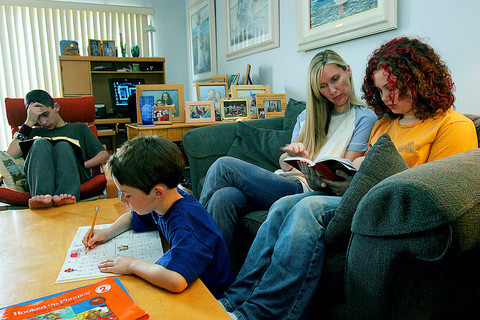
PHOTO: NY TIMES
As legislatures debate giving gay couples the right to marry -- 14 states have amended their constitutions to prevent it -- hundreds of couples are finding ways to create families with or without marriage through surrogates like Stiller, who are willing to help them have children genetically linked to them and to bypass the often difficult legal challenges gay men face in adoption.
The exact number of surrogates who have worked with gay couples is unknown, but nearly half of the 60 or so agencies and law firms around the country that broker arrangements between surrogate mothers and prospective parents work with gay couples or are seeking to, through advertising.
Within the close-knit world of professional childbearers, many of whom share their joys and disillusionments online and in support groups, gay couples have developed a reputation as especially grateful clients, willing to meet a surrogate's often intense demands for emotional connection, though the relationships can give rise to other complications within the surrogate's family and community.
Many surrogates who choose to work for gay couples say they feel ill- equipped or reluctant to deal with the sense of hopelessness and failure expressed by married women and men who have struggled unsuccessfully for years to bear children. Still others are drawn to men as clients because they fear the possible resentments and jealousies in working so closely with other women.
Surrogates, who are paid about US$20,000 above and beyond medical expenses to carry a child, are responsible for approximately 1,000 births a year, according to the Organization of Parents Through Surrogacy, a nonprofit group that records births brokered through agencies. That number does not include surrogate arrangements made privately on the Internet.
The many surrogates who choose not to work with gay couples frequently cite a spouse's disapproval or fears that their own children might be stigmatized by classmates and neighbors. In some instances surrogacy brokers bow to their own reservations.
Ann Coleman, an adoption and surrogacy lawyer in Greenville, South Carolina, said she would not pair women with gay couples. Though she once represented a lesbian couple in a custody suit against their former husbands, Coleman said she believed gay couples should pursue children through adoption, not surrogacy.
In the last 13 years, Stiller has had five children: one with her first husband, two with her current husband, and two more as a surrogate. Her first excursion into the world of surrogacy, for a Florida husband and wife, left her feeling unappreciated and depleted, she said.
getting deeper
Though the couple visited her in her 18th week of pregnancy and brought gifts for her children, Stiller sought a deeper relationship with the intended mother, a 40-year-old doctor. "She would call me as if I were working on a project," Stiller said. "She wouldn't say: `Hi, how are you feeling? Are you enjoying the weather?' Nothing. There was never any chitchat."
In her 37th week, Stiller experienced early contractions and called the woman, who drove to Texas right away, but Stiller remained displeased with her level of engagement. "She was here for two-and-a-half weeks, and she never made an opportunity to share in my family," Stiller said. "It was very important for me to have my children see that we were helping to create a family, that Mommy wasn't giving away a brother or a sister."
A friend in the surrogate world suggested she find a gay couple through the agency Circle Surrogacy.
John Weltman, a Boston lawyer, had a challenging time finding women to carry children for gay men when he founded Circle Surrogacy a decade ago. Today, he said, 80 percent of the surrogate mothers who come to him say they would be willing to work with gay couples, and half prefer to work with gay couples.
In Los Angeles, Growing Generations, a company formed to help gay couples become parents through egg donation and surrogacy, is responsible for more than 300 births, increasing from four births in 1998 to 108 within the last 17 months.
Dawn Buras, a Baltimore mother of four, has been to a fertility clinic in Los Angeles three times to receive embryonic transplants for a male couple in Boston. Each time the men, one of whom works in television, accompanied her. They took adjacent hotel rooms, dined out and provided a visit to the set of Desperate Housewives. The pregnancy attempts failed, but still the men try, refusing to work with anyone else.
And Buras remains committed, despite the limitations their efforts have placed on her intimate life. According to her contract, Buras cannot have sex with her husband either one month before or one month after the transfer. Though her husband has been very supportive, she explained, "I can't say that it doesn't bother him, because it does."
Nearly all agencies require that surrogates already have children of their own and that they and their husbands undergo medical and psychological screening to determine that they can handle the strains surrogacy inevitably levies on families.
Dr Hilary Hanafin, the chief psychologist at the Center for Surrogate Parenting in Los Angeles, the country's largest surrogacy agency, said many surrogates with teenage children shy away from working with gay couples. "The mother does not want to show up for a middle-school track meet and say, `I'm pregnant for a gay couple,"' Hanafin said.
And sometimes relatives cannot withhold their judgments. "I had one surrogate whose mother-in-law disowned her," said Amy Zaslow, a consultant to surrogates and prospective parents. "She did not walk into the house through the entire pregnancy."
Most surrogates, for heterosexual or gay couples, work as gestational carriers, meaning they bring children to term but not with their own genetic material. (Couples availing themselves of
surrogacy typically get eggs from banks where donors are identified by their height, weight, College Board and IQ scores.)
The typical surrogate, according to the Center for Surrogate Parenting, is a woman of 21 to 37, who has had two children and 13 years of formal education. In many cases, she is motivated by a desire to be pregnant, as well as by a desire for attention.
defying the odds
Some surrogates also say they find the sense of defiance in providing gay couples with children meaningful.
"In all honesty, there's a bit of a rebellious nature in me," acknowledged Shannon Klein, a mother of three in Cypress, California, who home-schools her children. "I know that there are people who wouldn't approve of being a surrogate for gay parents, and that has made it more intriguing."
Klein has borne two children for two gay couples, and she is pregnant with twins for a third.
"When she initially approached me with this, I said, `You want to do what?"' commented Klein's husband, Mark. "But we've developed friendships with these people, not fly-by-nights but lifelong relationships with people we may never have met otherwise."
Stiller's visit to Cambridge in March was her second. They cared for her children in Texas while she recuperated from giving birth to Samantha. Seeing the baby for the first time, she said, "was like seeing the baby of your best friend."
She and the couple have no prescribed plan for their future relationship, expecting it to evolve "as relationships with college friends do," Wellisch said. Friedman said, "We didn't go into this saying, `We want an intense relationship,' but I didn't necessarily expect that we'd develop the bond that we have."
They will have little competition for Stiller's affections. She will be working with no other couples in the future. When her husband, Keith, returned home last month from Iraq, where he had been stationed for a year, he told her he did not want her to work as a surrogate again.
"He was concerned for my health and emotional well-being," Stiller said. "For a year your life is devoted to someone else's. And physically I think he wanted me to get back to my wonderful size eight."

“Taiwan’s Opposition Leader Comes to US With a Message Straight Out of Beijing” read a May 31 headline in the Wall Street Journal. Top US administration officials and members of Congress almost certainly read the WSJ, and if there was a bullet point takeaway that people in Washington should absorb ahead of Chinese Nationalist Party (KMT) Chair Cheng Li-wun’s (鄭麗文) arrival in DC on June 9, that headline is it. The last few columns have discussed this very topic, and the timing is not coincidental. While those top officials likely do not read the Taipei Times, judging by the number

With weighty, anxiety-inducing geopolitical topics dominating the headlines, checking in on the wild and weird state of local politics can take some of the edge off. This November’s elections will determine who will be in charge of fixing potholes in your neighborhood, not the potholes in Taiwan’s complicated geopolitical space. Recently, after an online interview with a Taipei-based journalist, I commented that Taipei journalists never go further than the MRT can take them. He laughed and agreed. Naturally, the Taipei mayoral race is eating up much of the press attention. TAIPEI CITY Democratic Progressive Party (DPP) candidate Puma Shen (沈伯洋) has

Audiences in Leicester, Cardiff, London and Sheffield will this month gather to watch a series of black-and-white Taiwanese-language films made more than 70 years ago. On the surface, these screenings commemorate the seventieth anniversary of taiyupian (台語片) — Taiwanese-language cinema. Yet the significance of these events extends far beyond nostalgia or film history. They represent a remarkable chapter in Taiwan’s ongoing effort to recover, preserve and reinterpret a cultural heritage that was once thought to have largely disappeared. The centerpiece of the program is the Ho Chi-ming (何基明) directed Xue Pinggui and Wang Baochuan (薛平貴與王寶釧), a film produced in 1955 and

In December of 2008 Lee E-tin (李乙廷), a Miaoli county legislative hopeful, was convicted of vote-buying. Rather than buy votes retail, voter by voter, in the usual manner, Lee had done it wholesale, in a commendably efficient manner: he had visited local temples and made donations to gain their support. Because he did not normally make donations to temples, the court ruled he was attempting to improperly influence voter behavior. The case indicates how important temples are in influencing political life. Both judge and politician appeared to see them in the same way. Beijing sees them that way as well. Democratic Progressive


 RSS
RSS