


Every morning, members of Taiwan's U Theatre (優劇場) travel to Laochuan Mountain (老泉山), in Mucha, to begin their daily regime of meditation, martial arts and drumming. The performance company's rigorous routine and emphasis on Zen Buddhism is more comparable to that of a monastery than a theater troupe, making its latest collaborative project with Shaolin practitioners a fitting venture.
Twenty-one performers from the Shaolin Temple Academy in Henan province, China, will join two Taiwanese masters of martial arts and U Theatre to stage A Touch of Zen at the national theater in Taipei beginning next week.
U Theatre is perhaps most recognized for its percussion-based productions that incorporate elements of Beiguan opera and modern theater into its trademark on-stage sacred drumming (神鼓). The group also has a history of collaborating with other artists, including the 2001 re-staging of The Sound of Ocean in which a children's choir from Hualien Zhou Fang Elementary School was invited to perform.
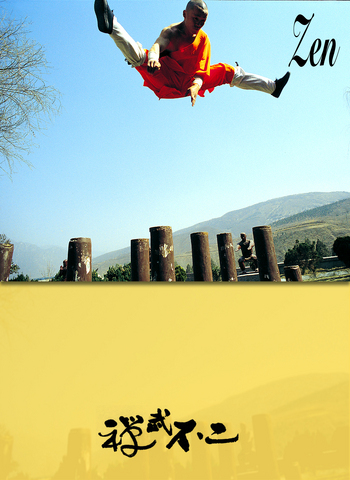
Unlike in past projects, this time it was a promoter within the Shaolin academy that approached U Theatre artistic director, Liu Ruo-yu (劉若瑀) and drum master Huang Chih-wen (黃志文) about incorporating theater and music into a martical arts performance. From there Liu and Huang took over and began penning a script. In the end, they produced a project that combines the talents of both groups and "has turned out to be a powerful learning experience for everyone involved," Liu said.
Like their co-performers, U Theatre members value meditation and qigong as much as any Shaolin apprentice, Liu said. Even their drum master, Huang, requires his students to first learn how to meditate properly before studying
percussion.
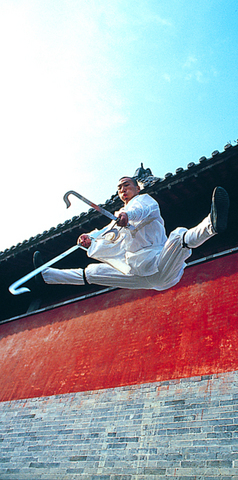
Witnessing the rigid schedule of the youthful (aged 14 to 20) Shaolin practitioners who wake up before 5am every morning to begin their training, U Theatre members have come to realize the strict discipline emphasized in martial arts, she explained. In the same vein, the project has also provided the Shaolin performers with an opportunity to study Buddhism, which for some is their first experience with the religion. "Martial arts is rooted in Zen, but many of those masters and students [in the Shaolin temple] have not read even one Buddhist scripture," Liu said.
The Shaolin temple shares a history with Buddhism's introduction into China. Both popular and academic opinions trace the Indian monk Da Mo (also known as Bodhidarma) to the early stages of the Shaolin lineage and the religion's induction into Chinese society. Historical evidence has also been used to show that the Indian master was invited to China to teach Buddhist theory during the reign of emperor Liang Wu (502-550 AD). When the emperor rejected Da Mo's religious philosophy, he withdrew to a Shaolin temple, taking his scriptures with him.
Restrictions on religious dogma and practice in China, however, have aided in turning the Shaolin tradition into more of a secular practice. "They [Shaolin practitioners] cannot really understand the Buddhist scripture but they have a history in it. Because they study martial arts they are familiar with the logic and they have an innate curiosity in Zen teachings," Liu claimed. This was her reason for including a scene in the show where all the performers recite a Buddhist scripture together on stage.
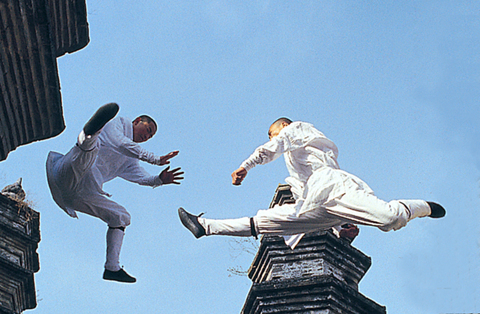
Similar to the troupe's last production -- Meeting with Vajrasattva, based on a meeting with the Tibetan Buddhist god of wisdom -- the new script is equally laden with religious undertones. A Touch of Zen, in which the English translation of the Chinese title reads, "Chan (Zen Buddhism), Martial Arts Not Two," holds the premise that martial arts are incomplete without Buddhism and vice versa, Liu said.
The storyline follows a child (Ao Xiang), abandoned by his mother at a Shaolin temple after his father is killed by a high-ranking general. When the boy turns 18 years old he learns of his father's murder and mother's imprisonment, and vows to avenge his family's tragedy by killing the general. Throughout the story both the boy and the general are confronted with the inseparable relationship between Buddhism and martial arts.
Apart from the roles of the general and an elderly monk, played by a Taiwanese taichi and qigong instructor respectively, Shaolin practitioners perform all the additional characters. To rehearse for the show, U Theatre traveled to China so they could practice with their young performers.

While most U Theatre's productions include minor elements of acting, singing and operatic movement, A Touch of Zen focuses on martial art movement with a background of dramatic on-stage drumming.
"This is our first time to use only martial arts as the basis of movement in a show. But dance is one way to tell a story and martial arts is another. For this performance we let martial arts narrate the story on stage," Liu said.
Performance notes:
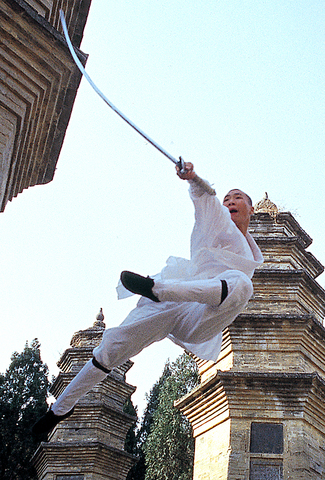
What: A Journey of Zen: A joint-performance with Henan Province Shaolin Temple Martial Arts Academy and Taiwan's U Theatre
When: Thursday June 2 to Saturday June 4, at 7:30pm, with a Sunday June 5 matinee at 2:30pm
Where: CKS Cultural Center National Theater (
Tickets: NT$400 to NT$2,500 available online at CKS Cultural Center Box Office or online at www.artsticket.com.tw
Telephone: (02) 3393 9888

In late October of 1873 the government of Japan decided against sending a military expedition to Korea to force that nation to open trade relations. Across the government supporters of the expedition resigned immediately. The spectacle of revolt by disaffected samurai began to loom over Japanese politics. In January of 1874 disaffected samurai attacked a senior minister in Tokyo. A month later, a group of pro-Korea expedition and anti-foreign elements from Saga prefecture in Kyushu revolted, driven in part by high food prices stemming from poor harvests. Their leader, according to Edward Drea’s classic Japan’s Imperial Army, was a samurai

The following three paragraphs are just some of what the local Chinese-language press is reporting on breathlessly and following every twist and turn with the eagerness of a soap opera fan. For many English-language readers, it probably comes across as incomprehensibly opaque, so bear with me briefly dear reader: To the surprise of many, former pop singer and Democratic Progressive Party (DPP) ex-lawmaker Yu Tien (余天) of the Taiwan Normal Country Promotion Association (TNCPA) at the last minute dropped out of the running for committee chair of the DPP’s New Taipei City chapter, paving the way for DPP legislator Su

It’s hard to know where to begin with Mark Tovell’s Taiwan: Roads Above the Clouds. Having published a travelogue myself, as well as having contributed to several guidebooks, at first glance Tovell’s book appears to inhabit a middle ground — the kind of hard-to-sell nowheresville publishers detest. Leaf through the pages and you’ll find them suffuse with the purple prose best associated with travel literature: “When the sun is low on a warm, clear morning, and with the heat already rising, we stand at the riverside bike path leading south from Sanxia’s old cobble streets.” Hardly the stuff of your
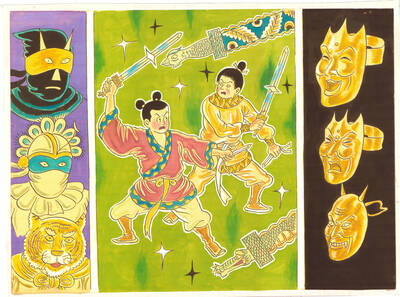
April 22 to April 28 The true identity of the mastermind behind the Demon Gang (魔鬼黨) was undoubtedly on the minds of countless schoolchildren in late 1958. In the days leading up to the big reveal, more than 10,000 guesses were sent to Ta Hwa Publishing Co (大華文化社) for a chance to win prizes. The smash success of the comic series Great Battle Against the Demon Gang (大戰魔鬼黨) came as a surprise to author Yeh Hung-chia (葉宏甲), who had long given up on his dream after being jailed for 10 months in 1947 over political cartoons. Protagonist


 RSS
RSS