


Everyone, it seems, wants a phone that does something more than call other cellphones and phones that take photos have been the rage since they hit the shelves just a few years ago. The problem is, the photos they take are often far below the quality you'd expect from even the lowest-end digital cameras.
That problem is being solved. At the end of last year, consumers began seeing cellphones with 1MP, 1.2MP and even 1.3MP ratings, shorthand for "this phone takes clear photos even if you blow them up to normal photo size."
In determining the quality of what we'll refer to here as megapixel phones, an important thing to keep in mind is why this business of enlarging photos hasn't been a major concern among the majority of cellphone consumers. Namely, convenience. Getting the photos from the tiny screen of your cell phone to your computer -- or perhaps your friends' e-mail inboxes -- has been something of a hassle that involved cables or card readers. Now that problem, too, is being solved. And the manufacturers who are solving the convenience problems best are the ones creating the better camera phones.
Here's a look at a few of the top-selling models.
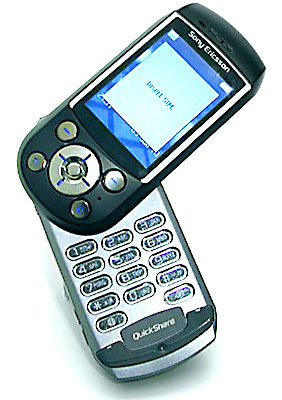
SONY-ERICSSON S710a (approx. NT$15,500)
Don't confuse this model with the company's S710. That one is a so-called smart phone hand-held organizer whose bells and whistles are geared toward business productivity. The S710a is for shutterbugs. So much so that the phone is even designed to look like a camera on one side. Its other distinctive design features are that, like the Kyocera Koi/KX2, it swivels to open up for talking. But unlike the Kyocera, it has a huge screen that frames up and displays photos of much better clarity and color contrast than the Kyocera. Those photos come from a 1.3MP camera, currently the largest on the market but not a great step up from Motorola's V710 at 1.2MP or even Nokia's 7610 at a single megapixel.
Remember that when digital cameras began increasing their pixelage, they jumped from one or two megapixels to five, eight and even 11MP. Don't be too impressed with 1.3MP.
What you should be impressed with is the ease with which you can share the photos you take. Here, Sony-Ericsson has offered a number of methods, not the least of which is a technology called EDGE that can e-mail photos into friends' inboxes or serve as a dial-up modem for your computer. And because the phone utilizes an excellent Bluetooth implementation, connecting to a computer doesn't require wires. Want to hand your photos over to friends without paying for the phone calls to e-mail them to him? Simply pull out the 32MB memory stick for them to plug into their computers.
Among the drawbacks to the S710a, however, is its battery life. If you want to talk about the photos you've just e-mailed to a friend, you'll have to limit your talk time given the phone's relatively short battery life (surprising, considering the phone's bulky size). The earpiece speaker is also not as loud as it could/should be, though most users claim this isn't a problem if you use a Bluetooth headset.
NOKIA 7610
(approx. NT$11,600)
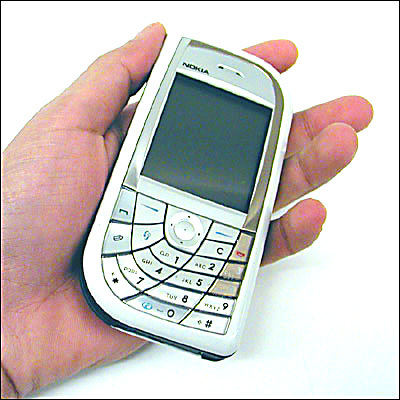
Used to be that if I was looking to buy a phone, I never looked far beyond my local Nokia dealer. As Nokia is the second most popular cellphone manufacturer in Taiwan, that's true of a lot of folks. But then something happened. I bought a 6300 that was slow and by the time I was ready to buy again, Nokia's phones all looked like they were designed by the love child of Coco Chanel and Salvador Dali.
This is true of the company's 7610, a megapixel phone whose swish-style keypad left-handed users can all but rule out. Having said that, if you're wanting a phone that takes clear 1MP photos without compromising on its phone qualities, this might be the gadget to grab.
The 7610 actually came to market a few months earlier than Sony-Ericsson's megapixel phone but didn't cause as much of a splash, ostensibly because it was only a single megapixel, a feat Motorola had already surpassed with their V710.
Like the S710a, the 7610 has all kinds of ways of sharing your photos, but it goes a step further into smart phone territory by incorporating a Symbian operating system. In addition to sending e-mail, you can also browse the Web and read Microsoft Office documents. A cool feature called Lifeblog lets you look at all your e-mail, text messages, and videos in chronological order, together, on your phone or PC screen.
MOTOROLA V710
(approx. NT$15,500)
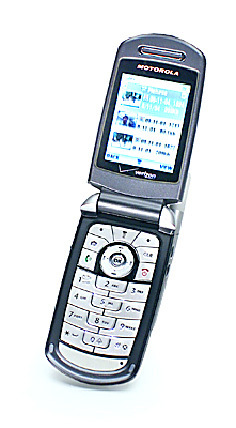
Why all of these phones have 710 in the name is beyond me, but like the S710a, Motorola's V710 has a 1.3MP camera and Bluetooth capabilities. But unlike the models above, that capability doesn't translate to sharing photos easily between the phone and your computer, because Motorola has disabled the Bluetooth file transfer function (It did so first on US models so that US carriers could entice customers to pay for a Pix Messaging service). And despite their file size, the photos the camera takes aren't as fine as on the Sony-Ericsson or Nokia.
The flip-side to this flip-style phone is the phone itself. Crystal clear reception is surely one of the reasons Motorola makes the best-selling phones in Taiwan. Also, it was one of the first models to have an external screen that shows the caller's photo, provided you've taken one and assigned it to the proper contact in your rolodex. But be warned; while the photos look great on either of the phone's screens, they're not as clear when you get them to your computer screen. That is, if you bother going through the inconvenience of getting them to your computer screen.
Lastly, for a visual comparison of photos taken by these and other camera phones, take a look at PC Magazine's camera phone test image gallery at the Web site www.pcmag.com/slideshow/0,2394,a=135650,00.asp. There you can enlarge the cellphone screen-sized thumbs to normal photo size and see clearly what's still unclear about megapixel phones: Even 1.3MP cameras have jagged diagonal edges in the images they take. If the quality of your photo is important it might be best to wait a generation for the 2 or 3MP models.

Sept.16 to Sept. 22 The “anti-communist train” with then-president Chiang Kai-shek’s (蔣介石) face plastered on the engine puffed along the “sugar railway” (糖業鐵路) in May 1955, drawing enthusiastic crowds at 103 stops covering nearly 1,200km. An estimated 1.58 million spectators were treated to propaganda films, plays and received free sugar products. By this time, the state-run Taiwan Sugar Corporation (台糖, Taisugar) had managed to connect the previously separate east-west lines established by Japanese-era sugar factories, allowing the anti-communist train to travel easily from Taichung to Pingtung’s Donggang Township (東港). Last Sunday’s feature (Taiwan in Time: The sugar express) covered the inauguration of the

The corruption cases surrounding former Taipei Mayor and Taiwan People’s Party (TPP) head Ko Wen-je (柯文哲) are just one item in the endless cycle of noise and fuss obscuring Taiwan’s deep and urgent structural and social problems. Even the case itself, as James Baron observed in an excellent piece at the Diplomat last week, is only one manifestation of the greater problem of deep-rooted corruption in land development. Last week the government announced a program to permit 25,000 foreign university students, primarily from the Philippines, Indonesia and Malaysia, to work in Taiwan after graduation for 2-4 years. That number is a

In a stark demonstration of how award-winning breakthroughs can come from the most unlikely directions, researchers have won an Ig Nobel prize for discovering that mammals can breathe through their anuses. After a series of tests on mice, rats and pigs, Japanese scientists found the animals absorb oxygen delivered through the rectum, work that underpins a clinical trial to see whether the procedure can treat respiratory failure. The team is among 10 recognized in this year’s Ig Nobel awards (see below for more), the irreverent accolades given for achievements that “first make people laugh, and then make them think.” They are not

This Qing Dynasty trail takes hikers from renowned hot springs in the East Rift Valley, up to the top of the Coastal Mountain Range, and down to the Pacific Short vacations to eastern Taiwan often require choosing between the Rift Valley with its pineapple fields, rice paddies and broader range of amenities, or the less populated coastal route for its ocean scenery. For those who can’t decide, why not try both? The Antong Traversing Trail (安通越嶺道) provides just such an opportunity. Built 149 years ago, the trail linked up these two formerly isolated parts of the island by crossing over the Coastal Mountain Range. After decades of serving as a convenient path for local Amis, Han settlers, missionaries and smugglers, the trail fell into disuse once modern roadways were built


 RSS
RSS