


You don't have to read very far into Dangerous Strait before you realize it's an exceptionally important book on Taiwan -- probably the most important to have been published on the subject for many years. It's simultaneously authoritative and deadly earnest. First, though, what kind of book is it?
What the seven US-based contributing writers have put together is an assessment of Taiwan's current situation, but viewed with the purpose of establishing what US policy should be in the region. The authors were invited in the summer of 2003 to hold a workshop for members of the Research Bureau of the Department of State where they presented their findings. That workshop was intended as a contribution to decision-making on Taiwan at the highest level in Washington. This book now follows up on that intention.
It opens with the assertion that the Taiwan Strait is the most dangerous place on earth as far as American interests are concerned. The Middle East, terrorism and rogue states may cause more immediate worries, but the implications of any armed conflict over Taiwan involving a nuclear-armed China and the US would be more serious than any of these.
The background to this cool-headed but nevertheless chilling analysis is the possibility of a shift in Washington from its traditional "strategic ambiguity" towards Taiwan (not specifying what it would do in the case of an attack by China) to "strategic clarity" (making clear in advance exactly what action it would take). President George W. Bush's assertion in 2001 that the US would do "whatever it takes" to defend Taiwan has been seen as a move from the former to the latter position, though it lacks the specific statement of intentions some hard-liners would still prefer to hear.
The conclusion of this book's editor, long-time China-watcher Nancy Bernkopf Tucker, who formerly worked in the US embassy in Beijing and in other posts with the State Department, is that the traditional US policy of strategic ambiguity remains the wiser option. She contributes the opening and closing chapters to the book, but it can be assumed the other contributors share the same opinion.
The pressure for a more exact statement of intentions includes the example of Iraq. The failure of the US to make clear its resolve encouraged Saddam Hussein to invade Kuwait, so the argument goes. But strategic ambiguity has served the US and the East Asia region well for 50 years, Tucker argues. Today, China's leaders "are using economic integration and patience rather than military coercion and deadlines to try to facilitate integration." They are doing this because they believe time is on their side, but also because, in the face of the US' strategic ambiguity, "a peaceful policy simply seems the wisest course," she concludes.
This is particularly important because the argument of those who urge on the US a more specific set of statements on what its reaction would be in the case of any conflict believe such statements would constitute a more effective deterrent to China. This book argues the opposite: Ambiguity is what has deterred effectively in the past and has resulted in a state of peaceful coexistence, whatever the sometimes confrontational rhetoric of the politicians. This policy, therefore, should not be changed.
Before reaching this conclusion, the book looks at all the main aspects of Taiwan's current situation. A large amount of history and contemporary material is surveyed, all the more attractively, given the status of the various authors, all previously published writers on the Taiwan question.
Richard Bush, former head of the American Institute in Taiwan and arguably the book's most distinguished contributor, examines the legacy of Lee Tung-hui. He sees Lee, despite his sometimes authoritarian paternalism, as having been pivotal in the balancing of KMT and DPP historical forces, albeit often an irritant in US-Taiwan relations on account of some of the positions he has endorsed.
Shelley Rigger places under the microscope the very complex historical strands the DPP has had no alternative but to try to weave together, and she doesn't hold back from pointing to the party's shortcomings in its early months in government. Steven Phillips, meanwhile, surveys the labyrinthine historical background of independence aspirations on the island.
On the economic front, T. J. Cheng considers the effect of the fast-increasing business ties between Taiwan and China, and concludes that these imply neither growing political harmony nor a business-backed move towards eventual unification.
Michael D. Swaine analyzes Taiwan's military reform and modernization program, and highlights differences in perceptions within Taiwan on military issues, differences exacerbated by uncertainties about the exact levels of future US assistance and commitment. But Michael Chase, also writing about military matters, points to a greater level of US-Taiwan cooperation in the field of military training than the public is generally aware of, while analyzing the differences that remain on the issue of weapons procurement.
All in all, Dangerous Strait is an outstanding book, uniquely authoritative and uniquely sober and careful in all its assertions. It could, of course, be perceived as a contribution to the chorus of critics calling on the current administration in Washington to think again before departing from traditional US policies. But in reality it is more than that. It's true that it is a call for caution by the US in its relations with both Taiwan and China, but it is also an enormously powerful source-book for facts and previous judgments on all aspects of the US-Taiwan question.

In late October of 1873 the government of Japan decided against sending a military expedition to Korea to force that nation to open trade relations. Across the government supporters of the expedition resigned immediately. The spectacle of revolt by disaffected samurai began to loom over Japanese politics. In January of 1874 disaffected samurai attacked a senior minister in Tokyo. A month later, a group of pro-Korea expedition and anti-foreign elements from Saga prefecture in Kyushu revolted, driven in part by high food prices stemming from poor harvests. Their leader, according to Edward Drea’s classic Japan’s Imperial Army, was a samurai

The following three paragraphs are just some of what the local Chinese-language press is reporting on breathlessly and following every twist and turn with the eagerness of a soap opera fan. For many English-language readers, it probably comes across as incomprehensibly opaque, so bear with me briefly dear reader: To the surprise of many, former pop singer and Democratic Progressive Party (DPP) ex-lawmaker Yu Tien (余天) of the Taiwan Normal Country Promotion Association (TNCPA) at the last minute dropped out of the running for committee chair of the DPP’s New Taipei City chapter, paving the way for DPP legislator Su

It’s hard to know where to begin with Mark Tovell’s Taiwan: Roads Above the Clouds. Having published a travelogue myself, as well as having contributed to several guidebooks, at first glance Tovell’s book appears to inhabit a middle ground — the kind of hard-to-sell nowheresville publishers detest. Leaf through the pages and you’ll find them suffuse with the purple prose best associated with travel literature: “When the sun is low on a warm, clear morning, and with the heat already rising, we stand at the riverside bike path leading south from Sanxia’s old cobble streets.” Hardly the stuff of your
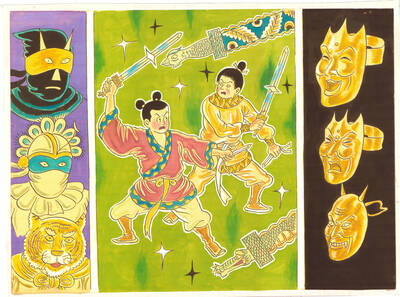
April 22 to April 28 The true identity of the mastermind behind the Demon Gang (魔鬼黨) was undoubtedly on the minds of countless schoolchildren in late 1958. In the days leading up to the big reveal, more than 10,000 guesses were sent to Ta Hwa Publishing Co (大華文化社) for a chance to win prizes. The smash success of the comic series Great Battle Against the Demon Gang (大戰魔鬼黨) came as a surprise to author Yeh Hung-chia (葉宏甲), who had long given up on his dream after being jailed for 10 months in 1947 over political cartoons. Protagonist


 RSS
RSS