


Many Taiwanese people have chosen to emigrate to the US to seek a better life for themselves and for their children. But the American dream is not always as glamorous as it looks.
According to the Overseas Chinese Affairs Commission (OCAC), about 166,000 Taiwanese people relocated to the US in the 1990s alone. As many as 529,000 Taiwanese people reside there at present. Many of them chose to do so in order to provide their children with a better education.
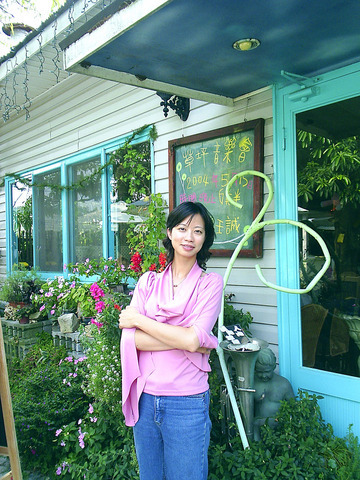
Take the Wang (
PHOTOS COURTESY OF THE FAMILIES
"I believe the education system in the US is not only liberal but also consistent compared to that in Taiwan. So my kids can choose to do what they like and give full play to their talent," said their mother Shirley Shen (
The three children are constantly busy with school and extra-curricular talent classes. They all attend cram schools for three hours of extra Chinese, English, and Mathematics classes during the weekdays to maintain their outstanding academic performance.
"Unlike most traditional Taiwanese parents, we do not force our kids to attend cram schools or talent classes, except for their Chinese courses," said their father Steve Wang (
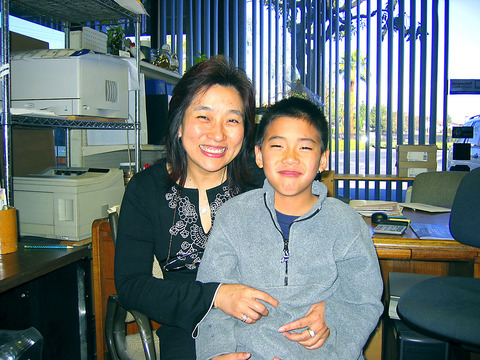
"My kids can often yield twice the result with half the effort, because they are taking these classes out of their own interests."
The Wang family pays more than US$750 (about NT$23,250) per month for the three children's extra classes and activities. But the parents think that it is an investment worth making.
Not always so rosy
But living abroad can also be a bittersweet experience sometimes, as parents and their children have to overcome numerous difficulties. The major problems that affect young emigrants the most are the cultural and linguistic barriers.
Since the three children of the Wangs were born in the US, they all speak English fluently and do not have problems with the language. They also speak Mandarin well because they are told to speak only Chinese to their parents and grandmother at home.
The experience of the children of Wang's younger brother, whose family moved to Los Angeles from Hsinchu seven years ago, was another story. They had to face not only various cultural but also language challenges.
The two boys -- Ray, 15, and Roy, 14 -- admitted that it was tough for them to communicate with other schoolmates at the beginning, and they did not really understand what their teachers said in the first six months or so.
"I was afraid to talk to others, and seldom spoke up in the first two or three months after I entered the school," said Ray.
"There are only a few Asian students in the school. Many are Mexican and Russian. We have very different backgrounds and ideas, as well as communication problems," his brother Roy said.
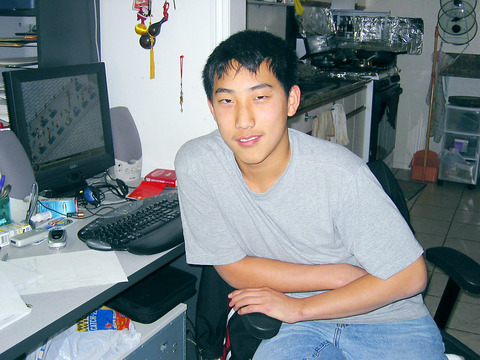
The boys said they were frustrated at first, because the pressure from school was huge. Later, things improved as they picked up the language. They also said that they prefer to live in the US now, and have less homework compared to their experience in Taiwan.
Keeping an identity
For the so-called "little overseas students" (
"I felt lost when my parents sent me to San Francisco for high school," said Julie Chang (
"Of course I was scared. I was lonely without my family around, especially when I was sick. Many of my friends got into trouble, because nobody could guide or discipline them."
"Drugs, guns, gambling ... they tried everything. Some even attempted suicide to get revenge on their parents for `deserting' them like this," said Chang, who returned to Taiwan right after she graduated from San Francisco State University in 2000.
"This phenomenon is a result of Taiwan's rigid education system, as parents are eager to send their children abroad in order to `escape' from it," said Ku Chung-hwa (
"We must guide them through educational means, so they can obtain correct cultural identity," said Ku.
"Then, based on their feelings for their motherland, we can help them expand their vision, and build a mature world view," said Ku.
The professor said the government should accelerate reforms to the education system, and push for the internationalization of education.
US is still No. 1
Today the US remains the first-choice destination for emigrants from Taiwan.
However, due to all these difficulties, young emigrants often face the dilemma of whether to return to Taiwan after college.
"US society is no longer as open as people think, especially after the 9/11 Incident," Wang said, adding that the country has become more conservative since US President George W. Bush took office.
"Besides, due to the economic downturn, it is not easy for colored people to find ideal jobs anymore, even for those with relatively high degrees," he said, adding that he may suggest to his children that they go back to the rapidly growing Asian market once they finish college.
According to an OCAC survey, about 32.9 percent of the 2,166 respondents said they plan to move back to Taiwan in the future.
About 4.5 percent said they plan to return to Taiwan soon, while about 28.4 percent said they plan to do so eventually. About half of them said they are not sure yet for many reasons.
Pop star Wang Lee-hom's (
"I am considered a foreigner in America, and also a foreigner in Taiwan. I find that quite funny," he said. "To say that I'm an American acknowledges only part of me, and vice versa."
He suggested that those who are in his shoes keep an open mind, and sincerely accept who they are.
"Now, when you talk about Chinese people, you're talking globally. Being an ABC (American-born Chinese) is something that I'm proud of. I am who I am. It's alright."

In late October of 1873 the government of Japan decided against sending a military expedition to Korea to force that nation to open trade relations. Across the government supporters of the expedition resigned immediately. The spectacle of revolt by disaffected samurai began to loom over Japanese politics. In January of 1874 disaffected samurai attacked a senior minister in Tokyo. A month later, a group of pro-Korea expedition and anti-foreign elements from Saga prefecture in Kyushu revolted, driven in part by high food prices stemming from poor harvests. Their leader, according to Edward Drea’s classic Japan’s Imperial Army, was a samurai

The following three paragraphs are just some of what the local Chinese-language press is reporting on breathlessly and following every twist and turn with the eagerness of a soap opera fan. For many English-language readers, it probably comes across as incomprehensibly opaque, so bear with me briefly dear reader: To the surprise of many, former pop singer and Democratic Progressive Party (DPP) ex-lawmaker Yu Tien (余天) of the Taiwan Normal Country Promotion Association (TNCPA) at the last minute dropped out of the running for committee chair of the DPP’s New Taipei City chapter, paving the way for DPP legislator Su

It’s hard to know where to begin with Mark Tovell’s Taiwan: Roads Above the Clouds. Having published a travelogue myself, as well as having contributed to several guidebooks, at first glance Tovell’s book appears to inhabit a middle ground — the kind of hard-to-sell nowheresville publishers detest. Leaf through the pages and you’ll find them suffuse with the purple prose best associated with travel literature: “When the sun is low on a warm, clear morning, and with the heat already rising, we stand at the riverside bike path leading south from Sanxia’s old cobble streets.” Hardly the stuff of your
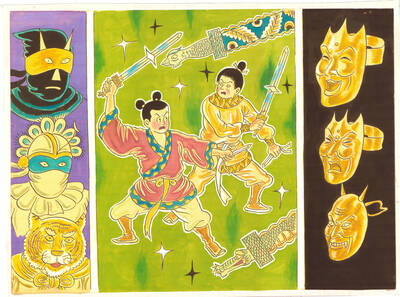
April 22 to April 28 The true identity of the mastermind behind the Demon Gang (魔鬼黨) was undoubtedly on the minds of countless schoolchildren in late 1958. In the days leading up to the big reveal, more than 10,000 guesses were sent to Ta Hwa Publishing Co (大華文化社) for a chance to win prizes. The smash success of the comic series Great Battle Against the Demon Gang (大戰魔鬼黨) came as a surprise to author Yeh Hung-chia (葉宏甲), who had long given up on his dream after being jailed for 10 months in 1947 over political cartoons. Protagonist


 RSS
RSS