


Nearly every recognized designer label associated with fashion has found its way into the sunglasses business. From progressive stylist Vivienne Westward to celebrity icon Britney Spears, there is a growing selection of designer eyewear on the market ensuring that consumers in Taiwan never run short of choices.
Once monopolized by European brand names, now most optical outlets and department stores stock a selection of Japanese labels vying to provide the latest innovative eyewear. The Asian brands are often preferred for their original handcrafted designs that are not so easily replicated.
"Like hand bags, 90 percent of the impostors [fake brand-name sunglasses sold illegally] are well made and most people cannot tell the difference," said Yang Ming-zhe (
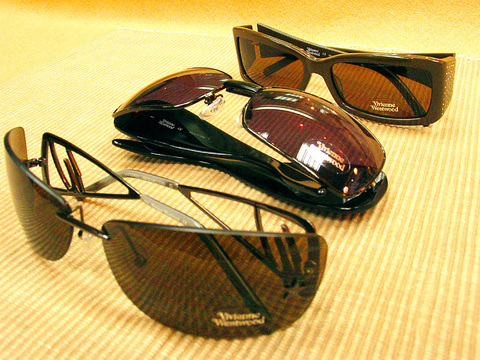
PHOTOS COURTESY OF VIVIENNE WESTWOOD
According to Yang, brand seekers are turning to Japanese labels and finding the Asian-designed vision wear to be more suited to their face shape.
High-end brands like Dolce & Gabbana, Chanel, Christian Dior, Fendi and Prada are being outsold in Taiwan by Japanese newcomers Yellows Plus, Spivvy, Spec Espace, Christian Roth, and Less Than Human, said Toshimoto Shou (
"European glasses are manufactured with a Caucasian face shape in mind; Japanese designers make glasses to suit an Asian face shape," he said and explained that the differences include wider, more rectangular eye frames and lenses with a slighter nose bridge.

PHOTO COURTESY OF YELLOWS PLUS
2005 FASHION EYEWEAR
Japanese brands tend to be more conservative and basic in shape and color than European designs, but their urban and vintage-inspired looks are equally unique and trendy.
Japanese manufactures favor handmade or finished work and the result is detailed craftsmanship and touches that set their work apart form other brands.
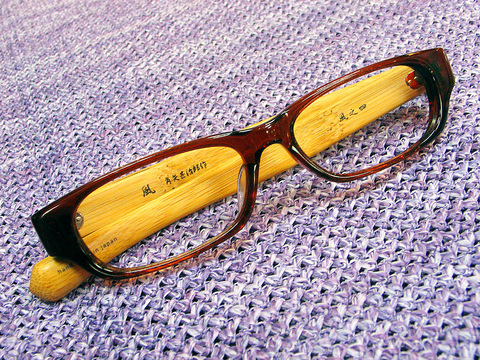
PHOTO COURTESY OF KO DOYA JINJIRO
Combining a plastic frame around the eyes with titanium arms, Yellows Plus produces glasses that are both light and strong, making it one of the most sought-after labels, Shou explained.
Tortoise shell Ko Doya Jinjiro (
European designs for summer 2005 are more retro, with shield-like lenses inside large square or oval frames. Most styles remain consistent with the designer's brand image; for example, Chanel sticks to chunky, thick frames in glossy or matte black, while Dolce & Gabbana glasses have a more glam-chic look with gem-encrusted frames in a range of colors.
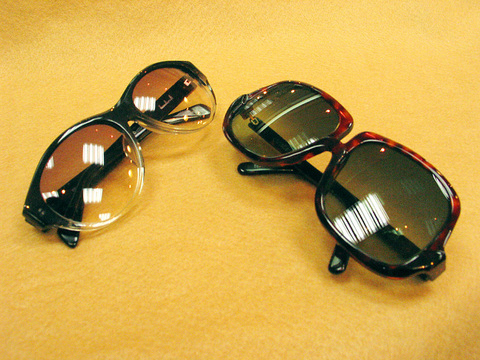
PHOTO COURTESY OF CHRISTIAN ROTH AND SPIVVY
When it comes to athletic eyewear, American and European brands still dominate the market with Oakley, Adidas, Fila and Nike favored by athletes and active types in Taiwan.
WHERE TO BUY
The latest in Japanese and European designer eyewear can be found at department stores and optical outlets island-wide. Popular Japanese brands such as Yellows Plus, Spivvy and Specs Espace average NT$8,500.
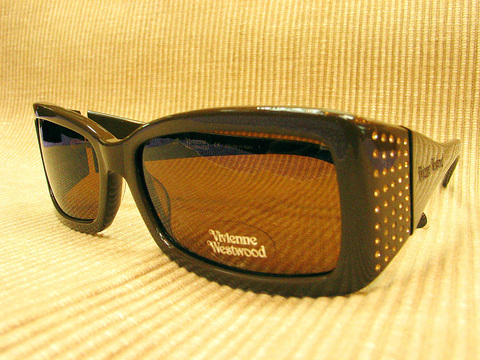
European labels have a wider price range starting at under NT$2,000 but reaching as high as NT$25,000. Most designer frames can also be altered to fit prescription lenses for an additional NT$1,000 to NT$2,000 per pair.
While fakes are illegal to sell or purchase, they have a more attractive price tag at NT$1,500 to NT$3,000 per pair and are often sold outside major department stores.
For cheap thrills, there is no shortage of inexpensive sunglasses made in the not-so-exact image of famous brand names. These can be found at night market vendors and in Ximending for NT$290 to NT$500 a pair. It is unlikely, however, that they have the same ultra-violet (UV) 400-500 polycarbonate lenses for UV protection that optical stores guarantee.
The numerous styles available can make choosing a new pair of sunglasses slightly daunting. Rain Lee (

Sept.16 to Sept. 22 The “anti-communist train” with then-president Chiang Kai-shek’s (蔣介石) face plastered on the engine puffed along the “sugar railway” (糖業鐵路) in May 1955, drawing enthusiastic crowds at 103 stops covering nearly 1,200km. An estimated 1.58 million spectators were treated to propaganda films, plays and received free sugar products. By this time, the state-run Taiwan Sugar Corporation (台糖, Taisugar) had managed to connect the previously separate east-west lines established by Japanese-era sugar factories, allowing the anti-communist train to travel easily from Taichung to Pingtung’s Donggang Township (東港). Last Sunday’s feature (Taiwan in Time: The sugar express) covered the inauguration of the

The corruption cases surrounding former Taipei Mayor and Taiwan People’s Party (TPP) head Ko Wen-je (柯文哲) are just one item in the endless cycle of noise and fuss obscuring Taiwan’s deep and urgent structural and social problems. Even the case itself, as James Baron observed in an excellent piece at the Diplomat last week, is only one manifestation of the greater problem of deep-rooted corruption in land development. Last week the government announced a program to permit 25,000 foreign university students, primarily from the Philippines, Indonesia and Malaysia, to work in Taiwan after graduation for 2-4 years. That number is a

In a stark demonstration of how award-winning breakthroughs can come from the most unlikely directions, researchers have won an Ig Nobel prize for discovering that mammals can breathe through their anuses. After a series of tests on mice, rats and pigs, Japanese scientists found the animals absorb oxygen delivered through the rectum, work that underpins a clinical trial to see whether the procedure can treat respiratory failure. The team is among 10 recognized in this year’s Ig Nobel awards (see below for more), the irreverent accolades given for achievements that “first make people laugh, and then make them think.” They are not

This Qing Dynasty trail takes hikers from renowned hot springs in the East Rift Valley, up to the top of the Coastal Mountain Range, and down to the Pacific Short vacations to eastern Taiwan often require choosing between the Rift Valley with its pineapple fields, rice paddies and broader range of amenities, or the less populated coastal route for its ocean scenery. For those who can’t decide, why not try both? The Antong Traversing Trail (安通越嶺道) provides just such an opportunity. Built 149 years ago, the trail linked up these two formerly isolated parts of the island by crossing over the Coastal Mountain Range. After decades of serving as a convenient path for local Amis, Han settlers, missionaries and smugglers, the trail fell into disuse once modern roadways were built


 RSS
RSS