


It takes eight men to catch a stray Indian cow. Fifteen if it's a particularly feisty animal. The tools of the cow catcher's trade are rudimentary -- bare hands, crude ropes and maybe a wooden stick.
Have no romantic notions of the Indian cow catcher as lasso-swinging cowboy. He is typically a disgruntled civic employee who works 16 hours a day, six days a week, for little money and no appreciation.
Since April 28, cow catchers of the Municipal Corporation of Delhi (MCD) have been on overdrive, following a high court warning to clear the streets of stray cows and buffaloes within a week.
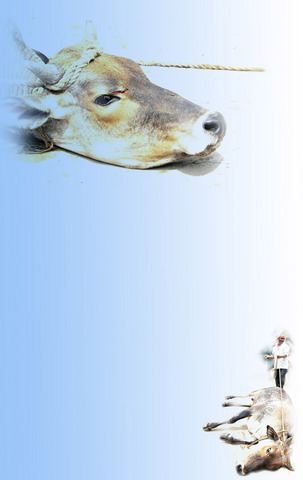
PHOTO: AFP
"From September 2003 to March 2005 we have rounded up about 30,000 cows. There are around 35,000 still on the roads," said S.K. Yadav, MCD veterinary officer, hours before the deadline approached.
Thousands of cows and bulls continued to wander aimlessly in the scorching heat, park themselves in the middle of busy roads and feast at overflowing garbage dumps.
An MCD truck swooped down on an alarmed black bull placidly perched on a central traffic verge as cars, buses and bikes whizzed by in chaotic waves. The truck stopped bang in the middle of the traffic and 11 cow catchers surrounded the animal to slip a rope around its mouth. They dragged the protesting creature onto a hydraulic lift and poked it with canes into the truck. Quite easily done.
But, many operations are dangerous, with cow catchers fracturing limbs and suffering bruises.
"Once an angry bull stuck its horns into a catcher's eye. Our work is very difficult, and there is no compensation for injuries," said Nand Kishore, a cow catcher for 25 years.
The men work without any protective gear. Most are in slippers, and use their bare hands to coax difficult animals.
"We have no training. We first use our imagination, and then learn from experience. I used to be scared, but not anymore," said Suraj Mal, 35, who has been catching cows for 12 years since he joined the MCD and was posted to this department without any scope for a transfer.
Three years ago, the cow catchers petitioned the MCD for a risk allowance of 690 rupees (US$1) per month. There was no response. Their monthly salaries begin at 3,000 rupees (US$69).
The day before yesterday, the cow catchers prepared for their 16-hour day, an eye open for stray cattle as they patrolled the roads in seven army green trucks with hydraulic lifts. Each vehicle could accommodate 12 animals.
They were followed by 15 cane-wielding police officers to deal with often violent cow owners and protesting locals.
Stray cattle are a problem in most cities because of the large number of unlicensed dairies and illegal cow sheds. With a shortage of grazing land, owners let the cows and buffaloes loose to feed themselves.
In Govindpuri village, MCD and police shut down two illegal dairies and rounded up 11 cows and calves. Sukhbiri, 45, almost in tears, said: "Nine months back they took away 10 cows. These were my last two, my source of livelihood. I have nothing left now." The cows helped her support her unemployed husband, four children and two grandchildren.
Those animals that resisted were dragged by their tails and mouths. One particularly aggressive brown cow with crazed red eyes fought off 15 cow catchers, as hundreds of people gathered to watch.
Once rounded up, the animals are taken to shelters on the outskirts of the city and auctioned off to farmers from neighboring states. "They have to sign an affidavit saying they will not keep the animals in New Delhi. If caught, they will be fined 10,000 rupees (US$230)," Yadav said.
The MCD said it alone cannot clear the city of cows. "The public should develop awareness and police should take action against illegal dairies," Yadav said.
India has a strange relationship with its cows. Hindus worship the animals and consider them holy. They are a symbol of prosperity and the backbone of Indian agriculture. But they are also left to run loose on the streets, with no one to care for them. Many are run over by speeding vehicles or choke on plastic eaten from open garbage bins.
In August 2001 the government instituted a National Commission on Cattle to suggest ways to preserve and protect cattle.
MCD officials seemed doubtful that the roads would ever be cow-free. Urban cows are so much a part of every Indian city that even German Nobel laureate Gunter Grass said he missed them when he visited eastern Calcutta city after 18 years this January.
The trip was "a little bit like coming home," Grass said. "There was something missing somewhere. I was definitely missing something. Then I realized it was the cows! The cows weren't on the streets any more."

In late October of 1873 the government of Japan decided against sending a military expedition to Korea to force that nation to open trade relations. Across the government supporters of the expedition resigned immediately. The spectacle of revolt by disaffected samurai began to loom over Japanese politics. In January of 1874 disaffected samurai attacked a senior minister in Tokyo. A month later, a group of pro-Korea expedition and anti-foreign elements from Saga prefecture in Kyushu revolted, driven in part by high food prices stemming from poor harvests. Their leader, according to Edward Drea’s classic Japan’s Imperial Army, was a samurai

The following three paragraphs are just some of what the local Chinese-language press is reporting on breathlessly and following every twist and turn with the eagerness of a soap opera fan. For many English-language readers, it probably comes across as incomprehensibly opaque, so bear with me briefly dear reader: To the surprise of many, former pop singer and Democratic Progressive Party (DPP) ex-lawmaker Yu Tien (余天) of the Taiwan Normal Country Promotion Association (TNCPA) at the last minute dropped out of the running for committee chair of the DPP’s New Taipei City chapter, paving the way for DPP legislator Su
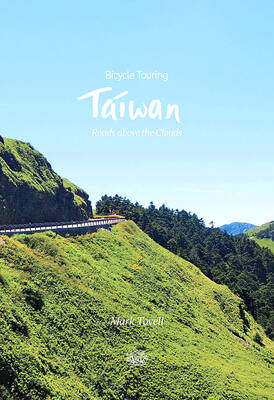
It’s hard to know where to begin with Mark Tovell’s Taiwan: Roads Above the Clouds. Having published a travelogue myself, as well as having contributed to several guidebooks, at first glance Tovell’s book appears to inhabit a middle ground — the kind of hard-to-sell nowheresville publishers detest. Leaf through the pages and you’ll find them suffuse with the purple prose best associated with travel literature: “When the sun is low on a warm, clear morning, and with the heat already rising, we stand at the riverside bike path leading south from Sanxia’s old cobble streets.” Hardly the stuff of your

April 22 to April 28 The true identity of the mastermind behind the Demon Gang (魔鬼黨) was undoubtedly on the minds of countless schoolchildren in late 1958. In the days leading up to the big reveal, more than 10,000 guesses were sent to Ta Hwa Publishing Co (大華文化社) for a chance to win prizes. The smash success of the comic series Great Battle Against the Demon Gang (大戰魔鬼黨) came as a surprise to author Yeh Hung-chia (葉宏甲), who had long given up on his dream after being jailed for 10 months in 1947 over political cartoons. Protagonist


 RSS
RSS