


Simon Napier-Bell looks lost as he trudges around Hong Kong looking for a coffee shop.
"It's changed so much I don't recognize the place," the former pop-music guru says standing on a traffic island in the middle of the downtown Central district.
Indeed Hong Kong has changed, mostly as a result of the huge changes in China, the city's parent nation just a few miles to the north. And Napier-Bell is all too aware of change there.

PHOTO: AFP
"We helped start that," he says with no hint of sarcasm in his tone.
He's stretching the point, of course, but he's not far off the mark. Twenty years ago Napier-Bell took singers George Michael and Andrew Ridgeley, then known as pop duo Wham, to play the first-ever gig by a Western pop band in communist China.
In artistic and financial terms a flop, the show did however impress on the world that China meant business when it said it wanted to open up to market reform.
"There's no doubt about it, foreign investment came flooding in as a result of that concert," says Napier-Bell, now 67 and a long way from the heady days when he was British pop's Mr Big.
The concert at Beijing's People's Stadium on April 7, 1985, became a milestone not only in pop but also in Chinese history, even if few Chinese actually knew about it.
"We were not interested in promoting it in China. We wanted to promote it to the rest of the world," Napier-Bell says.
"In the end everybody got what they wanted from it -- Wham became the biggest, most famous band in the world and the Chinese got a concert that proved they meant what they said about opening up."
The concert was a nightmare to arrange, says Napier-Bell, who now spends his time writing his memoirs and developing the career of a young singer in Thailand, his adopted home.
After two years of badgering communist leaders and sweet-talking them into believing a pop concert was just what China needed, he finally got the gig Michael and Ridgeley wanted -- only to be told months after that they wanted to split the band.
"All that effort and they called it a day soon after," Napier-Bell laments over a bottle of spring water. "But it was worth it for the fun."
Fun seems to have been the driving force behind Napier-Bell's 40-odd year career in the pop business.
Stumbling into management almost by accident in the early 1960s, he took the then unknown Dusty Springfield under his wing, penning her biggest hit single, You Don't Have to Say You Love Me.
Goaded on by the hedonistic life the royalties allowed, he soon took on managerial duties for some of the biggest acts of the era including The Yardbirds, who went on to become Led Zeppelin, and Marc Bolan who became a hit with T-Rex.
In the 1970s he came to the fore with the art-rock band Japan, whose apt success in Japan allowed Napier-Bell to develop his love affair with Asia. It was this as much as any desire by Wham to play China that gave him the idea to organize the Beijing concert.
"It was over an Indian dinner and George said he wanted Wham to be the biggest band in the world within two years -- I said it would take at least five to break America," Napier-Bell says.
"So the China gig was mentioned as a way of short-circuiting the usual promotional routine. And it worked. After the gig, Wham was in every newspaper for weeks."
Napier-Bell has been back to China only once since the concert. Last year he tried to track down Zhou Renkai, the party official who, as head of the All-China Youth Federation, had greased the way for the gig.
Apart from being horrified to learn that all records of Zhou had been "lost" he also found the city transformed from the drab uniformity of its communist past to a thriving capitalist metropolis.
"I have never seen such a transformation, anywhere," he said.
Openly gay, Napier-Bell's books -- including an examination of drugs in rock called Black Vinyl, White Powder -- pull no punches when it comes to outing the music industry's foibles.
His latest, an account of the events leading up to Wham's China concert, I'm Coming to Take You to Lunch, is just as candid, but this time about the rigid authoritarianism of the Chinese officials.
With politburo members still wearing Mao suits and riding cycles in the 1980s, the inner circle of the Chinese ministries were like Masonic lodges, he says.
"Everything had to be done sensitively so as not to upset anyone," he says. "A lot of attention had to be paid to etiquette and manner. It took me a long time to work it out."
He believes all that has changed since then is the suits.

In late October of 1873 the government of Japan decided against sending a military expedition to Korea to force that nation to open trade relations. Across the government supporters of the expedition resigned immediately. The spectacle of revolt by disaffected samurai began to loom over Japanese politics. In January of 1874 disaffected samurai attacked a senior minister in Tokyo. A month later, a group of pro-Korea expedition and anti-foreign elements from Saga prefecture in Kyushu revolted, driven in part by high food prices stemming from poor harvests. Their leader, according to Edward Drea’s classic Japan’s Imperial Army, was a samurai

The following three paragraphs are just some of what the local Chinese-language press is reporting on breathlessly and following every twist and turn with the eagerness of a soap opera fan. For many English-language readers, it probably comes across as incomprehensibly opaque, so bear with me briefly dear reader: To the surprise of many, former pop singer and Democratic Progressive Party (DPP) ex-lawmaker Yu Tien (余天) of the Taiwan Normal Country Promotion Association (TNCPA) at the last minute dropped out of the running for committee chair of the DPP’s New Taipei City chapter, paving the way for DPP legislator Su
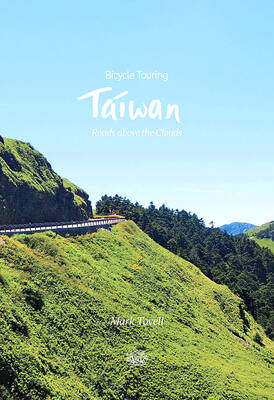
It’s hard to know where to begin with Mark Tovell’s Taiwan: Roads Above the Clouds. Having published a travelogue myself, as well as having contributed to several guidebooks, at first glance Tovell’s book appears to inhabit a middle ground — the kind of hard-to-sell nowheresville publishers detest. Leaf through the pages and you’ll find them suffuse with the purple prose best associated with travel literature: “When the sun is low on a warm, clear morning, and with the heat already rising, we stand at the riverside bike path leading south from Sanxia’s old cobble streets.” Hardly the stuff of your
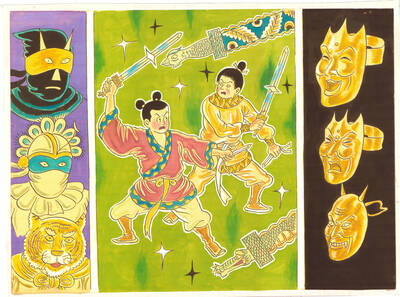
April 22 to April 28 The true identity of the mastermind behind the Demon Gang (魔鬼黨) was undoubtedly on the minds of countless schoolchildren in late 1958. In the days leading up to the big reveal, more than 10,000 guesses were sent to Ta Hwa Publishing Co (大華文化社) for a chance to win prizes. The smash success of the comic series Great Battle Against the Demon Gang (大戰魔鬼黨) came as a surprise to author Yeh Hung-chia (葉宏甲), who had long given up on his dream after being jailed for 10 months in 1947 over political cartoons. Protagonist


 RSS
RSS