


One of the first Taiwanese designers to have her pieces paraded down runways in Europe and the US, Sophie Hong (
"When I began presenting my creations overseas, I was the only Taiwanese in sight. These days I am continually running into young compatriots enjoying great success at fashion weeks around the world," Hong said.
Once again she is at the vanguard of fashion in Taiwan, only now Hong is leading the way for a future trend in sustainable development of the garment industry. Last weekend she joined a panel of urban planners, architects and interior designers in Kaohsiung for an international conference on culture and creation.
From her point of view as a fashion designer, Hong said it's time for Taiwan to take steps to ensure the textile industry conforms with principles of sustainable growth. Her proposals include the use of non-toxic substances in the manufacturing of fabrics, fair working conditions of employees, and a labeling scheme that identifies these provisions to the consumer.
"It is true these demands are made for the most part by consumers in wWestern countries and in Japan, and are less frequently voiced in the developing world; but the trend they represent is irreversible, and it must be expected to penalize irresponsible business people in the clothing industry as in every other sector .... Is Taiwan to wait passively until these labeling protocols are clearly established and administrated by other countries, or should it become involved immediately by joining the NGOs developing these new norms?" Hong asked.
Fifty percent of the world's textile exports and 70 percent of exported clothing are produced in developing nations, a result of cheaper materials and labor. In a world where big business profits take precedence over civil liberties, Hong is not targeting the individual shopper or street vendor, but rather the mass-distribution networks, including department stores and clothing chains.
It is those that make up the bulk of the textile industry, she added, that must make necessary changes in their manufacturing techniques so as to have the least impact on the environment.
Unlike many advocates of eco-friendly consumerism, Hong actually offers viable, pragmatic solutions, which include the retrieval and development of natural fabrics and coloring agents in place of toxic ones.
"In the French Armanac region, one of the historical plant-derived dyes of Europe, pastel, has been rediscovered. Other ancient dyes are likewise being revived because they are non-toxic. We should be studying these advances and taking inspiration from them as we revisit the ecology-friendly products and techniques of our own past," she said.
Hong gave the example of a natural fabric-dying procedure that has been recently revived in Taiwan through the use of indigo grass, which produces a natural blue color.
"We must learn to retrieve and preserve such natural methods that we once acquired," she added.
In her own designs, Hong has always utilized natural fibers and fabrics including bamboo, linen and silk and employed organic coloring agents, such as indigo. Equally natural are her varied ways of treating the fabric, notably her lacquered silk. Also known as mud silk, it is a process that originated in the Ming dynasty. Starting with white fabric, she sprays yam juice on it then places it in the sun to dry before dampening it again with mud retrieved from the bottom of the river.
Such procedures don't lend themselves to mass production, but Hong insists there are alternatives to manufacturing that protect the environment and workers rights and maintain a firm commitment to style.
"My unwavering use of non-toxic and non-polluting materials and dyes has nothing to do with some hippy-dippy idea of what is natural. The flower-child style is a refusal of style. What I love and what I strive for is a stylish effect, indeed," she said.
A painter and sculptor, as well as a clothing, shoe and jewelry designer, Hong is as much an artist as she is a fashion designer. She began her fashion studies at Shihchien University in Taiwan after which she moved to New York City, where she attended the Fashion Institute of Technology. Later she worked in couture workshops for Chanel in Paris, before returning to Taipei in 1984 to open her own studio.
Hong's boutique fuses fashion with art and is nothing like the florescent-lit, tacky techno music clothing stores plaguing the city. Located off a major commercial street in downtown Taipei, the large plate-glass windows, heavy iron casements and artwork that decorate her studio illustrate Hong's philosophy of creating, living and working in an art-inspired environment. "Clothing is simply another form of art ?. I design clothes the way I paint on a canvas or make a sculpture. I like to draw inspiration from everything around me."
She treats each design as if it were a painting, blending different colors, fabrics and patterns to create texture. Roughly 200 pieces are prepared for each fashion season (spring/summer and fall/winter), at which time the buyers place their orders and, with the help of 20 or more workers, production begins. From manufacturing the fabric to adding the hand-trim finishes, all pieces begin and end with Hong. It is her personal touch to each piece that gives it personality and makes it special to the designer and wearer.
Influenced by, but not restricted to, traditional Chinese designs, Hong creates styles for men and women that flatter all body shapes and are as comfortable as they are elegant. She mixes fabrics and prints to create textured jackets, dresses, tops and vests that are ready-to-wear anywhere, at anytime and by anyone.
Her clothing is available in boutiques around the world and is worn by celebrities, models, artists and writers -- those with a refined sense of style. Her prices reflect the work involved, but are not exorbitant, ranging from NT$10,000 to NT$30,000 for an entire outfit. Building a Hong-made wardrobe is a good investment, considering the classic-yet-chic designs do not seem to have a must-wear-before expiration date.
Similarly, the eco-friendly manufacturing and fair treatment of employees make discount and competitive pricing near impossible, and perhaps it is time for the price of merchandise to reflect its real cost to the environment. With the loss of renewable resources in Taiwan and the rest of the world, Hong agrees that individual consumers and big businesses will need to make sacrifices.
Sophie Hong's Taipei studio is located at 4, Lane 228, Xinyi Rd, Sec 2 (

In late October of 1873 the government of Japan decided against sending a military expedition to Korea to force that nation to open trade relations. Across the government supporters of the expedition resigned immediately. The spectacle of revolt by disaffected samurai began to loom over Japanese politics. In January of 1874 disaffected samurai attacked a senior minister in Tokyo. A month later, a group of pro-Korea expedition and anti-foreign elements from Saga prefecture in Kyushu revolted, driven in part by high food prices stemming from poor harvests. Their leader, according to Edward Drea’s classic Japan’s Imperial Army, was a samurai

The following three paragraphs are just some of what the local Chinese-language press is reporting on breathlessly and following every twist and turn with the eagerness of a soap opera fan. For many English-language readers, it probably comes across as incomprehensibly opaque, so bear with me briefly dear reader: To the surprise of many, former pop singer and Democratic Progressive Party (DPP) ex-lawmaker Yu Tien (余天) of the Taiwan Normal Country Promotion Association (TNCPA) at the last minute dropped out of the running for committee chair of the DPP’s New Taipei City chapter, paving the way for DPP legislator Su

It’s hard to know where to begin with Mark Tovell’s Taiwan: Roads Above the Clouds. Having published a travelogue myself, as well as having contributed to several guidebooks, at first glance Tovell’s book appears to inhabit a middle ground — the kind of hard-to-sell nowheresville publishers detest. Leaf through the pages and you’ll find them suffuse with the purple prose best associated with travel literature: “When the sun is low on a warm, clear morning, and with the heat already rising, we stand at the riverside bike path leading south from Sanxia’s old cobble streets.” Hardly the stuff of your
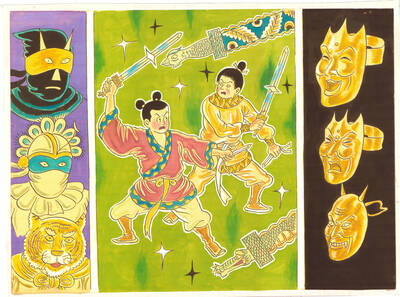
April 22 to April 28 The true identity of the mastermind behind the Demon Gang (魔鬼黨) was undoubtedly on the minds of countless schoolchildren in late 1958. In the days leading up to the big reveal, more than 10,000 guesses were sent to Ta Hwa Publishing Co (大華文化社) for a chance to win prizes. The smash success of the comic series Great Battle Against the Demon Gang (大戰魔鬼黨) came as a surprise to author Yeh Hung-chia (葉宏甲), who had long given up on his dream after being jailed for 10 months in 1947 over political cartoons. Protagonist


 RSS
RSS