


Dunhuang is a name that resonates through the ages as one of the truly great treasure troves of art and culture. The National Museum of History's (NMH) exhibition From the Forgotten Deserts: Centuries of Dazzling Dunhuang Art, which promised so much, is not only a sad disappointment but an object lesson in how sloppy exhibition design can undermine even the most exciting of exhibits.
From the moment I walked into the exhibition area, I was exposed to a series of minor disappointments that marred much of my enjoyment of the exhibition. First there was the semi-literate English introduction posted in large type, with its usual complement of typographic errors. This is hardly the first time that the NMH has been guilty of this sort of carelessness, and for a national museum with international pretensions, carelessness of this kind is simply unforgivable.
Then there is the question of the arrangement of the artifacts. The exhibition is organized by theme, which is fair enough, but no attempt is made in the layout to create a sense of thematic or chronological progression. After your ticket is taken, you find yourself, without preamble, in an area of frescos featuring the theme of clothing, and a few steps further on, the frescos are illustrative of architecture. It all is rather haphazard, without clear focus or progression.
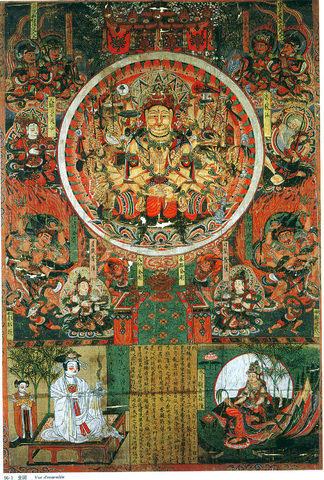
PHOTO COURTESY OF NMH
Then, moments later, one is brought to a further realization. The "frescos" that one is looking at are part of a collection of "30 genuine fresco copies" that are on loan from the Dunhuang Academy. While there is nothing wrong with copies being featured in an exhibition, it seemed a little odd that they would constitute such a large proportion of the exhibited materials -- a total of 102 items -- and most aggravating of all, that they are not clearly distinguished from the few original works: 10 very fine paintings on silk from the Musee National des Arts Asiatiques-Guimet.
To add insult to injury, some of the "exhibits" are no more than large-scale computer printouts -- of indifferent quality to boot -- of frescos. With exhibits of this quality, you would be better off with a book of illustrations.
Then there are the 20 "musical instrument replicas" from the Tainan National University of the Arts, most of which would not look out of place in the souvenir shop. As with the "genuine fresco copies," these may serve some purpose in an educational or research context but are certainly out of place as key exhibits.
As if all this wasn't enough, some of the frescos are sloppily tacked or pasted to the wall in a manner that would shame any self-respecting high school art class. By trying to pass this off as an international exhibition, and charging accordingly, the NMH is guilty of the type of skullduggery that can only injure its reputation. Taiwan's art lovers deserve more than this inept slight-of-hand.
Among the original works on display from the Musee National des Arts Asiatiques, there are two pages from the notebook of Paul Pelliot and a letter to Pelliot from his rival, Sir Aurel Stein. These documents are undated and are not given any context outside a timeline on the other side of the room and a brief background on Pelliot. Having placed these items in the show, no effort has been made to provide any context regarding the removal of Dunhuang's artifacts by foreign explorers in the early part of the 20th century.
Included in the exhibition are 12 works by Chang Da-chien (
It would be nice to say that the exhibition, despite its faults, is not without merit. Given the interest of the subject, it is really impossible not to learn something from the show, if one can put up with the frustration and irritation caused by the slapdash and thoughtless presentation. For the most part, a good book about Dunhuang would provide greater satisfaction, or check the list of academic and general links at the International Dunhunag Project links page at idp.bl.uk/chapters/links/links.html.
Exhibition Notes:
What: From the Forgotten Deserts: Centuries of Dazzling Dunhuang Art
Where: The National Museum of History
When: until May 29
Tickets: NT$150

Sept.16 to Sept. 22 The “anti-communist train” with then-president Chiang Kai-shek’s (蔣介石) face plastered on the engine puffed along the “sugar railway” (糖業鐵路) in May 1955, drawing enthusiastic crowds at 103 stops covering nearly 1,200km. An estimated 1.58 million spectators were treated to propaganda films, plays and received free sugar products. By this time, the state-run Taiwan Sugar Corporation (台糖, Taisugar) had managed to connect the previously separate east-west lines established by Japanese-era sugar factories, allowing the anti-communist train to travel easily from Taichung to Pingtung’s Donggang Township (東港). Last Sunday’s feature (Taiwan in Time: The sugar express) covered the inauguration of the

The corruption cases surrounding former Taipei Mayor and Taiwan People’s Party (TPP) head Ko Wen-je (柯文哲) are just one item in the endless cycle of noise and fuss obscuring Taiwan’s deep and urgent structural and social problems. Even the case itself, as James Baron observed in an excellent piece at the Diplomat last week, is only one manifestation of the greater problem of deep-rooted corruption in land development. Last week the government announced a program to permit 25,000 foreign university students, primarily from the Philippines, Indonesia and Malaysia, to work in Taiwan after graduation for 2-4 years. That number is a

In a stark demonstration of how award-winning breakthroughs can come from the most unlikely directions, researchers have won an Ig Nobel prize for discovering that mammals can breathe through their anuses. After a series of tests on mice, rats and pigs, Japanese scientists found the animals absorb oxygen delivered through the rectum, work that underpins a clinical trial to see whether the procedure can treat respiratory failure. The team is among 10 recognized in this year’s Ig Nobel awards (see below for more), the irreverent accolades given for achievements that “first make people laugh, and then make them think.” They are not

This Qing Dynasty trail takes hikers from renowned hot springs in the East Rift Valley, up to the top of the Coastal Mountain Range, and down to the Pacific Short vacations to eastern Taiwan often require choosing between the Rift Valley with its pineapple fields, rice paddies and broader range of amenities, or the less populated coastal route for its ocean scenery. For those who can’t decide, why not try both? The Antong Traversing Trail (安通越嶺道) provides just such an opportunity. Built 149 years ago, the trail linked up these two formerly isolated parts of the island by crossing over the Coastal Mountain Range. After decades of serving as a convenient path for local Amis, Han settlers, missionaries and smugglers, the trail fell into disuse once modern roadways were built


 RSS
RSS