


At least another year will pass before Hollywood, notoriously wary of films based on "current events," is ready to face the trauma of 9/11 head-on. Universal Pictures is developing a script about the last two Port Authority officers pulled from the World Trade Center rubble, and Columbia Pictures only recently acquired rights to 102 Minutes, a book about the terrorist attacks by Jim Dwyer and Kevin Flynn, reporters for the New York Times.
Certainly, Spike Lee's 25th Hour, a crime story released by Touchstone in 2002, acknowledged the attacks with scenes set in the barren landscape of ground zero. (And the Tribeca Film Festival has announced plans to show The Great New Wonderful, an independently financed black comedy from the Dude Where's My Car? director, Danny Leiner, set in post-9/11 New York.)
But that day's real impact on cinema has quietly arrived, written small in a series of new pictures that have no political content but that are suffused with a deep, enduring sense of grief born in the attack's wake.
PHOTO: NY TIMES
Sudden loss has ever been the stuff of movies; but the American take on the subject has tended toward tales of healing and inspiration. Thus, Ordinary People 25 years ago preached therapeutic breakthrough after a young man's drowning, much as Julia Roberts' radiant Shelby brought her family closer by her untimely demise in Steel Magnolias a decade later.
In the much darker season at hand, however, death has recovered its sting. The Robert De Niro thriller Hide and Seek dramatizes a child's near catatonic withdrawal after her mother's suicide, though the mournful premise gives way to a gimmicky horror plot. Another recent movie, Fear X, is a more haunting psychological thriller about a distraught security guard (John Turturro) grieving for his wife, who was killed in a mysterious shooting.
Winter Solstice, opening next month, is a subtle drama about a widower, played by Anthony LaPaglia, and his two sons, whose lives have been thrown into disarray by the accidental death of his wife. In Bereft, which was shown on the film festival circuit last fall, a photographer, played by Vinessa Shaw, has been unable to absorb the death of her husband; she remains in a state of paralysis.
Imaginary Heroes, which opened recently in the US, begins with the suicide of a teenage swimming star and details the sometimes bizarre reactions of his parents (Sigourney Weaver and Jeff Daniels) and younger brother (Emile Hirsch). And in The Upside of Anger, which opened this weekend, Joan Allen surrenders to outbursts of anger and drunken despair after her husband disappears and leaves her to raise four daughters on her own.
Healing figures in some of these new movies, but it is a minor part of the story; most of the films survey characters who remain stuck in a syndrome of grief and anger that overpowers them for months or even years after the traumatic event. They convey a profound sadness that in some cases has more than subliminal connection to the post-9/11 mood in which the pictures, with their typically long lead times, took shape.
"You'll notice if you look closely at the film, American flags are on every house," Tim Daly, co-director of Bereft, said of his movie. "In a subtle way, this reminds you of the black armband on people's psyches since Sept. 11."
Tellingly, the characters in this somber wave are shattered by a sudden, violent event rather than a family member's death after a long illness. "I'm not a therapist," said Josh Sternfeld, the writer-director of Winter Solstice, "but I would think that the very sudden loss of a person to a random act immediately throws the survivors into a whole new plane of consciousness. Instinctively I wanted the death in my film to be a violent accident."
If these new films are coming at social upheaval by indirection, they are behaving in a way typical of American movies. During the divisive Vietnam War, few Hollywood films addressed the conflict overtly. Important pictures about Vietnam -- Coming Home, The Deer Hunter and Platoon among them -- were made years after the war ended. But you could sense the rebelliousness, nihilism and despair of the era in such films as Bonnie and Clyde, The Wild Bunch and Easy Rider.
Non-American films are far more likely to tackle volatile subjects with directness and dispatch. Shortly after the fall of the Taliban in Afghanistan, director Siddiq Barmak made Osama, a drama about the regime's oppression of women.
A new Spanish documentary, Zahira's Peace, about a survivor of the Madrid train bombings last year, is already on national television in Spain. American moviemakers and studio executives have always been slower to respond to social unrest, perhaps out of fear that controversy will scare away audiences. So hot-button issues find their way into our films circuitously.
Of course, the current movies were often shaped by their directors' experiences with grief. Dan Harris, the writer-director of Imaginary Heroes, lost his mother, an aunt and a cousin in a short period of time, and what he endured was not at all what he had observed in the movies.
"In movies you see neighbors bringing over soup," Harris wrote in an e-mail message from Australia, where he is working on the final script of the new Superman movie for Warner Brothers. "I saw women walk up to me, stare me directly in the eyes and run away crying. I've heard about women hitting on men at the funeral of their wives. Tragedies have this amazing ability to make people lose their sense of appropriateness, and I wanted to capture the unpredictability of people's response."
Bereft marks the directorial debut of the actor Tim Daly, who also co-stars in the film with Tim Blake Nelson, Marsha Mason and Edward Herrmann. Daly said that the movie drew on his still-
unresolved feelings about the sudden death of his father, the actor James Daly, more than two decades ago.
"It's an odd world you find when you are grief-stricken," Daly observed. "My dad died the day we were to begin rehearsals for a summer stock production of Equus, which was my first professional job. Within two days we had the funeral, and I came back and went to work in the play. It wasn't until six months later that I fell apart. In making the movie, I wanted to suggest that grieving is a longer and deeper emotional experience than people sometimes acknowledge."
Harris saw parallels between the family in Imaginary Heroes and the country at large.
"In the late 90s, everything seemed great," he said. "But the world was hanging by a thread, the same way the Travis family is hanging in balance at the beginning of the film. Tragedy strikes in both cases, and everything spills into a sense of anger, hate and vengeance. The family in our film ultimately starts healing. I don't know when that's going to happen in this world. One thing I do know is that our country is like a family, and we're a bit dysfunctional right now."

In late October of 1873 the government of Japan decided against sending a military expedition to Korea to force that nation to open trade relations. Across the government supporters of the expedition resigned immediately. The spectacle of revolt by disaffected samurai began to loom over Japanese politics. In January of 1874 disaffected samurai attacked a senior minister in Tokyo. A month later, a group of pro-Korea expedition and anti-foreign elements from Saga prefecture in Kyushu revolted, driven in part by high food prices stemming from poor harvests. Their leader, according to Edward Drea’s classic Japan’s Imperial Army, was a samurai

The following three paragraphs are just some of what the local Chinese-language press is reporting on breathlessly and following every twist and turn with the eagerness of a soap opera fan. For many English-language readers, it probably comes across as incomprehensibly opaque, so bear with me briefly dear reader: To the surprise of many, former pop singer and Democratic Progressive Party (DPP) ex-lawmaker Yu Tien (余天) of the Taiwan Normal Country Promotion Association (TNCPA) at the last minute dropped out of the running for committee chair of the DPP’s New Taipei City chapter, paving the way for DPP legislator Su

It’s hard to know where to begin with Mark Tovell’s Taiwan: Roads Above the Clouds. Having published a travelogue myself, as well as having contributed to several guidebooks, at first glance Tovell’s book appears to inhabit a middle ground — the kind of hard-to-sell nowheresville publishers detest. Leaf through the pages and you’ll find them suffuse with the purple prose best associated with travel literature: “When the sun is low on a warm, clear morning, and with the heat already rising, we stand at the riverside bike path leading south from Sanxia’s old cobble streets.” Hardly the stuff of your
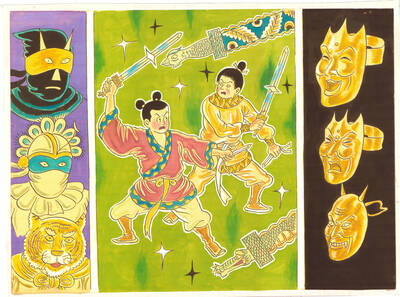
April 22 to April 28 The true identity of the mastermind behind the Demon Gang (魔鬼黨) was undoubtedly on the minds of countless schoolchildren in late 1958. In the days leading up to the big reveal, more than 10,000 guesses were sent to Ta Hwa Publishing Co (大華文化社) for a chance to win prizes. The smash success of the comic series Great Battle Against the Demon Gang (大戰魔鬼黨) came as a surprise to author Yeh Hung-chia (葉宏甲), who had long given up on his dream after being jailed for 10 months in 1947 over political cartoons. Protagonist


 RSS
RSS