


Food is on her mind "every minute of the day," said Hsu, but whenever she eats, she feels guilty. The easiest way for her to deal with the guilt is to get rid of it. Bulimia is an eating disorder characterized by binge eating followed by self-induced vomiting, and it's a disorder Hsu has been dealing with for the last five years.
The young Taiwanese high school teacher, who asked to remain anonymous, said her eating disorder began when she was a third year university student. At 168cm and 55kg she wanted to lose weight. "I've never felt like I was good at anything. I thought I would have more confidence if I was thin, but the more I lost, the less confident I felt, because I was never thin enough," she said.
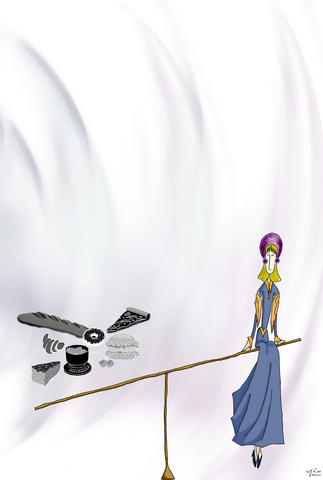
In less than a year, her weight fluctuated between 42kg and 63kg. Her friends and family watched the rapid loss and gain without comment and when she returned to her current weight of 55kg, they thought her problem was over.
Actually it had only begun.
Hsu is one of 20 patients under the care of Dr Chen Kuan-yu (
"This is a hidden problem. Most people don't come forward; either they are in denial or they don't know where to go," Chen said. Having treated 300 patients in the last eight years, he said the numbers, compared to five years ago, have doubled. The actual statistics of people living with eating disorders, he expects, is substantially higher: "My patients talk about their friends and mothers having these problems, but these mentioned people never come forward."
Golden Girls?
Once known as the "golden girl syndromes" because they primarily struck rich, white, well-educated women, bulimia and anorexia nervosa, a disorder in which a person becomes exceedingly thin yet still believes he or she is overweight, have spread to women of different economic and ethnic backgrounds. Considering one of the hallmarks of an eating disorder is denial, diagnosing people is difficult and calculating percentages nearly impossible. However, according to statistics published in an Asian medical journal and those cited by Chen, the percentage of females who suffer from anorexia and bulimia in Japan, South Korea and Singapore is nearly 1 percent. The figures are not as high as North America and Europe, which fall between 0.5 percent and 5 percent of the female population.
With the collaboration of doctors at National Taiwan University Hospital (NTUH), however, Chen published a recent survey-study of high school students that showed an average of one in 100 girls to be bulimic. He says: "We don't have any statistics of anorexia because it involves interviewing each person individually and we don't have the time and financial resources to do a very accurate study in Taiwan."
From his report on bulimia and experience counseling patients, he estimated the instance to be at 0.2 percent among women in Taiwan.
Thin is in
Eating disorders, said Chen, are to some extent Western cultural conditions that have infected Taiwan culture with the fear of being fat introduced via the entertainment industry "Most of my patients are very sensitive about their body weight. Fear of eating in public and fear of getting fat are relatively new issues here and I think this is more of a western notion ?. Not so long ago, being slightly overweight was viewed as a sign of wealth, but over time modern society sees only skinny as beautiful and now this idea has spread to Asia," he said.
It might not be healthy, but body weight reduction is a big industry in Taiwan right now and the result is a vast number and selection of slimming teas, powders and herbal remedies to shed pounds.
There are two legalized brands of diet pills on the market in Taiwan, Reductil and Xenical, both of which are available at the chemist without prescription. A pharmacist at a local drug store in Tianmu said she sees an average of five girls every month. Three years ago, she might see two. She claimed to warn people of the adverse side effects and refuses those who are not overweight, but can't stop girls from going elsewhere, she added.
As a high school teacher in Taipei city, Hsu said she is constantly listening to her female students discuss their weight. They think they are too fat and they always talk about different diets.
Self-control
The tendency to link eating disorders to western pathologies and to view them as conditions that afflict celebrities and the girls who want to look like them is dated, according to Professor Ning Yin-bin (
In his book, Ning draws comparisons between religious fasting, rigorous training by athletes and eating disorders. He labels it a double standard when the public praises one form of self-starvation and condemns another. Not suggesting self-starvation be rewarded, he explains that it relates to a psychological desire for strict individual control over one's body.
"Critics put the blame on society, magazines, television, instead of looking at the deeper cultural and personal reasons why someone does this [bulimia or anorexia]. Actually it is personal warfare between a women and her body. There are multiple elements that contribute to this war," he said.
One theory Ning expressed, which was confirmed by Chen, is the view that anorexia and bulimia are generic casualties of someone who views eating as the only aspect of their lives they have control over.
"For some girls it is a way to express their emotions. Many of my patients are so repressed. A lot of the girls come from overprotective families with strict school and home regimes with little room for individual freedom. They see eating as the only thing they have control over ?. Bulimic patients tell me they binge because it's the only time they can let go, and feel this short, high, period of happiness. Shortly after it is followed by strong feelings of guilt, and this is when they purge."
Either way, said Chen, the effects of an untreated eating disorder can be severe.
Physical consequences
According to research done in Germany and the US, between 5 percent and 20 percent of those struggling with anorexia will die, the highest cause of death among psychological disorders. Having lost touch with most of his 300 patients over the years, Chen could not confirm a mortality figure. He cited one follow-up study completed by NTUH where 30 patients were contacted. One had died. It is difficult to have an exact death rate, because most causes are complications from the disorder such as cardiac arrest, electrolyte imbalance or suicide, and it can happen later after a patient developed a healthy eating pattern.
While death is the worst-case scenario, other complications are of major concern for both bulimics and anorexics, he said. Some recover after a single episode, some, like Hsu, have a fluctuating pattern of weight gain and relapse, and others experience a chronically deteriorating course of illness over many years.
Purging on a daily basis for more than three years, Hsu said the worst physical effect she has suffered is the decay of her teeth enamel from stomach bile. Girls she befriended in the group therapy, however, were not so lucky and suffer from chronic stomach pains or kidney problems.
A multi-disciplinary approach with psychiatric, medical, nutritional and family counseling support is the only way to treat the illness, said Chen, but it is both time-consuming and costly and it requires national recognition of the problem.
"They [Department of Health] recognize a problem with weight gain among the general population, but their anti-obesity campaigning does not include non-visible eating disorders, like bulimia or anorexia," he said. In terms of medical economics it is not a good subject. If the numbers are small then there is no funding, and you need programs in schools and hospitals to let people know where and how to get help.
Is there help?
There is no National Eating Disorder Association in Taiwan and likewise there are no public or private clinics. At present there are only two psychiatrists focusing their research and work on anorexia and bulimia, Chen and a female doctor at NTUH. Chen is currently talking with officials in the Bureau of Health Promotion and Protection under the Ministry of Health about establishing a national education program on eating disorders. Given the current lack of resources, however, most patients receive medication for an illness which he said requires psychiatric therapy not prescription drugs.
Hsu first learned the term "bulimia" when she researched it on the Internet. It wasn't until after several hospital visits and prescriptions for the anti-depression drug Prozac that she met Chen and began her psychotherapy sessions. "Three years ago, I felt I had lost the ability to live a normal life. Now I enjoy my job, I have friends and my family life has improved. I still make myself get sick, but I actually feel myself getting better," Hsu said.
Help and information can be obtained from the Mental Health department at any public or private hospital or by calling Taipei City Psychiatry Center (臺北市立療養院) at (02) 2726-3141 X 1119.

Sept.16 to Sept. 22 The “anti-communist train” with then-president Chiang Kai-shek’s (蔣介石) face plastered on the engine puffed along the “sugar railway” (糖業鐵路) in May 1955, drawing enthusiastic crowds at 103 stops covering nearly 1,200km. An estimated 1.58 million spectators were treated to propaganda films, plays and received free sugar products. By this time, the state-run Taiwan Sugar Corporation (台糖, Taisugar) had managed to connect the previously separate east-west lines established by Japanese-era sugar factories, allowing the anti-communist train to travel easily from Taichung to Pingtung’s Donggang Township (東港). Last Sunday’s feature (Taiwan in Time: The sugar express) covered the inauguration of the

The corruption cases surrounding former Taipei Mayor and Taiwan People’s Party (TPP) head Ko Wen-je (柯文哲) are just one item in the endless cycle of noise and fuss obscuring Taiwan’s deep and urgent structural and social problems. Even the case itself, as James Baron observed in an excellent piece at the Diplomat last week, is only one manifestation of the greater problem of deep-rooted corruption in land development. Last week the government announced a program to permit 25,000 foreign university students, primarily from the Philippines, Indonesia and Malaysia, to work in Taiwan after graduation for 2-4 years. That number is a

In a stark demonstration of how award-winning breakthroughs can come from the most unlikely directions, researchers have won an Ig Nobel prize for discovering that mammals can breathe through their anuses. After a series of tests on mice, rats and pigs, Japanese scientists found the animals absorb oxygen delivered through the rectum, work that underpins a clinical trial to see whether the procedure can treat respiratory failure. The team is among 10 recognized in this year’s Ig Nobel awards (see below for more), the irreverent accolades given for achievements that “first make people laugh, and then make them think.” They are not

This Qing Dynasty trail takes hikers from renowned hot springs in the East Rift Valley, up to the top of the Coastal Mountain Range, and down to the Pacific Short vacations to eastern Taiwan often require choosing between the Rift Valley with its pineapple fields, rice paddies and broader range of amenities, or the less populated coastal route for its ocean scenery. For those who can’t decide, why not try both? The Antong Traversing Trail (安通越嶺道) provides just such an opportunity. Built 149 years ago, the trail linked up these two formerly isolated parts of the island by crossing over the Coastal Mountain Range. After decades of serving as a convenient path for local Amis, Han settlers, missionaries and smugglers, the trail fell into disuse once modern roadways were built


 RSS
RSS