


At a theater on Taipei's west side, a set piece is being broken down and hauled out to make way for the next production. A couple of stagehands discuss what they'll need for the show, crunching wood shavings underfoot.
It's a scene played out at theaters the world over, but the stage at this theater is among the world's smallest, and its actors -- the ones the audience sees, at least -- are made of wood. It's TTT Puppet Theater (大稻埕偶戲館) and it's the sole puppet theater in a district that once had 10 such venues.
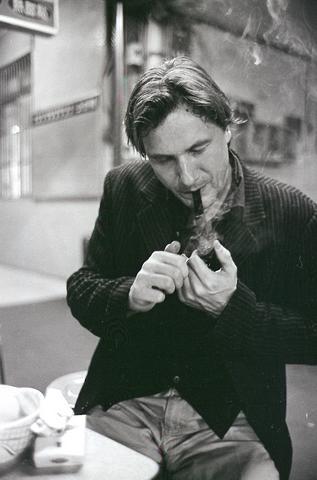
PHOTO COURTESY OF NATALIE FALGARONE
Presiding over the company of puppeteers, wood carvers and lighting and costume designers is Robin Ruizendaal, an 11-year resident of Taiwan and a paradox of a local personality. Though a man holding a puppet isn't often taken seriously, Ruizendaal also holds a wealth of knowledge on Chinese and Taiwanese culture, gleaned from years of research in sinology.
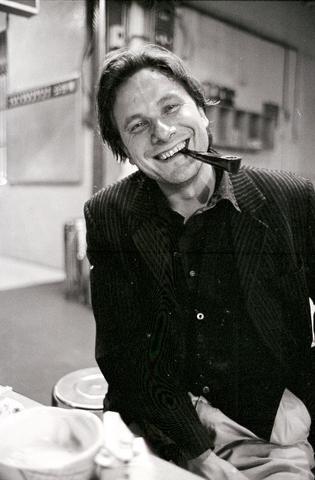
PHOTO COURTESY OF NATALIE FALGARONE
Ruizendaal first began learning Mandarin at 19 and continued his studies at Holland's Leiden University. In the early 1980s, he began research on his doctoral dissertation on Chinese marionette theater. It was a topic that would gain him a kind of access to Chinese culture that few researchers before him had enjoyed.
"I thought [puppet theater] was a nice window to research Chinese society because it's not upper-class culture, it's grassroots culture," he said.
"At the time China was very closed. We didn't know anything about what was happening in the countryside. I thought it was a really interesting, very localized form of art through which I could observe society, because it's related to religion, social groups, theatre, language, music. It had many elements which interested me."
In China, his research followed people associated with the art form from the Republican period in the 1920s, through the Cultural Revolution and up to the 1990s. Among his several observations, Ruizendaal said he learned that the politics of the Chinese Communist Party and the Chinese Nationalist Party were actually very similar.
"The destruction of Chinese religion was high in the priorities of both parties," he said. "I observed China as a religious state where everything is related to religion; everybody lives from house altar to neighborhood altars to temples. What the Communists were doing, as well as the Kuomintang was trying to destroy that element of Chinese culture."
The Communists succeeded in the cities, Ruizendaal said, razing hundreds of temples in Beijing alone.
"But in the countryside where I worked you see the tenacity of religious structure, which was interlinked with social culture so strong that it made an enormous rebound."
"The same thing is happening in Communist China now as happened in Taiwan, with the government initially against theater, banning it for several reasons. ... But in the 1990s there was this turnaround where Communist cadres started supporting theater as a local art, trying to make it function outside the state system."
Was it allowed to be as bawdy an entertainment as it previously had been?
"Yes. You can't get away from sex and shit," he laughs. "Without them, nobody would come."
But Ruizendaal considers Taiwanese puppet culture special compared with its counterparts in China or Japan or other parts of Asia in that it's been popularized in the media.
"Starting in the 1970s, there was an enormous craze for puppet theater -- televised puppet theater -- and so it's really part of the heritage of people in their 40s, 50s and 60s. They all have a warm feeling for puppet theater even though they don't watch it anymore."
The craze continues today, Ruizendaal said, with televised puppet shows and Web sites dedicated to puppets that provide information on each character's biography and birth sign, even their blood type.
"It goes far -- especially among university students," Ruizendaal said.
"It's one of the only forms of art that didn't come from China or Japan or the US. The traditional small puppets come from China, but the big puppets, with their specific Taiwanese lingo, they're a purely Taiwanese art."
And so Ruizendaal's job is as much popularization of puppetry as it is preservation. His main tasks, he explains, are making new plays based on traditional ones, creating a new audience for live puppet theater and promoting it abroad.
TTT works closely with theaters in Cambodia, Myanmar, Indonesia and India.
Last year they toured 12 countries. This year they'll take in five countries, including a second appearance at London's Victoria and Albert Museum.
Despite the considerable attention he's received in local media for his work, Ruizendaal doesn't find it strange that the task of preserving a uniquely Taiwanese art form has fallen to a foreigner.
"I think that, in a global perspective -- in the world of the arts, at least -- the concept of `foreigner' is changing a bit. Maybe not for bus drivers ... but in the arts it's getting quite normal to have conductors from Japan working in Europe. Puppetry is just on the periphery of the arts."
TTT Puppet Theater's upcoming shadow puppet production, The Child in the Rice Paddy (

In late October of 1873 the government of Japan decided against sending a military expedition to Korea to force that nation to open trade relations. Across the government supporters of the expedition resigned immediately. The spectacle of revolt by disaffected samurai began to loom over Japanese politics. In January of 1874 disaffected samurai attacked a senior minister in Tokyo. A month later, a group of pro-Korea expedition and anti-foreign elements from Saga prefecture in Kyushu revolted, driven in part by high food prices stemming from poor harvests. Their leader, according to Edward Drea’s classic Japan’s Imperial Army, was a samurai

The following three paragraphs are just some of what the local Chinese-language press is reporting on breathlessly and following every twist and turn with the eagerness of a soap opera fan. For many English-language readers, it probably comes across as incomprehensibly opaque, so bear with me briefly dear reader: To the surprise of many, former pop singer and Democratic Progressive Party (DPP) ex-lawmaker Yu Tien (余天) of the Taiwan Normal Country Promotion Association (TNCPA) at the last minute dropped out of the running for committee chair of the DPP’s New Taipei City chapter, paving the way for DPP legislator Su
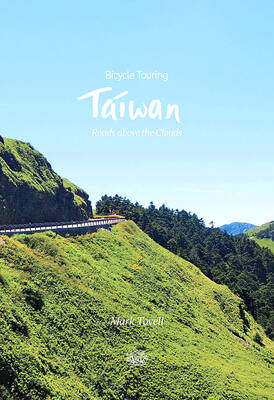
It’s hard to know where to begin with Mark Tovell’s Taiwan: Roads Above the Clouds. Having published a travelogue myself, as well as having contributed to several guidebooks, at first glance Tovell’s book appears to inhabit a middle ground — the kind of hard-to-sell nowheresville publishers detest. Leaf through the pages and you’ll find them suffuse with the purple prose best associated with travel literature: “When the sun is low on a warm, clear morning, and with the heat already rising, we stand at the riverside bike path leading south from Sanxia’s old cobble streets.” Hardly the stuff of your
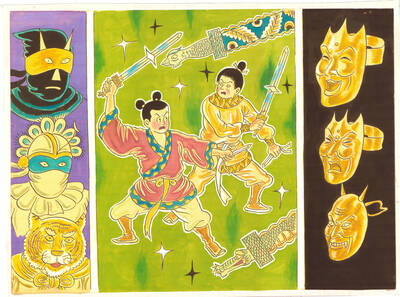
April 22 to April 28 The true identity of the mastermind behind the Demon Gang (魔鬼黨) was undoubtedly on the minds of countless schoolchildren in late 1958. In the days leading up to the big reveal, more than 10,000 guesses were sent to Ta Hwa Publishing Co (大華文化社) for a chance to win prizes. The smash success of the comic series Great Battle Against the Demon Gang (大戰魔鬼黨) came as a surprise to author Yeh Hung-chia (葉宏甲), who had long given up on his dream after being jailed for 10 months in 1947 over political cartoons. Protagonist


 RSS
RSS