


Literary Culture in Taiwan is a cogent and important contribution to Taiwan studies in English. Subtitled From Martial Law to Market Law, it covers the last 50 or so years with an admirable even-handedness.
The sardonic subtitle, on the surface merely indicating a historical period, appears also to suggest a double bind within which literature in Taiwan is somehow caught. The idea is unavoidable that serious writing has in some way been unable to find a free space for itself and instead has lurched from one set of restrictions to another. Martial law didn't end until 1987, which doesn't leave market law, usually called market forces, much time to set in with its own form of stormy weather. "Was there a brief blossoming some time in the early 1990s?" you wonder.
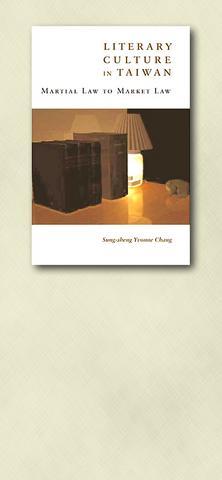
In fact the book doesn't really take so dark a view. The title is closer to being a joke than to being a prison sentence. Even so, the restrictions resulting from both military rule and commercial pressures are part of the picture the author paints.
One virtue the book has is that Sung-sheng Yvonne Chang, who teaches at the University of Texas at Austin, is aware of the different needs of different kinds of readers. She begins, for example, with an overview of Taiwan's history, adding that Taiwan specialists should skip it and move directly to the next chapter. It's thus clear that she does not intend her book to be read only by her fellow-academics, but is making a bid to attract ordinary educated readers as well.
Essentially, this is a positive and enthusiastic survey of how ideals derived from China's literary classics dominated one period, how middle-class demands took over from these, and finally of how the growing demand for entertainment other than books influenced publishers' ideas as to what the public would buy. Nevertheless, despite varied attempts to hem in authors, Taiwan's writers have been a brave and lively lot, you feel, and the author by and large agrees with you.
There are many themes in this book. One is that the characteristic elitism of modernism gave way to more middle-brow, semi-popular cultural products, and that this process was facilitated in Taiwan by the cultural supplements (fukan) of the large Chinese-language newspapers. Modernism had been elitist everywhere, with the mature works of writers such as James Joyce, composers such as Arnold Schoenberg, and painters such as Mark Rothko producing unapproachable mega-works that almost no one enjoyed but which nonetheless were widely held to command the cultural heights. In Taiwan, you have to read "the classical literature of China" in place of Western abstraction and intellectual complexity. This more or less prevailed under martial law. It was after this ended that the floodgates were opened.
But once an elite "high" literature was displaced (for all but the very few), there was nothing to prevent the earthy tastes of the population at large from taking control of the commanding heights of cultural production. Very recently, for instance, one major Western-style leisure store in Taipei appears to have removed serious books altogether from its main outlet, substituting software for computer games in their place. This is precisely what this author means by "market law" -- and the effects it can have on leisure habits and book production.
Even so, Taiwan remains a more literary place than anywhere close by in the region, Japan always excepted. (Just about everyone appears to be reading on the Tokyo subway, though long commuting distances may partly account for this). If literature is on the slide in Taiwan, it isn't going down without a fight.
Those of us who read only English can be unaware of this. But strong proof of the on-going vitality of the written word in Taiwan was remarkably demonstrated five years ago when a quasi-public selection of the "Literary classics of Taiwan" was staged, sponsored by the Council of Cultural Affairs. The circus that resulted surprised almost everyone.
Predictably, the arguments that emerged mirrored in many ways those that continue to divide the main political parties -- "Mainstream" versus "Localist" and "pure" literature versus works representing the modern Taiwanese experience such as the effects of rapid urbanization. And so on.
Nevertheless, as with the political divides, so with the literary ones. Life would be duller without them. Moreover, they represent the very mixtures that make Taiwan what it is: its history, the various waves of immigrants and the residual differences and oppositions. These inevitably throw up conflict, and conflict -- so long as it doesn't become physical -- remains the spice of life.
These divides also throw up their inevitable paradoxes. None of these is more remarkable than those surrounding the 1940s novel Orphan of Asia. The book, depicting the uncertainties of the Taiwanese psyche, was banned under martial law, and so became a cause celebre with the Localists, in so many ways the literary equivalents of the modern political greens.
But few things are simple in Taiwan. What makes this particular book paradoxical is one simple fact. It was originally written, not in Chinese, nor in any of the dialects or languages today current in Taiwan. Instead, this celebrated, though doom-laden, analysis of the nature of Taiwan was written in Japanese.

In late October of 1873 the government of Japan decided against sending a military expedition to Korea to force that nation to open trade relations. Across the government supporters of the expedition resigned immediately. The spectacle of revolt by disaffected samurai began to loom over Japanese politics. In January of 1874 disaffected samurai attacked a senior minister in Tokyo. A month later, a group of pro-Korea expedition and anti-foreign elements from Saga prefecture in Kyushu revolted, driven in part by high food prices stemming from poor harvests. Their leader, according to Edward Drea’s classic Japan’s Imperial Army, was a samurai

The following three paragraphs are just some of what the local Chinese-language press is reporting on breathlessly and following every twist and turn with the eagerness of a soap opera fan. For many English-language readers, it probably comes across as incomprehensibly opaque, so bear with me briefly dear reader: To the surprise of many, former pop singer and Democratic Progressive Party (DPP) ex-lawmaker Yu Tien (余天) of the Taiwan Normal Country Promotion Association (TNCPA) at the last minute dropped out of the running for committee chair of the DPP’s New Taipei City chapter, paving the way for DPP legislator Su
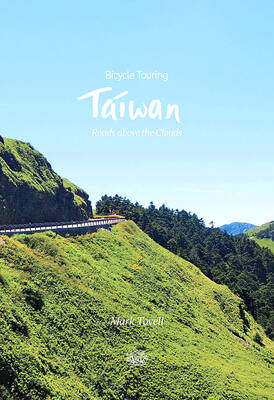
It’s hard to know where to begin with Mark Tovell’s Taiwan: Roads Above the Clouds. Having published a travelogue myself, as well as having contributed to several guidebooks, at first glance Tovell’s book appears to inhabit a middle ground — the kind of hard-to-sell nowheresville publishers detest. Leaf through the pages and you’ll find them suffuse with the purple prose best associated with travel literature: “When the sun is low on a warm, clear morning, and with the heat already rising, we stand at the riverside bike path leading south from Sanxia’s old cobble streets.” Hardly the stuff of your
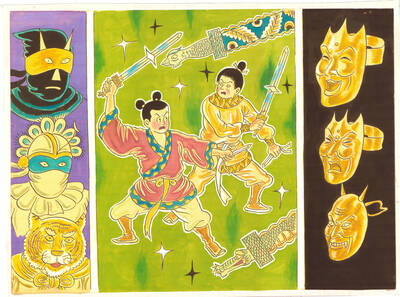
April 22 to April 28 The true identity of the mastermind behind the Demon Gang (魔鬼黨) was undoubtedly on the minds of countless schoolchildren in late 1958. In the days leading up to the big reveal, more than 10,000 guesses were sent to Ta Hwa Publishing Co (大華文化社) for a chance to win prizes. The smash success of the comic series Great Battle Against the Demon Gang (大戰魔鬼黨) came as a surprise to author Yeh Hung-chia (葉宏甲), who had long given up on his dream after being jailed for 10 months in 1947 over political cartoons. Protagonist


 RSS
RSS