


At this year's Taiwan Lesbian, Gay, Bisexual, Transgender Pride Parade (
However, parade organizers from the Taiwan Tongzhi Hotline Association (
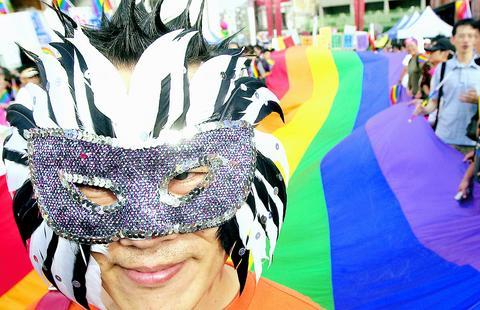
"Despite the image the media puts forth, we are not all drag queens," said Wu Hsu-liang (
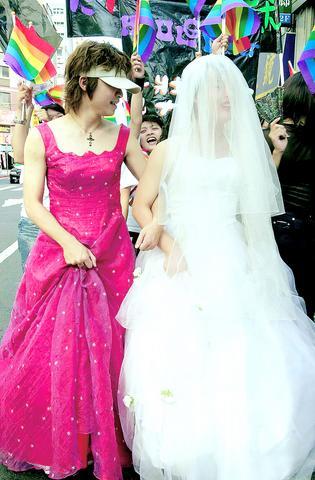
The event starts tomorrow at 1pm, with a street party led by local DJs Victor Cheng and Kay at Chiang Kai-shek Memorial Hall (
The Pride Parade is the most demonstrative expression of the Tongzhi Hotline's work, which includes over-the-phone counseling on topics ranging from relationship trouble to attempted suicide. This year, the Hotline inaugurated a parents and friends of sexual minorities support group -- modeled after the famous Parents and Friends of Lesbians and Gays (PLAG) organization in the US.
Taiwan's Pride Parade, touted as the first ever in the Chinese-speaking world, was held last year and attracted 1,000 lesbians, gays, bisexuals, transgenders and their supporters. Organizers expect to attract more than 2,000 this year.
The parade also promises to distinguish itself on several new fronts. This year's event is centered around four slogans: Citizens with Exceptions (
"People think that our parade is just a copy because other big cities in the world have them," Wu said. "But this time the Pride Parade is really stressing the point that we are all citizens with rights and that all of us can be involved in the civic process of law- and policy-making."
Last year, the Taipei City Government provided NT$720,000 for the event, but the Taiwan Tongzhi Hotline chose not to solicit government funds this year. "The government is a little conservative and we felt pressure from them last time. If it is a government-sponsored event they have more control. This year we had some ideas we wanted to express free of the government," Wu said.
The potentially controversial ideas Wu alluded to might include those stemming from a group new to the Pride Parade roster. This year BDSM, whose members include adherents to bondage, discipline, and sadomasochism, will show their solidarity with the LGBT (transgender) community by joining the parade with groups such as Ri Ri Chun (日日春關懷互助協會), an organized association of sex workers.
Some worry that these unconventional groups and the often exaggerated image of gays projected by the media might further alienate transgender groups from mainstream society.
Roan Ching-yueh (
But those reluctant to support the gay movement on moral grounds might rather look to the profit principle for persuasion. Even famously conservative Singapore is jumping on the gay band-wagon, hoping that the so-called "pink dollar" will bolster the economy through gay tourism.
In August, a gay sponsored event that coincided with Singapore's National Day raked in over US$6 million and attracted over 2,500 foreign visitors. Singapore has even put economists on the job. They found that acceptance of gay culture can, in fact, help transform the city-state into a creative, idea-driven economy.
Wu said the Taiwanese government, if only for economic reasons, would be wise to join the Pride Parade in Taipei. "Of course we invite government officials, but we also would like them to walk with us and show their support, with more than just words and nice speeches."
At this time last year, when the US government was making strides toward banning gay marriage, gay rights supporters championed in vain for the Taiwanese Ministry of Justice's proposed Protection of Human Rights Basic Act (
Cautious supporters of the Taiwanese gay rights movement, like author Roan, think that the very idea of a gay parade in Taiwan warrants reconsideration.
"I question whether or not the parade is suitable for Taiwanese society. We have to consider what Taiwanese gays really need. Western gays needed to build a strong bond and centralized community, but in Taiwan this is not very necessary."
Roan might try running that idea past a computer science student at National Taiwan University who goes by the name of Kevin. He said that before he found other gay friends on the Internet he felt isolated and had "dark thoughts." It was precisely the community he found that he said "helped me get through and come out to my parents."
Whatever reservations one might have about the cultural or philosophical limitations of a gay rights movement in Taiwan, the Pride Parade symbolizes a degree of freedom that Taiwan's homosexual cousins in China are light-years away from achieving. And political, historical, and moral considerations aside, the parade promises to be a colorful and entertaining fete filled with boas, leather, speedos and even the average gay next door.
For your information :
What: Taiwan Lesbian, Gay, Bisexual, Transgender Pride Parade (
When: Saturday, from 1pm to 5pm
Where: Assemble at Chiang Kai-shek Memorial Hall
For more details: See a map of the Pride Parade route and information on how to donate to the parade and Taiwan Tongzhi Hotline at: http://1106.bdsm.com.tw/ (Chinese and English)
Taiwan Tongzhi Hotline Association: www.hotline.org.tw. Call (02) 2392 1970 or (02) 2392 1890


The US war on Iran has illuminated the deep interdependence of Asia on flows of oil and related items as raw materials that become the basis of modern human civilization. Australians and New Zealanders had a wake up call. The crisis also emphasizes how the Philippines is a swatch of islands linked by jet fuel. These revelations have deep implications for an invasion of Taiwan. Much of the commentary on the Taiwan scenario has looked at the disruptions to world trade, which will be in the trillions. However, the Iran war offers additional specific lessons for a Taiwan scenario. An insightful
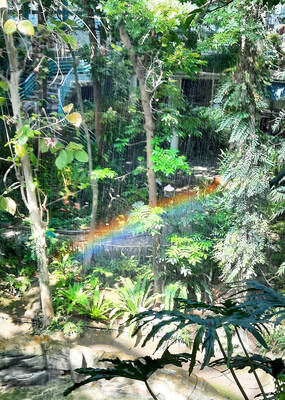
It’s only half the size of its more famous counterpart in Taipei, but the Botanical Garden of the National Museum of Nature Science (NMNS, 國立自然科學博物館植物園) is surely one of urban Taiwan’s most inviting green spaces. Covering 4.5 hectares immediately northeast of the government-run museum in Taichung’s North District (北區), the garden features more than 700 plant species, many of which are labeled in Chinese but not in English. Since its establishment in 1999, the site’s managers have done their best to replicate a number of native ecosystems, dividing the site into eight areas. The name of the Coral Atoll Zone might
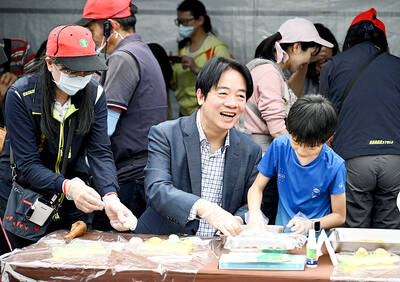
Polling data often confirms what we expect, but sometimes it throws up surprises. When examined over time, some patterns appear that speak to something bigger going on. In this column, whenever possible, Formosa’s polls are used. Despite the sometimes cringeworthy antics of Formosa’s Chairman, Wu Tzu-Chia (吳子嘉), the data produced includes detailed breakdowns crucial for analysis. It has also been conducted monthly 11-12 times a year for many years with many of the same questions, allowing for analysis over time. When big shifts do occur between one month and the next it is usually in response to some event in
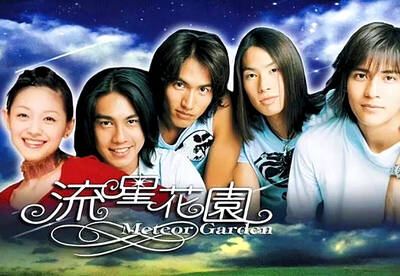
April 6 to April 13 Few expected a Japanese manga adaptation featuring four tall, long-haired heartthrobs and a plucky heroine to transform Taiwan’s television industry. But Meteor Garden (流星花園) took the nation by storm after premiering on April 12, 2001, single-handedly creating the “idol drama” (偶像劇) craze that captivated young viewers across Asia. The show was so successful that Japan produced its own remake in 2005, followed by South Korea, China and Thailand. Other channels quickly followed suit, with more than 50 such shows appearing over the following two years. Departing from the melodramatic


 RSS
RSS