


Virgin Atlantic Airways is hoping business travelers will say, "Oh, behave!" after seeing a cheeky new commercial, which uses bawdy British humor to spoof cheesy soft-core pornography.
The jest even extends to the choice of media for the parody, which will appear where the intended audience watches actual cheesy soft-core pornography, on the adult-entertainment channels of the closed-circuit television systems in hotel rooms.

PHOTO: NY TIMES
The spoof, almost 10 minutes long, promotes Virgin Atlantic's Upper Class Suite service on flights between London and New York. Though there is no nudity or profanity, there is enough wink-wink, nudge-nudge japery to fill a fourth Austin Powers film.
First, there is the title, "Suite & Innocent," then come woodenly-acted characters, with names like Miles High, Big Ben and Summer Turbulence, who deliver dialogue replete with double-entendres about "your first time" onboard and enjoying "several inches more" of legroom.
The airline's American agency, Crispin Porter & Bogusky in Miami, spent almost US$1 million to produce and place the parody, which is part of a wry campaign carrying the theme "Go jet set, go!" that also includes droll seat-pocket safety cards and an in-flight magazine called Jetrosexual.
The commercial will be available from this week through the end of the year on the Adult Desires pay-per-view channel on hotel TV networks operated by the LodgeNet Entertainment Corp. Hotel guests will find it listed among real films like Girl-on-Girl and As Wet as They Come, but unlike them the parody can be watched free.
The spoof is emblematic of efforts by advertisers to make media choices outside traditional realms like broadcast television or direct mail to reach busy contemporary consumers. Crispin Porter has become known for such offbeat projects, from a Web site for Burger King presenting an accommodating fowl in a garter belt (subservientchicken.com) to mock contracts bound into magazines stipulating owners of Mini Cooper convertibles must drive with the tops down "for at least 90 percent" of their rides.
"We were trying to figure out the best way to reach these highly elusive business travelers," said Chris Rossi, vice president for North American sales and marketing at the Norwalk, Connecticut, office of Virgin Atlantic, part of the Virgin Group, "and this is where they're spending time." The airline's research found that 78 percent of the target market stays at hotels equipped with LodgeNet pay-per-view channels, he said.
The provocative nature of the project is unusual, Rossi acknowledged, but "people expect us to be irreverent."
The plot, such as it is, is centered on a buxom blonde, the chief executive of a lingerie company, who enjoys a business trip from New York to London in a Virgin Atlantic Upper Class Suite. In one scene, a venture capitalist she meets on board offers to invest in her company, and as he writes a check for US$100 million, she recites aloud each zero by moaning, "Oh, oh, oh, oh."
When he is finished, she whips out a digital camera and snaps the check. "Voila," he exclaims, "the money shot."
In another scene, a woman getting an in-flight massage is interrupted by a hunk carrying a wrench, who proclaims, "I've come to fix your pipes." A Virgin Atlantic employee tells him: "I'm afraid you've wandered into the wrong movie. You're one channel over."
The cast enthusiastically mocks the conventions of soft-core pornography by continuously delivering lines with double meanings; the women sigh and moan and the men speak in gruff growls. The cast overacts each scene by performing any activity, from getting a shoeshine to pouring hot fudge on an ice-cream sundae, in a sexually suggestive manner.
The parody ends with text on screen identifying Virgin Atlantic as the sponsor and offering a frequent-flier reward for watching.
"Where you tell your friends you saw this offer," the text reads, "well, that's entirely up to you."

It seems every few days one bumps into one of those “real man” comments in which Taiwan is urged to “face reality” or similar, and “make a deal,” with the speaker implying that soon it will be too late. “Deal” advocates always present themselves as having a superior grip on reality, and the manly ability to make the “hard choice.” Their testosterone-laden language often echoes that of Taiwan sellout advocates. Note that such commentary always specifies a process (“make a deal, work with, make progress”), never the end state of what occupation by a violent authoritarian colonialist state will entail. In

There are shadowy cabals plotting to sell out Taiwan to be annexed by China, by invasion if necessary. Fortunately, they are buffoons. In 2019, former Bamboo Union gangster and founder of the China Unification Promotion Party (CUPP), Chang An-le (張安樂, colorfully known as “White Wolf”), led a protest at the Legislative Yuan against comments made by then-premier Su Tseng-chang (蘇貞昌) that in the event of an attack by China, he would never surrender, but would protect the nation by fighting to the end, even if he only had a broom. Chang had party members bring a wooden casket that they
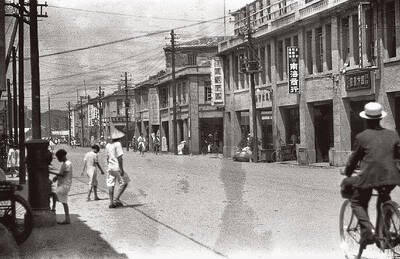
June 1 to June 7 "If all Taiwanese were as afraid of dying as you, then what would happen?” Physician Shih Chiang-nan (施江南) reportedly said this to his wife Chen Chiao-tung (陳焦桐) after she urged him to stop intervening on behalf of Taiwanese soldiers stranded overseas after serving in the Japanese Army during World War II. Shih had clashed with high-ranking officials over the issue, engaged in several heated arguments with Taiwan governor-general Chen Yi (陳儀) and allegedly shouted at general Ko Yuan-fen (柯遠芬), chief of staff of the Taiwan Garrison Command, over

Food prices have often played a major role in Taiwan’s history. The first major wave of migration from China occurred in 1628. A moderate drought, the Ming Dynasty maritime ban that prohibited fishing and trading (intended to reduce piracy) and a temporary tax, conspired to exhaust local resources, leading to famine in Fujian Province. The famed pirate and trader Zheng Zhilong (鄭芝龍), scooped up starving people from Fujian and transported them across the Taiwan Strait, where they settled under the Dutch. Two factors enabled Zheng. First, by 1624 he had settlements around today’s Beigang (北港) in Yunlin County with a small


 RSS
RSS