


Over the past three years BB gun war-gaming has become one of Taiwan's least publicized yet fastest growing pastimes. On any given weekend, boys and men aged between 14 and 40, don military fatigues and head out into the countryside with realistic looking assault rifles, machine guns and pistols to partake in well-organized battles.
Call them mad, call them desperate, in fact, call them what you will, but seasoned BB gun fans like Scott Sung (宋亮德) really couldn't care less. Since the 33-year-old BB buff first got involved with war-gaming he's heard it all. But come rain or shine, nothing will deter him from spending a day in the trenches with his mates.
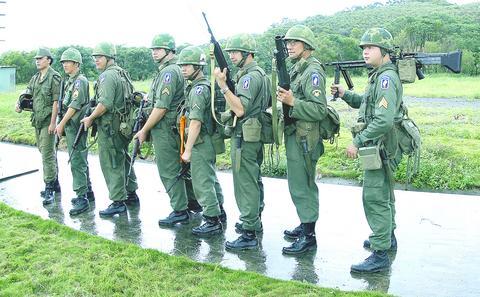
PHOTO COURTESY OF DAVID W. SMITH, ASIAWORKS PHOTOGRAPHY
"My wife thinks I'm like a big kid. She makes a face which says as much whenever I leave the house to take part in an event," said Sung. "But, hey, it's fun. It's not real, nobody gets hurt and, of course, you get fit running around."
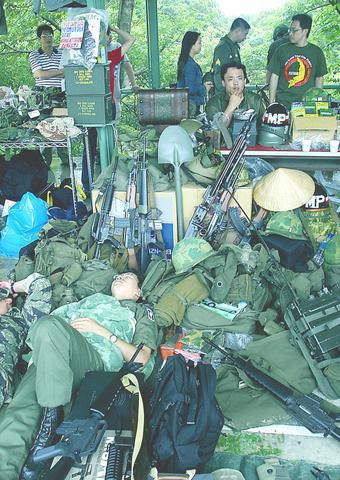
PHOTO COURTESY OF DAVID W. SMITH, ASIAWORKS PHOTOGRAPHY
There are reportedly 150,000 BB guns in the homes of 10,000 individuals throughout Taiwan. And while not all BB gun owners are regular players, many thousands are.
The fanaticism of these players and their demand for accuracy has made BB gun wargaming an expensive sport. Players spend NT$10,000 or upward on their specially imported uniforms which typically range from Gulf War gear to SWAT team garb to WWII battle dress and 1960s Vietnam War era uniforms. Extras, such as genuine period-piece insignia and regalia, come at a price.

PHOTO COURTESY OF DAVID W. SMITH, ASIAWORKS PHOTOGRAPHY
"The accurate uniforms and attention to detail is one of the main reasons the sport is so popular," said BB gun gamer, Jeffery Chen (
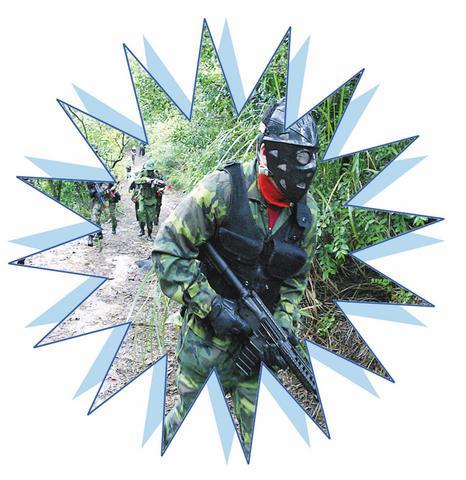
PHOTO COURTESY OF DAVID W. SMITH, ASIAWORKS PHOTOGRAPHY
Players' wardrobes aren't the only costly overhead and wargamers are always happy to splash out heftier sums on weaponry. BB handguns, assault rifles, machine guns, grenade launchers or even anti-personnel mines (yes, there really are such things) cost from between NT$8,000 to NT$40,000.
Once monopolized by Japanese companies like Tokyo Marui and Maruzen, local companies like I Chih Shivan Enterprises (
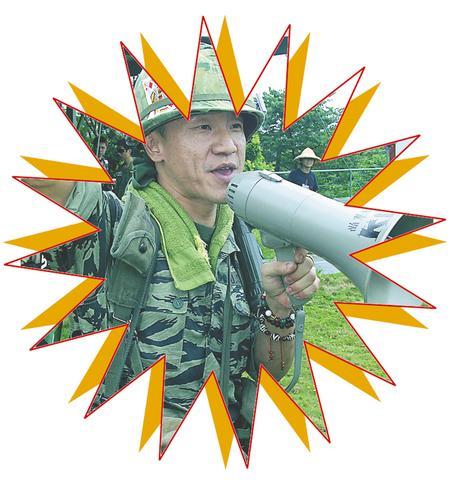
PHOTO COURTESY OF DAVID W. SMITH, ASIAWORKS PHOTOGRAPHY
"The quality of Taiwan's guns began to surpass that of the Japanese companies about a year ago. And the cost, well, that was slashed because production costs are a lot cheaper in Taiwan," said Harrier Wang (
Taiwan's military might be forced to look to foreign powers from which to procure its top-grade weaponry, but when it comes to toy guns, the world looks to Taiwan for realism and quality. For companies like I Chih Shivan Enterprises, which is the sole manufacturer of toy guns in Taiwan that has been granted a license by a genuine US arms manufacturer to replicate its product, the shift has proved hugely lucrative.
"I'll admit that the local market for guns is pretty limited, but overseas markets are huge and we are now one of the largest manufacturers and exporters in the world," said Chu Chen-tang (
While Taiwan's manufacturers continue to enjoy success abroad, the image of toy guns at home was tarnished earlier this year, when it was discovered that the gun used by the assailants in the March 19 shooting of President Chen Shui-bian (
There was a call for a ban on sales of toy guns and several legislators went as far as to demand that all toy guns be made illegal. Both BB gun manufacturers and players expect the issue to be put in front of lawmakers sometime early next year.
In the wake of the outcry and subsequent negative media coverage, BB gun hobbyist Tsai Chang-tai (
"It was just stupid. People were ill-informed and thought that any toy gun could fire a projectile and wound someone," said Tsai. "Nobody bothered to point out that it wasn't a toy gun that was used to shoot the president but a model, or blank gun. There's a big difference, but it's not one that people, even lawmakers are aware of."
The problem, according to Tsai, revolves around the wording of official legal documents. These don't differentiate between toy and model, or blank guns. Made of alloy, model guns are designed to make a noise much like a child's cap gun, but are not designed to fire projectiles. Regulations also stipulate that all blank guns must have a barrel width of 8mm. This odd size is to ensure that regular 9mm handgun ammunition cannot be used.
Unfortunately, the firing mechanisms installed in many model guns are very similar to those of real handguns. Anybody with access to a lathe could, given the time, very easily bore out the barrel, or add a new one, design 8mm projectiles and convert a model gun into a rudimentary weapon with the capability to kill.
AEG and gas powered BB weaponry, although appearing more genuine than model guns, cannot be converted. Designed solely to fire plastic pellets weighing between 0.12g and 0.43g, at speeds ranging from 90 meters per second to 120 meters per second, the pellet guns used by Taiwan's BB wargamers can certainly sting, but they can't kill or penetrate skin.
"The problem has arisen because in legal terms all toy guns, including AEG, gas pellet guns and model guns are all classified in the same legal category. What we are asking for is that toy guns and model guns be classified separately," Tsai said. "It's just a question of rewording a document. We're not asking the Legislature to do a whole lot of work. The police are well aware of the differences, but the law courts and lawmakers aren't."
While BB gun enthusiasts are ready to counter any ban imposed on the sale and use of toy guns, a proposed demonstration was canceled by Tsai for fear that hundreds of BB gun enthusiasts would arrive outside the legislature toting their weaponry, albeit fake, thus causing an even greater stink.
An incident in Hsichih earlier this week, which saw the glass facades of six store fronts shot out in what police believe to be the nation's first drive-by BB gun shooting, has brought BB guns back into the headlines. And, sadly for the thousands of educated and responsible BB gun wargamers, it has generated yet more unwanted and negative press.
"The major problem is that the guns look real, so it's presumed that they must hurt people and be dangerous," said Roman Hsu, Manager of G & G Armaments and the Guay Guay (怪怪) chain of gun stores. "If they ban BB guns then it will just go underground like 10 years ago. I think that if it was explained more clearly then people would understand that [BB gun gaming] is just a sport."

Sept.16 to Sept. 22 The “anti-communist train” with then-president Chiang Kai-shek’s (蔣介石) face plastered on the engine puffed along the “sugar railway” (糖業鐵路) in May 1955, drawing enthusiastic crowds at 103 stops covering nearly 1,200km. An estimated 1.58 million spectators were treated to propaganda films, plays and received free sugar products. By this time, the state-run Taiwan Sugar Corporation (台糖, Taisugar) had managed to connect the previously separate east-west lines established by Japanese-era sugar factories, allowing the anti-communist train to travel easily from Taichung to Pingtung’s Donggang Township (東港). Last Sunday’s feature (Taiwan in Time: The sugar express) covered the inauguration of the

The corruption cases surrounding former Taipei Mayor and Taiwan People’s Party (TPP) head Ko Wen-je (柯文哲) are just one item in the endless cycle of noise and fuss obscuring Taiwan’s deep and urgent structural and social problems. Even the case itself, as James Baron observed in an excellent piece at the Diplomat last week, is only one manifestation of the greater problem of deep-rooted corruption in land development. Last week the government announced a program to permit 25,000 foreign university students, primarily from the Philippines, Indonesia and Malaysia, to work in Taiwan after graduation for 2-4 years. That number is a

In a stark demonstration of how award-winning breakthroughs can come from the most unlikely directions, researchers have won an Ig Nobel prize for discovering that mammals can breathe through their anuses. After a series of tests on mice, rats and pigs, Japanese scientists found the animals absorb oxygen delivered through the rectum, work that underpins a clinical trial to see whether the procedure can treat respiratory failure. The team is among 10 recognized in this year’s Ig Nobel awards (see below for more), the irreverent accolades given for achievements that “first make people laugh, and then make them think.” They are not

This Qing Dynasty trail takes hikers from renowned hot springs in the East Rift Valley, up to the top of the Coastal Mountain Range, and down to the Pacific Short vacations to eastern Taiwan often require choosing between the Rift Valley with its pineapple fields, rice paddies and broader range of amenities, or the less populated coastal route for its ocean scenery. For those who can’t decide, why not try both? The Antong Traversing Trail (安通越嶺道) provides just such an opportunity. Built 149 years ago, the trail linked up these two formerly isolated parts of the island by crossing over the Coastal Mountain Range. After decades of serving as a convenient path for local Amis, Han settlers, missionaries and smugglers, the trail fell into disuse once modern roadways were built


 RSS
RSS