


Were it not for the involvement of Taipei American School's (TAS) head of the Life Skills department, Peter Clark, then the achievement's of Nathan Baggaley, a member of the Australian Olympic kayaking team, probably wouldn't have raised much of an eyebrow in the expat enclave of Tianmu. But then, it's not Baggaley who has become the center of attention. And while nearly everyone involved with TAS now knows the 28 year-old kayaker's name. It is instead Clark who has found himself in the spotlight in the northern Taipei suburb.
Baggaley's silver medals in the Flatwater Men's 500m and the Flatwater Two Man 500m meant that the teaching staff, parents and students of the TAS have been able to enjoy their own slice of Olympic glory in recent weeks. Peter, to his friends and associates, or Mr. Clark as he's more formally known by his students has become TAS' very own Olympic hero.
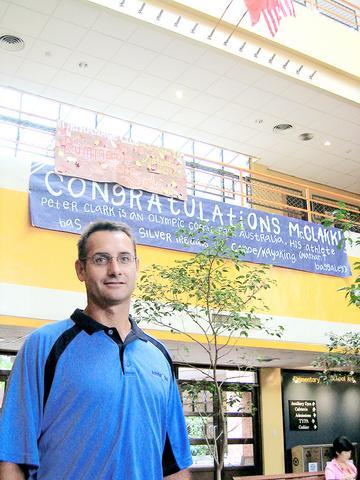
PHOTO: GAVIN PHIPPS, TAIPEI TIMES
Close friends and colleagues were aware of Clark's coaching of Baggaley when he took on the task last year, but it wasn't until he was already in Athens that his involvement was announced openly in a TAS newsletter. Since his return to Taiwan in early September, Clark's achievement has been the focal point of many a conversation in the school grounds and, when walking through the school today, talk of Clark's glory is a hot topic.
A huge blue and white banner honoring the teacher's triumph currently hangs in the school's reception area and an endless stream of parents and students offer congratulations whenever they see the head of Life Skills department wandering the school's corridors. Still many more go out of their way to visit him in his office and offer more personal forms of felicitation.
"Response at the school has been incredible. I've been overwhelmed by the number of people who have shown an interest," said Clark. "I think because of what I did, people here feel as if they've had a connection with the Olympics."
While personal coaches the world over are a firm fixture what sets Clark apart from a multitude of his peers is that in the year leading up to Athens he coached via email and telephone -- a method of coaching that even Clark himself considers "a bit of a strange one."
A physical education teacher at TAS for the past five years, Clark hails from the New South Wales water sports Mecca of Byron Bay. A keen kayaker and a coach in his native Australia, Clark worked closely with Baggaley for six years prior to relocating to Taiwan with his family to take up a position with TAS. Following Clark's departure, Baggaley secured himself a scholarship to the prestigious Australian Institute of Sport (AIS) in Canberra. It wasn't long, however, before Baggaley felt that he'd outgrown his coaches at the institute and turned to Clark for advice.
"[We] kept a close relationship and caught up whenever we could. About two years ago he contacted me and said he wasn't happy with the coaching he was receiving at the institute and did I think I could do something with him?" said Clark. "He'd got to the stage where he felt he got as much out of the program as he could. He was a fully evolved athlete and I think he wanted someone he could communicate with better and who understood him and who could take him to the next level."
And so began a long-distance training odyssey, that within two years would bring both Clark and his student Olympic success. While Clark was more than happy to work with Baggaley the powers that be at AIS didn't initially take too kindly to the request. After all, Clark was working in Taiwan while Baggaley was located some 7,000km away in the Australian Capital Territory.
"It wasn't immediately accepted, not warmly anyway. It got mixed reviews. Some thought that is was not the he should go and others were quietly wondering what would happen," Clark said.
The pair silenced critics at last year's World Championships in Atlanta when Baggaley became a world champion after placing first in the 500m single man kayak finals. According to Clark, it was then that the once bemused coaches in the Land Down Under realized that the long distance training regime in preparation for this year's Olympics "wasn't going to do him any harm."
"[Baggaley] is what I'd call a highly evolved athlete and I didn't think of myself as his boss as much as his mentor and someone to bounce ideas off," said Clark. "This was a special deal leading up to the Olympics and the time period we set for the Olympics meant that travel wouldn't have been easy."
TAS allowed Clark some leave time to return to Australia for the National Championships and the Olympic trial regattas, but a vast majority of the training regime was transmitted via cyberspace. In order to ensure that the kayaker get the most from his long distance training, Clark set about doing something that coaches are not known for. Rather than getting in his pupil's face and yelling instructions, Clark began to spend many hours in front of his computer creating monthly training programs.
Baggaley would in turn e-mail Clark back with outlines and results of each training session on water, out-of-water and in the gym. These e-mails came in the form of breakdowns in which he would specify how he felt and what was happening at certain stages throughout the races and training sessions.
In addition to Baggaley's data, Clark also received information pertaining to his stroke and heart rates during races which had been monitored by the AIS.
However impersonal the offbeat form of personal training appeared, the mass of online communications and long-distance telephone calls gave Clark enough information to be able to fully understand the kayaker's needs.
"Obviously it is ideally best for a coach to be on the water with him everyday, but we know each other very well and I knew what his needs were," Clark said. "I could tell what was going on by looking at the spread sheets and data, just like a baseball coach can look at the stats of a game on tell what
happened."
With Clark still "really happy" over the success of his charge, his future as an Olympic coach remains on hold for the time being, as Baggaley is currently enjoying a well-earned break.
"We haven't discussed future plans. We got to Athens and did the best we could, but the future will depend on where he wants to go," said Clark. "He's taking a break at the moment and I'm sure he'll contact me when he's decided where he wants to go from here."
Talk of a return to the Olympics in Beijing in 2008 might be on hold, but Clark is already planning to make his mark in the world of rowing at a locale much closer to his home in Tianmu. TAS' Dragon Boat team hasn't wasted anytime calling on the talents of the Olympic winning coach in order to help it take the top spot in next year's Taipei City Dragon Boat races.

Taiwan’s English education system is being pulled apart by three opposing forces. Bilingual Nation 2030 pulls students toward English and global communication. Artificial Intelligence (AI) readiness pulls them toward digital judgment, verification and AI-mediated work. But Taiwan’s old exam culture pulls them back toward memorization, grammar drills, timed reading and correct answers. If the education system keeps using old exams to define success, it risks producing graduates who are neither genuinely bilingual nor genuinely AI-ready, but trained for tasks machines can already perform. The first force is Bilingual Nation 2030. Launched in 2018, the policy aimed to “help Taiwan’s workforce connect

It seems every few days one bumps into one of those “real man” comments in which Taiwan is urged to “face reality” or similar, and “make a deal,” with the speaker implying that soon it will be too late. “Deal” advocates always present themselves as having a superior grip on reality, and the manly ability to make the “hard choice.” Their testosterone-laden language often echoes that of Taiwan sellout advocates. Note that such commentary always specifies a process (“make a deal, work with, make progress”), never the end state of what occupation by a violent authoritarian colonialist state will entail. In

There are shadowy cabals plotting to sell out Taiwan to be annexed by China, by invasion if necessary. Fortunately, they are buffoons. In 2019, former Bamboo Union gangster and founder of the China Unification Promotion Party (CUPP), Chang An-le (張安樂, colorfully known as “White Wolf”), led a protest at the Legislative Yuan against comments made by then-premier Su Tseng-chang (蘇貞昌) that in the event of an attack by China, he would never surrender, but would protect the nation by fighting to the end, even if he only had a broom. Chang had party members bring a wooden casket that they
June 1 to June 7 "If all Taiwanese were as afraid of dying as you, then what would happen?” Physician Shih Chiang-nan (施江南) reportedly said this to his wife Chen Chiao-tung (陳焦桐) after she urged him to stop intervening on behalf of Taiwanese soldiers stranded overseas after serving in the Japanese Army during World War II. Shih had clashed with high-ranking officials over the issue, engaged in several heated arguments with Taiwan governor-general Chen Yi (陳儀) and allegedly shouted at general Ko Yuan-fen (柯遠芬), chief of staff of the Taiwan Garrison Command, over


 RSS
RSS