


A housewife calls to talk about a broken sewer pipe. A student calls to talk about a lost love. A shopkeeper calls to say what he thinks of the violent insurgency that has swept his country.
The callers have reached Iraq's first talk radio station, Radio Dijla, which opened in April and has been putting Iraqis' opinions directly on the air, mainlining democracy from a two-story villa in central Baghdad for 19 hours a day.
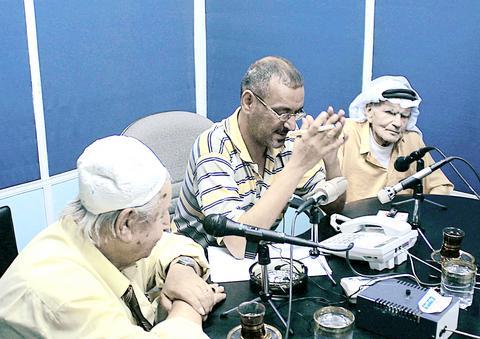
PHOTO: NY TIMES
In all, about 15 private radio stations have sprung up since the US occupation began, but Dijla, whose name is Arabic for "Tigris," is the first to serve only talk. The station is one of the most listened-to in Baghdad, according to its employees, a claim that appears to have merit, judging by its broad following among the city's taxi drivers, housewives, students and late-night listeners, who tune in to a night talk show about relationships.
The station receives an average of 185 calls an hour, far more than it can handle, according to its owner, Ahmed al-Rakabi, who said he planned to buy more telephone lines to accommodate callers. Most calls are about the nuts and bolts of life. Many public services have not recovered since the US occupation began more than a year ago. Daily power failures persist. Piles of trash are heaped on city streets. In poorer areas, leaky sewage pipes taint water supplies.
"Iraqi citizens have big problems but nobody listens to them," said Haidar al-Ameen, 34, a businessman, who listens to Dijla while driving. "If I have no gun, there's no one who is going to listen to me. The government has no time to listen."
The station forces the government to make time. Local and federal officials come as guests and are grilled by listeners. The talk shows result in uncomfortable situations, which would have been unheard of in the time of Saddam Hussein, when government officials were royalty and ordinary citizens were mere supplicants who were easily ignored.
On a recent Thursday, callers from the Mansour neighborhood questioned its local government leader, Ali Laaibi, about one of life's basic necessities.
"Why aren't there any garbage trucks?" a woman caller asked in an urgent voice. "It's been so long since anyone came to take out the garbage."
Another woman caller added, "Please, I don't know where to throw the garbage," and said she had even followed someone she had mistakenly thought was a garbage collector. Laaibi squirmed, trying to reassure the callers that he did in fact have a plan. "We've got 13 million garbage bags and we're going to give them out to people," he said.
Beyond easing the frustrations of daily life, the station provides a chance for Iraqis to talk publicly about politics for the first time in decades. Listeners' calls open a window onto the lives of ordinary Iraqis, whose opinions often go unheard in the frantic pace of bombings, kidnappings and armed uprisings.
"After 35 years of people not being able to say what they wanted, we need something that can translate our feelings," said Imad al-Sharaa, a news editor at the station.
One such program was broadcast June 30, on the day before Saddam first appeared in court. The program director and host, Majid Salim, asked listeners what they wanted to see happen to him. The answer was something of a surprise for Salim.
"Most people wanted him executed," Salim said.
Another time, Salim asked listeners what they thought about the violent insurgency that has roiled Iraq.
"We asked them, is it terrorism or is it resistance," Salim said. "A very large proportion -- almost 100 percent -- said terrorism. They did not like it."
In the time of Saddam, Iraqi stations other than the official state station were forbidden. Even so, dedicated listeners like Ameen secretly tuned in to the Voice of America and the British Broadcasting Corp and strained to hear Iraq news reports in Arabic.
Those days are still fresh for Salim, who was a host at a station called Youth Radio run by one of Saddam's sons. Callers were prerecorded, and content was censored. "Now I'm free to say anything I want," Salim said.
The radio's staff is overwhelmingly young, which Salim said was a policy of the station from its inception in April. Women in hejabs, the Islamic head covering, and high heels click around the office. Sound engineers move mice at computers. Photocopied pictures of employees' smiling faces are pinned to a bulletin board near a staircase.
Employees like Sharaa, who is 26, bring a fresh sense of optimism to the station. He also writes for the Institute for War and Peace Reporting in London. He said he had been interested in politics from the age of 12, but was not able to apply any of that knowledge until now.
The station was started with seed money from the Swedish government. Its founder, Ahmed al-Rakabi, the former chief of the US-financed Iraqi Media Network, was born in 1969 in Prague, in what was then Czechoslovakia, after his family was forced to leave Iraq to escape political repression under Saddam.
On the station's first day, Salim simply sat at the microphone and asked listeners what they wanted to talk about. Now, in addition to the government official call-in shows, the station has programs in which lawyers answer questions. It also has a program called Fatwa, led by both Sunni and Shiite clerics, which invites callers to discuss differences in religious practices. A fatwa is an order from a religious leader.
The late-night show in which people call in to dedicate songs and discuss their relationships is particularly popular. The topic is a racy one in Iraq, which has become more conservative since the 1980s, when Saddam, in an effort to appease religious leaders here, required stricter adherence to religious rules.
One night a few weeks ago, a woman called to confess that her boyfriend of four years had just married her closest friend, after she introduced them several weeks before, Salim said. Listeners called to offer sympathy for the unforgivable betrayal.
Ameen welcomes such public heart-to-hearts. "Let everyone talk," he said. "All of Iraqis in different lines must talk, must talk under sun, not in secret."

In late October of 1873 the government of Japan decided against sending a military expedition to Korea to force that nation to open trade relations. Across the government supporters of the expedition resigned immediately. The spectacle of revolt by disaffected samurai began to loom over Japanese politics. In January of 1874 disaffected samurai attacked a senior minister in Tokyo. A month later, a group of pro-Korea expedition and anti-foreign elements from Saga prefecture in Kyushu revolted, driven in part by high food prices stemming from poor harvests. Their leader, according to Edward Drea’s classic Japan’s Imperial Army, was a samurai

The following three paragraphs are just some of what the local Chinese-language press is reporting on breathlessly and following every twist and turn with the eagerness of a soap opera fan. For many English-language readers, it probably comes across as incomprehensibly opaque, so bear with me briefly dear reader: To the surprise of many, former pop singer and Democratic Progressive Party (DPP) ex-lawmaker Yu Tien (余天) of the Taiwan Normal Country Promotion Association (TNCPA) at the last minute dropped out of the running for committee chair of the DPP’s New Taipei City chapter, paving the way for DPP legislator Su

It’s hard to know where to begin with Mark Tovell’s Taiwan: Roads Above the Clouds. Having published a travelogue myself, as well as having contributed to several guidebooks, at first glance Tovell’s book appears to inhabit a middle ground — the kind of hard-to-sell nowheresville publishers detest. Leaf through the pages and you’ll find them suffuse with the purple prose best associated with travel literature: “When the sun is low on a warm, clear morning, and with the heat already rising, we stand at the riverside bike path leading south from Sanxia’s old cobble streets.” Hardly the stuff of your
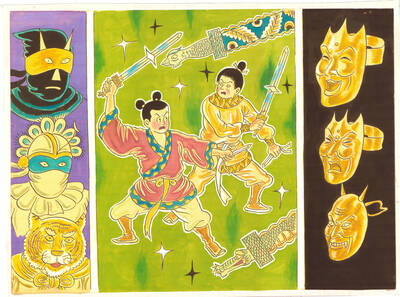
April 22 to April 28 The true identity of the mastermind behind the Demon Gang (魔鬼黨) was undoubtedly on the minds of countless schoolchildren in late 1958. In the days leading up to the big reveal, more than 10,000 guesses were sent to Ta Hwa Publishing Co (大華文化社) for a chance to win prizes. The smash success of the comic series Great Battle Against the Demon Gang (大戰魔鬼黨) came as a surprise to author Yeh Hung-chia (葉宏甲), who had long given up on his dream after being jailed for 10 months in 1947 over political cartoons. Protagonist


 RSS
RSS